
Craterocephalus eyresii
Lake Eyre Hardyhead
Species Summary
The most common and widely distributed native fish of South Australia’s Flinders Ranges, Craterocephalus eyresii occupies both the Lake Torrens and Lake Eyre drainage components of that isolated mountain system. Older Murray–Darling Basin records under this name actually refer to the separate Murray and Darling Hardyheads; the three were only distinguished as different species in 1990.
Etymology
The species name refers to the Lake Eyre Basin in South Australia, the drainage this species is largely restricted to.
Etymology compiled from C. Scharpf (2020), “Fishes of Sahul: An Etymological Survey (Part 3)”, Fishes of Sahul 34(2): 1568–1582, and etyfish.org.
Distribution & Habitat
Descended from marine ancestors, Craterocephalus eyresii is remarkably salt-tolerant, capable of living in water almost three times the salinity of seawater, and grows to about 10.5 cm total length in Flinders Ranges waters. Rather than breeding on a strict seasonal cycle, it appears to spawn and recruit opportunistically after rainfall or flood events, which also trigger extensive migration through the range’s network of ephemeral waterways. Populations regularly blink in and out of existence at particular sites as conditions change — the species was absent from Paralana Hot Springs between 1991 and 1998 despite being recorded there previously, then reappeared, while other, previously empty waters have been recolonised after flooding, sometimes from upstream donor populations when downstream connections fail to eventuate. A relict, apparently isolated population in Stuart’s/Yarra Wurta Creek on the Lake Torrens side of the range attracted particular interest as a possibly distinct form, prompting a dedicated expedition (with genetic sampling through the South Australian Museum) to Yarra Wurta Springs to investigate further.
Description & Ecology
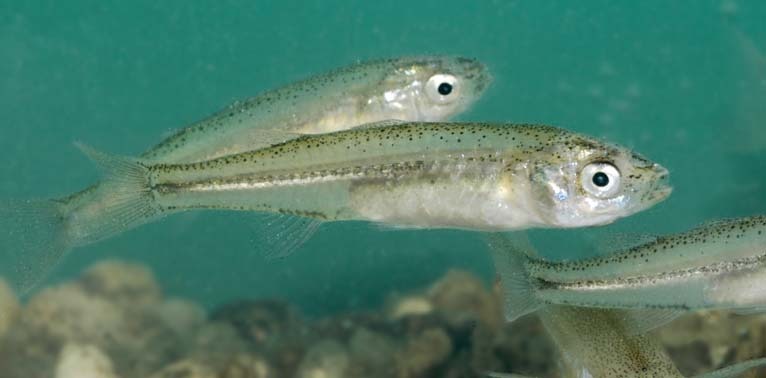
A small, schooling fish typically found in mid-water, with the conspicuous silver mid-lateral stripe, forked tail and two separate dorsal fins typical of the genus. It is an opportunistic predator of small aquatic invertebrates including mosquito larvae, and in turn is an important food source for migrating fish-eating birds and, where it shares farm dams with them, for larger native predators such as the Lake Eyre Callop.
Remarks
The first confirmed Queensland record of this species came from the Cooper Creek/Mulligan River system, noted during a study of the extraordinary “fish rain” events that can follow major flooding in the Lake Eyre Basin’s ephemeral channels.
Compiled for Home of the Rainbowfish from ANGFA sources: B. E. Pierce, M. Young & T. Sim, “South Australia’s Flinders Ranges Fishes”, Fishes of Sahul 18(2), 2004, pp. 26–30; G. Walker, “An Isolated Desert Fish”, Fishes of Sahul 18(4), 2004, pp. 77–79; and R. Kuiter, “Torrens Catchment’s Lake Eyre Hardyhead”, Fishes of Sahul 20(3), Jul–Sep 2006, pp. 252–265.
References
- Crowley L.E.L.M. and W. Ivantsoff (1990) A review of species previously identified as Craterocephalus eyresii (Pisces: Atherinidae). Proceedings of the Linnean Society of New South Wales 112: 87-103.