
Craterocephalus fluviatilis
Murray Hardyhead
Species Summary
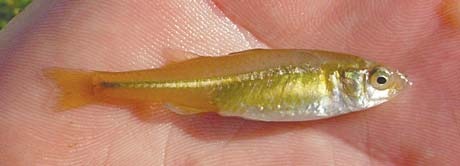
An elongated, silver-to-golden hardyhead endemic to the Murray–Darling Basin, Craterocephalus fluviatilis commonly reaches 30–70 mm total length. Its range has been contracting steadily as the Basin has been developed, and it is now formally listed as threatened at international level and protected in South Australia, Victoria and New South Wales alike — a decline made worse by repeated drought across southern Australia.
Etymology
The species name is Latin for “of a river”, referring to its life in freshwater rivers — somewhat ironic given that today the species survives mainly in isolated lakes rather than the flowing rivers its name describes.
Etymology compiled from C. Scharpf (2020), “Fishes of Sahul: An Etymological Survey (Part 3)”, Fishes of Sahul 34(2): 1568–1582, and etyfish.org.
Distribution & Habitat
Historically the species occupied lowland wetland habitat right through the southern Murray–Darling Basin, including the Murrumbidgee River and the Murray both above and below its junction with the Darling, extending into ephemeral lakes well away from the main channel. That range has since contracted dramatically: today it survives only in a small number of saline deflation lakes in Victoria and three larger South Australian populations — saline wetlands near Berri and Renmark, and Lakes Alexandrina and Albert at the Murray mouth — with scattered smaller wetland populations elsewhere in South Australia. It favours both isolated and connected wetlands and sheltered lake-edge habitat with dense beds of submerged plants such as milfoil, foxtail and eel grass, tolerating conditions from slightly to highly saline (roughly 1–35 parts per thousand) — a tolerance that appears to give it a genuine physiological advantage in the salty habitats it now mostly occupies.
Description
Identifying hardyheads in southern Australia has a long history of confusion due to how similar several related species look. Craterocephalus fluviatilis is most easily confused with the Lake Eyre Hardyhead (C. eyresii), but the two don’t overlap geographically and differ in body shape, scale characters and molecular markers — older Murray–Darling Basin records of C. eyresii actually refer to this species. Within the Basin it can be told apart from the Unspecked Hardyhead (C. stercusmuscarum fulvus) by a deeper body (10–11 transverse scales with 3 rows above the lateral line, versus 7–8 in Unspecked Hardyhead), an irregular rather than uniform scale pattern, and the absence of the black lips often seen in Unspecked Hardyhead; from the Smallmouth Hardyhead (Atherinosoma microstoma) by a much greater body depth and shorter gill rakers.
Keeping & Caring
Murray Hardyhead is a mobile, schooling omnivore, taking zooplankton, insect larvae, detritus and algae, often seen foraging over the substrate and algal films in clear saline water. It appears able to recolonise nearby habitat through small-scale movements, having been observed settling freshly flooded ground soon after inundation. A small-scale captive spawning trial (1999–2000) succeeded with five wild fish held in a 150-litre aquarium of neutral, hard Adelaide tap water at room temperature with morning sun, fed on frozen and live brine shrimp, mosquito larvae, frozen bloodworm and Spirulina-based flake. Larger-scale captive maintenance during a PhD study (2004–2007) found that salinity was critical for long-term survival: fish held at ordinary tap-water salinity (0.3 ppt) suffered moderate mortality over several weeks, while fish held at a slightly elevated 1 ppt showed none over the same period, making a minimum of around 1 ppt salinity a sensible target for anyone maintaining this species long-term. Fish are also known to carry an internal nematode parasite, successfully treated in one instance using a praziquantel-based bird-worming syrup dosed into the tank water, with a follow-up treatment after two weeks.
Breeding
Spawning occurs in spring and summer, with larval numbers in Victorian lake populations peaking in early November; the species appears to be largely annual, with most fish maturing, spawning and dying within a single year, meaning a single year of poor recruitment can be very damaging to a population. In the successful small-scale trial, males coloured up golden around the nape and upper dorsal surface as breeding condition approached, while females developed a distended abdomen; eggs, large and adhesive at 1–2 mm, were laid on wool spawning mops in batches of 4–16 through most of a three-week spawning window, with the best results following a heavy feed of live food the day before. Eggs hatched in around 10 days at 24 °C, and fry (3–4 mm at hatching) were readily raised on newly hatched brine shrimp and commercial dry fry food; the main hazard encountered was Hydra in the hatching tray, which took a toll on fry before being brought under control by physical removal.
Compiled for Home of the Rainbowfish from ANGFA sources: M. Hammer & S. Wedderburn, “The Threatened Murray Hardyhead: natural history and captive rearing”, Fishes of Sahul 22(1), Jan–Mar 2008, pp. 390–398.