
Craterocephalus stercusmuscarum
Flyspecked Hardyhead
Species Summary
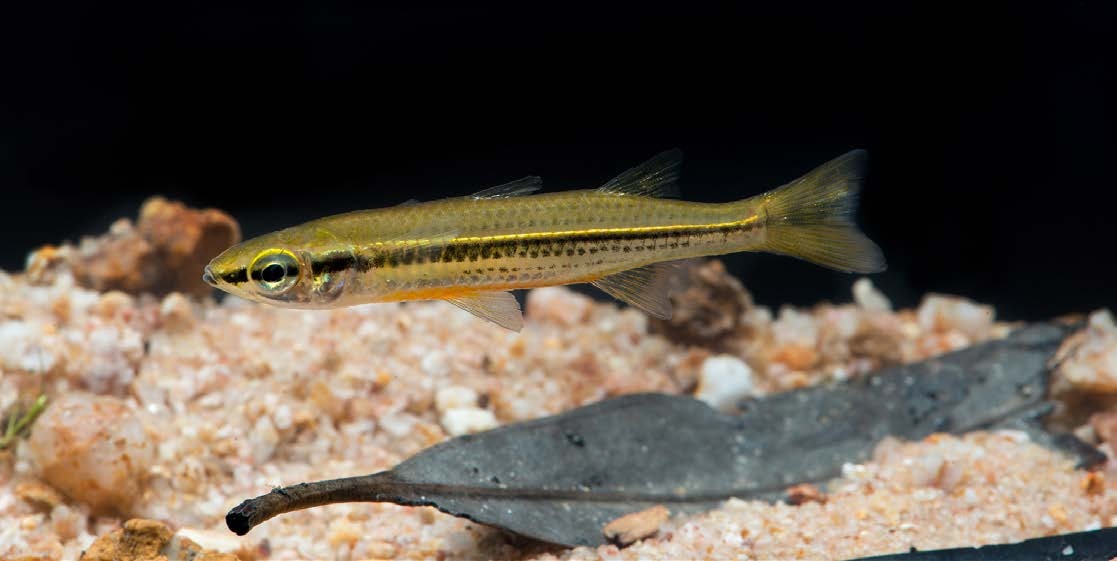
The best-known member of what taxonomists informally call the “stercusmuscarum” group — a set of related, generally slender hardyheads with a dark mid-lateral stripe and rows of small spots along the flanks. As with many widespread Australian freshwater fishes, what is currently recognised as a single species is genetically at least six distinct lineages across the continent, several of which likely deserve recognition as full species in their own right once formally reviewed. Craterocephalus stercusmuscarum in the strict sense — the “Stercusmuscarum lineage” — occurs from the upper North Johnstone and Barron Rivers north through Cape York and west to around the Gove Peninsula, Northern Territory.
Etymology
The species name combines the Latin stercus, dung, and muscarum, of flies — literally “fly-specked” — almost certainly describing the small dark spot at the base of each scale rather than anything less flattering.
Etymology compiled from C. Scharpf (2020), “Fishes of Sahul: An Etymological Survey (Part 3)”, Fishes of Sahul 34(2): 1568–1582, and etyfish.org.
Distribution & Habitat
The wider group occurs right across Australia as well as southern New Guinea, in everything from fast, clear rainforest creeks to slow, turbid temperate rivers, tropical floodplain wetlands, desert waterholes and even hot springs. For the Stercusmuscarum lineage specifically, recorded water conditions span roughly 22.9–29.4 °C, pH 6.2–8.2 and conductivity 98–391 µS/cm.
Keeping & Caring
All species in the group are behaviourally and ecologically similar, and keeping and breeding them follows roughly the same approach as most rainbowfishes. Wild fish shoal, so they should be kept in a group — the bigger the better — and mixed shoals of hardyheads with rainbowfishes or other small natives are entirely natural and do well together in the aquarium. They are active swimmers that appreciate open water to move around in as well as plants and structure to retreat to, and over a fine substrate they will spend considerable time turning over the top centimetre or so hunting for food; they also make good filamentous-algae cleaners. Diet in the wild is best described as “microphagic carnivore” — mostly microcrustaceans and other small invertebrates, with a notable amount of detritus and algae too. In captivity they take frozen brine shrimp and bloodworm readily, dry foods more slowly, and will happily graze filamentous algae and sift sand for scraps. It is not clear how long they live in the wild, but captive Fulvus-lineage fish have been kept for around five years, and few wild fish likely exceed two.
Breeding
Courtship and spawning have been documented in detail for two of the group’s lineages, Fulvus and Lentiginosus, whose broad pattern likely applies across the group: a male identifies a spawning site — typically java moss or a spawning mop — and darts in and out of it to attract a female, turning an intense golden-yellow through the lower half of his body as he does so; once he has her attention he nudges her anal fin from behind, and the pair swim side by side into the spawning site to release eggs and sperm together, the female shuddering as she spawns. Neither parent shows further interest in the eggs afterwards. Spawning activity tends to be concentrated in the morning, and depending on temperature the eggs take 4–13 days to hatch, with larvae 4.8–6 mm long at hatching. Raising them is much the same as for rainbowfishes — fine powdered foods and vinegar eels at first, moving on to newly hatched brine shrimp.
Remarks
In the Finniss River’s Rum Jungle area, Northern Territory, where both this species and the Blackmast (C. stramineus) are commercially netted for the aquarium trade from the same water, some collected fish show an unusual mix of features — broadly Flyspecked Hardyhead in size, but with rounder fins and far fainter spotting than typical examples from the same catch. This is now regarded as the first documented case of natural hybridisation anywhere in the genus Craterocephalus, and a reason not to keep different hardyhead species together in the same tank if maintaining pure stock matters to you.
K. G. Moy, D. Wilson, G. Briggs, B. Hansen & P. J. Unmack, “Fish in Focus: Craterocephalus “stercusmuscarum” group species (Atherinidae)”, Fishes of Sahul 34(2), June 2020, pp. 1583–1608 — current thinking treats several named Craterocephalus taxa as points within one broader, genetically complex species assemblage rather than as fully independent stories, and this account draws heavily on that review.
References
- Bishop K.A., S.A. Allen, D.A. Pollard and M.G. Cook (2001) Ecological studies on the freshwater fishes of the Alligator Rivers Region, Northern Territory: autecology. Environment Australia, Darwin.
- Ivantsoff W., L.E.L.M. Crowley, E. Howe and G.P. Semple (1988) Biology and early development of eight fish species from the Alligator Rivers region.
- McGlashan D.J. and J.M. Hughes (2000) Reconciling patterns of genetic variation with stream structure, earth history and biology in the Australian freshwater fish Craterocephalus stercusmuscarum (Atherinidae). Molecular Ecology 9: 1737-1751.
- Milton D.A. and A.H. Arthington (1983) Reproduction and growth of Craterocephalus marjoriae and C. stercusmuscarum (Pisces: Atherinidae) in south-eastern Queensland, Australia. Freshwater Biology 13: 589-597.
- Semple G.P. (1985) Craterocephalus stercusmuscarum - maintenance, reproduction and early development of the fly-specked hardyhead. Fishes of Sahul 3(1): 97-102.
- Unmack P.J. and T.E. Dowling (2010) Biogeography of the genus Craterocephalus (Teleostei: Atherinidae) in Australia. Molecular Phylogenetics and Evolution 55: 968-984.