

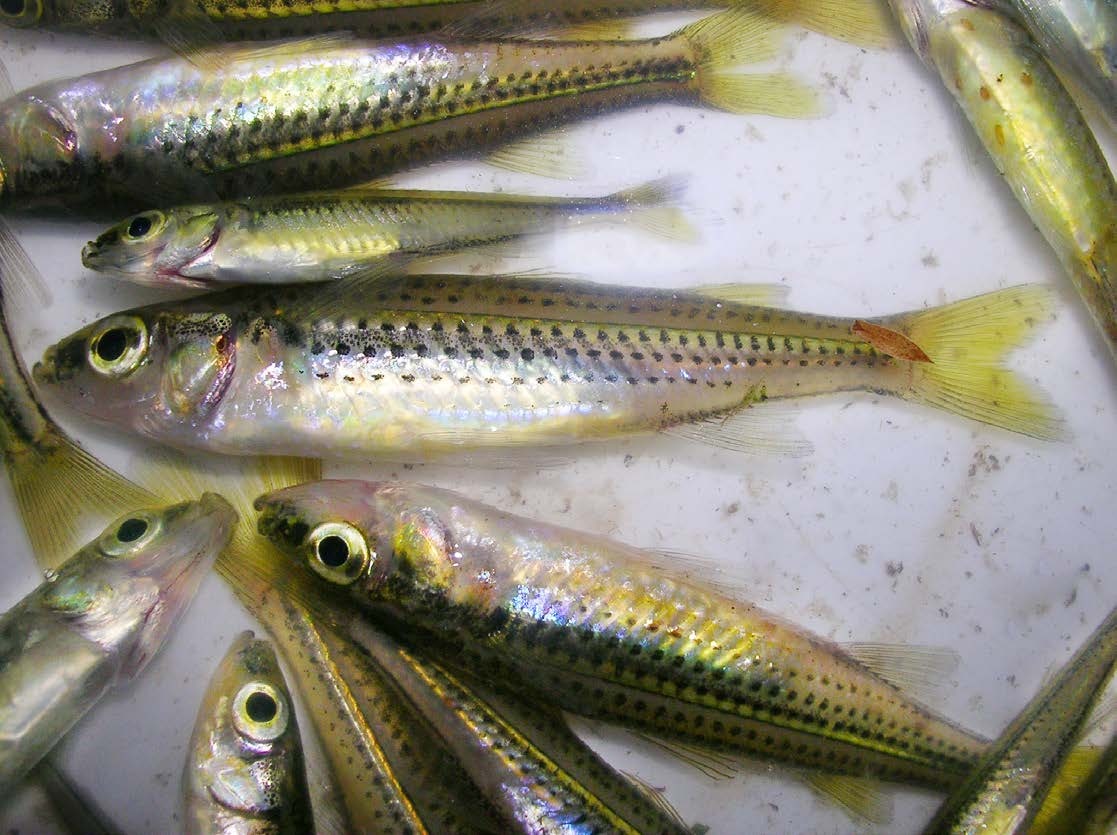
Craterocephalus stercusmuscarum fulvus
Unspecked Hardyhead (also Tawny Hardyhead)
Species Summary
Described in 1987 as a subspecies of the Flyspecked Hardyhead (C. stercusmuscarum) covering that species’ south-eastern populations, Craterocephalus stercusmuscarum fulvus is genetically one of six distinct lineages now recognised within the broader “stercusmuscarum” group — and in more recent years several authors have argued it deserves recognition as a full species in its own right, though the formal taxonomy has not yet caught up. Where most of its close relatives carry a scattering of dark spots along the flanks, this lineage is almost totally devoid of any spotting.
Etymology
The name fulvus is Latin for brownish-yellow, referring to the tawny hue that gives this form its other common name, the Tawny Hardyhead.
Etymology compiled from C. Scharpf (2020), “Fishes of Sahul: An Etymological Survey (Part 3)”, Fishes of Sahul 34(2): 1568–1582, and etyfish.org.
Distribution & Habitat
Craterocephalus stercusmuscarum fulvus occurs right across the Murray–Darling Basin and along the coast from the Tweed River in New South Wales north to the Kolan River, with a separate, disjunct population further north again in the upper Dawson and Nogoa Rivers of the Fitzroy River Basin, Queensland. Recorded water conditions span an unusually wide range for the group: 12.4–33.6 °C, pH 6.1–9.1 and conductivity 19.5–5,380 µS/cm.
Description & Sexing
Growing to about 78 mm (averaging around 34 mm), with males maturing at roughly 37 mm and females at 24 mm. Sexual dimorphism outside the breeding season is extremely subtle. Coming into breeding condition, males typically develop a golden colouration below the lateral line — on Fraser Island fish this shows as a yellow breeding suffusion — while females develop a transparent, flattened urinogenital papilla and a darkened, more visible ovary; mature females also tend to show a dark blotch near the vent.
Keeping & Caring
Care follows the same general pattern as other members of the “stercusmuscarum” group (see the Flyspecked Hardyhead account for detail on diet, tankmates and general husbandry). Captive individuals have been kept for around five years or more.
Remarks
Chunky-bodied populations of Craterocephalus stercusmuscarum fulvus from the Pine River catchment in south-east Queensland have on occasion been misidentified as Marjorie’s Hardyhead (C. marjoriae) on account of their build. In one striking illustration of how barriers affect fish movement, a single seine haul at Bonshaw Weir on the Dumaresq River once turned up 100–500 individuals of this lineage after a rain event caused the weir to overflow — but a return visit some six-and-a-half weeks later found only 10–20% of that number, the difference put down to birds picking off fish trapped below the weir’s fishway-less barrier in the interim.
K. G. Moy, D. Wilson, G. Briggs, B. Hansen & P. J. Unmack, “Fish in Focus: Craterocephalus “stercusmuscarum” group species (Atherinidae)”, Fishes of Sahul 34(2), June 2020, pp. 1583–1608 — current thinking treats several named Craterocephalus taxa as points within one broader, genetically complex species assemblage rather than as fully independent stories, and this account draws heavily on that review.