
Craterocephalus stramineus
Blackmast
Species Summary
The Blackmast has had an unsettled scientific history. First collected from the Katherine River, Northern Territory, by Eric Worrell in 1945, it was described in 1950 by Gilbert Whitley, curator of fishes at the Australian Museum, as Quiris stramineus — a name referring to its yellowish, straw-like colouring. When it turned out Quiris was already in use for a group of insects, the species was renamed Quirichthys stramineus the following year, and was shuffled between the Melanotaeniidae and Telmatherinidae over the following decades before a 1992 review of the genus placed it in Craterocephalus, within the hardyhead family Atherinidae, where it sits today. Its common name reflects a tall, dark first dorsal fin that struck Worrell more than the straw-coloured body that inspired Whitley’s original name (occasionally still seen as “Strawman”). The genus name itself, coined in 1912, is something of a puzzle: it’s usually translated from the Greek for “bowl-head” or read as “strong/hard-head”, and may in fact be a Latinised version of the older Australian fishermen’s term “hardyhead” for silversides generally, rather than the other way around — the common name appears to predate the scientific one by about three decades.
Etymology
The species name stramineus is Latin for straw-like, specifically describing the “straw-yellowish” colour Whitley recorded in preserved (alcohol-stored) specimens rather than the colour of a live fish.
Etymology compiled from C. Scharpf (2020), “Fishes of Sahul: An Etymological Survey (Part 3)”, Fishes of Sahul 34(2): 1568–1582, and etyfish.org.
Distribution & Habitat
Craterocephalus stramineus has a patchy distribution across northern Australia, currently known from the Ord River (Western Australia), the Victoria, Daly-Katherine and Finniss Rivers (Northern Territory), and a disjunct population in the Nicholson-Gregory and Leichhardt Rivers of the Gulf of Carpentaria (Queensland). Only one species is currently formally recognised, but genetic evidence points to three: a strongly distinct Queensland form, and Ord/Victoria River fish that are also quite different from Daly/Finniss River fish. They typically live among aquatic vegetation in freshwater billabongs and still or slow-flowing stretches of creeks and rivers, often over shallow sandy flats or in deeper, well-vegetated water, and are usually found where limestone influence makes the water hard and alkaline. They form moderate-sized shoals, swimming just below the surface.
Description
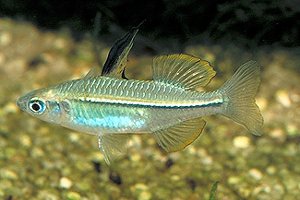
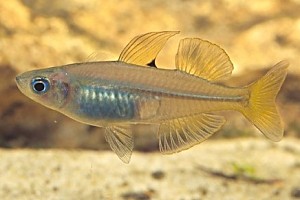
A slender, attractive fish to about 5–7 cm, semi-transparent with a pale yellowish or bluish hue. A black mid-lateral stripe runs the length of the body with an iridescent blue-green or silver stripe above it, and a fine reticulated pattern covers the upper body. The fins are mostly clear, with black on the front of the first dorsal fin and yellow on the outer edge of the second dorsal and anal fins. Its most distinctive feature is a tall, feather-shaped first dorsal fin with elongated black spines — the source of the common name — the membrane between them clear to yellowish; females carry a noticeably shorter first dorsal fin.
Keeping & Caring
Craterocephalus stramineus is sensitive to changes in water chemistry, and wild-caught fish can stress badly during collection or transport, sometimes dying in the net; transport survival is reported to improve with a little salt added to the water (around 5–10 parts per thousand). Once settled, it is fairly easy to maintain given regular partial water changes, and does best kept as a small group in its own aquarium of medium-hard, alkaline water — a long, shallow tank around 120 cm × 45 cm × 45 cm, furnished with driftwood, river stones and aquatic plants, suits its constantly active, schooling habits well. It feeds on a mix of small aquatic life and terrestrial insects taken from the surface in the wild, and in the aquarium takes commercial pellet food readily, doing even better with the addition of live or frozen foods such as bloodworms, daphnia or mosquito larvae, which are considered important for maintaining a self-sustaining captive population. Adrian Tappin successfully kept and bred Blackmast for 15 years at 20–28 °C, pH 7.6–8.2 and hardness 100–220 ppm.
Breeding
Courtship resembles that of the rainbowfishes: intermittent chasing and display, in which the male intensifies his colouration while trying to lead a female into a bed of spawning mops, where the pair eventually swim side by side, releasing eggs and sperm together while touching along their lateral lines. Large females may lay 40–60 eggs, with total output increasing with the size and age of the fish. Eggs are best collected by removing the mops daily and checking them over; infertile eggs burst easily when handled, while fertile eggs are firm enough to lift off with a fingertip and transfer to a hatching container, with a trace of methylene blue added if desired to guard against fungus. At 24–28 °C the eggs hatch in about 7–10 days, and fry are soon seen at the surface, reaching maturity (around 35 mm total length) within 4–5 months in good conditions. Newly hatched fry take a range of fine foods — micro-encapsulated fry diets, egg-yolk infusion or infusorians — and after 7–14 days can move on to newly hatched brine shrimp, microworm and finely powdered flake; the presence of filamentous algae in the rearing tank is reported to help fry along.
Remarks
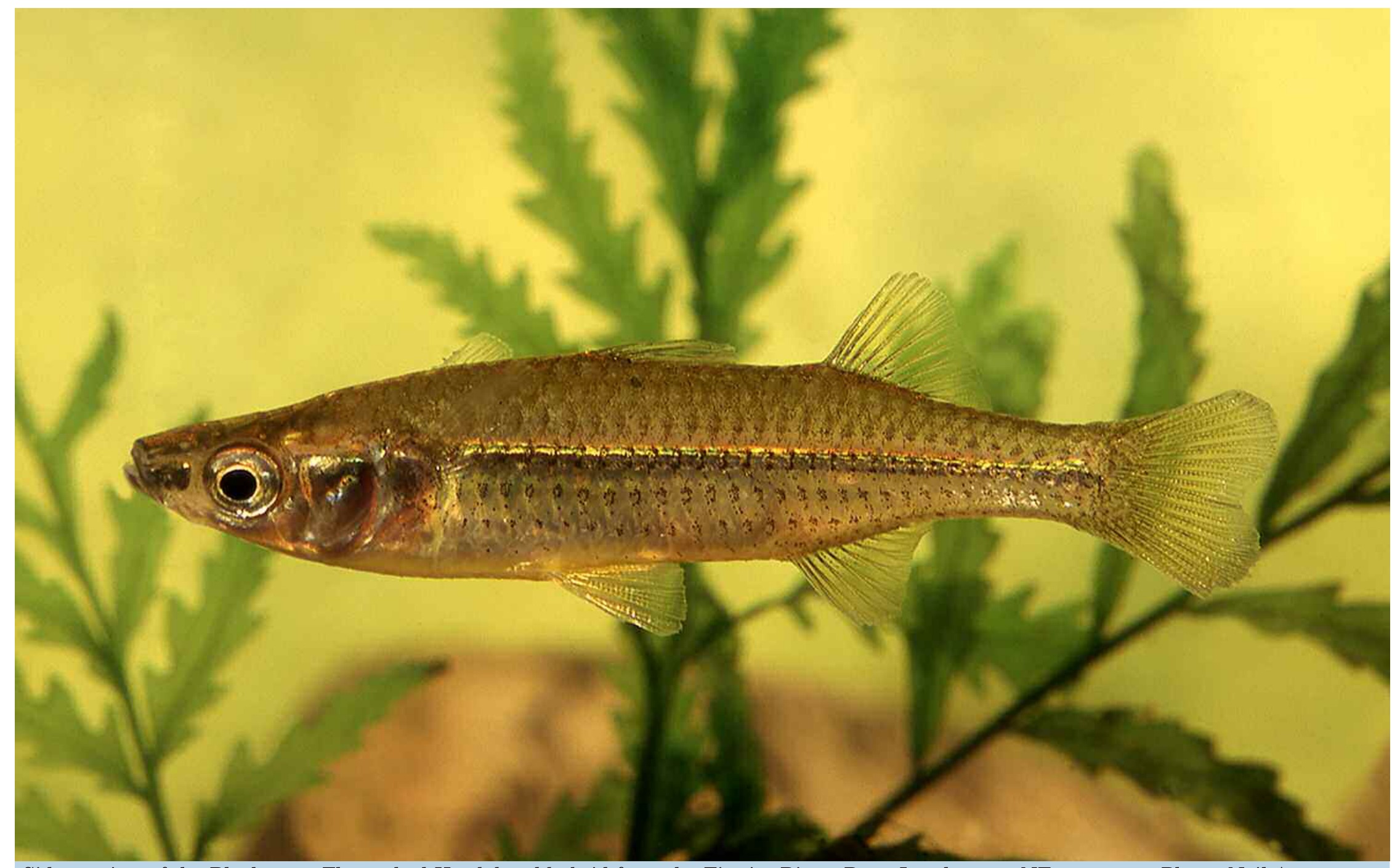
In the Finniss River’s Rum Jungle area, where both Blackmast and Flyspecked Hardyhead (Craterocephalus stercusmuscarum) are regularly netted together for the aquarium trade, some collected fish have shown an odd mix of traits — the size and general look of Flyspecked Hardyhead but more rounded fins and only very faint spotting compared to typical examples of that species from the same catch. Whether these individuals are first-generation hybrids or later backcrosses isn’t yet clear, but they represent the first documented case of natural hybridisation anywhere in the genus Craterocephalus — a reminder that different hardyhead species are best not kept together if maintaining pure breeding stock matters to you.
Blackmast was first reported in the aquarium hobby in 1960 by Ron Bowman, a well-known Melbourne native fish enthusiast, in the November edition of “Finchat”, a publication of the Aquarium Society of Victoria. Adrian Tappin obtained his first specimens from the Katherine River in November 1982, first bred them in April 1983, and reported his breeding success in Fishes of Sahul the following year — adding further wild specimens in 1985 and 1989, and maintaining a permanent captive population until 1995.
Account compiled for Home of the Rainbowfish from A. R. Tappin (1996–2000), “Rainbowfish On-line”, originally published at rainbowfish.angfa.org.au, archived by the National Library of Australia, with the author’s own account of first breeding the species in 1983 (reported in Fishes of Sahul 1(3), 1984), and A. Tappin, G. Briggs & D. Wilson, “Fish in Focus: Blackmast Craterocephalus stramineus”, Fishes of Sahul 30(2), June 2016, pp. 1002–1008. Republished with the author’s permission.