

Activated Carbon
Since the Egyptians discovered that storing water in charcoal made it stay fresher and taste better, carbon has been a standard feature in water treatment. Its centuries of popularity attest to its effectiveness. Activated carbon has a very high surface area and its adsorptive and absorptive properties make it one of the most cost effective materials for removing a wide range of water contaminates. Activated carbon has been used for specialised industrial and water treatment applications for many years. However, all carbons are not created equal and some perform much better than others, and some are designed for special purposes. However, there are many misconceptions about what activated carbon can and cannot do.
Most aquarists are familiar with the use of activated carbon as a filtration medium although few know what is being removed or how it is being removed. Virtually every new filter system sold in the aquarium trade contains activated carbon or a section for its use. For most filters, the carbon comes conveniently pre-packaged as an insert or cartridge so that it can be easily used and replaced in the filter. However, these inserts do not contain a lot of carbon and I suggest that their use is more of a cosmetic nature rather than being of any practical use.
Activated carbon is one of the most misunderstood filtration media available to the aquarium hobbyist. As with many facets of our hobby you will find much confusion and differing opinions regarding its value, even among the “experts”. Opinions ranged from “never use it” to “never be without it”. However, activated carbon filtration is a most effective method of removing dissolved organic compounds from aquarium water.
The fact that activated carbon has an extremely large surface area per unit weight makes it an extremely efficient adsorptive material. The activation of carbon and its manufacture produces many pores within the particles, and it is the vast areas of the walls within these pores that accounts for most of the total surface area of the carbon. Activated carbon is usually rated by the size of the particles it is able to remove, measured in microns, and generally range from 50 microns (least effective) down to 0.5 microns (most effective).
Carbon filtration removes certain substances by the process of adsorption (as opposed to absorption). Upon contact with water containing soluble organic materials, activated carbon selectively removes these materials. Adsorption is the phenomenon whereby molecules adhere to a surface with which they come into contact, due to forces of attraction at the surface. The use of surface energy to attract and hold molecules is physical adsorption. Adsorption is said to occur in three basic steps. These are film diffusion, pore diffusion, and adhesion to the solute molecules to the carbon surfaces. Film diffusion is the penetration of the solute molecule, the adsorbate, through the carbon particle’s “surface film”. Pore diffusion involves the migration of solute molecules through the carbon pores to an adsorption site. Adhesion occurs when the solute molecule adheres to the carbon pore surface.
In simple terms carbon attracts certain substances at the molecular level much in the way that a magnet attracts and holds metal filings. In water, activated carbon has a preference for large organic molecules and for substances that are nonpolar in nature. The forces of attraction between the carbon and the adsorbed molecules are greater the closer the molecules are in size to the pores. The best adsorption takes place when the pores are just large enough to admit the molecules. Its action in adsorbing the impurities is physical, no chemical reaction taking place between it and the water or impurities in the water.
In the aquarium hobby, activated carbon is commonly used for the removal of dissolved organic compounds. Dissolved organic compounds rapidly accumulate in an aquarium especially if the water is not changed on a regular schedule. These metabolic compounds remain largely unidentified but include organic acids, phenolics, proteins, hormones, and other compounds. The toxicity of these dissolved organics to fish is not completely known, however research has indicated that certain components will inhibit the growth and development of the aquarium inhabitants.
Dissolved organics also act as a nutrient source for bacteria, increasing the demand for oxygen, increasing carbon dioxide levels, lowering the pH, and contributing towards the deterioration of water quality, thus increasing their susceptibility to disease. Some researchers believe that there is a direct relationship between high levels of dissolved organic compounds and dense populations of disease organisms in aquaria. Therefore the reduction of these organic compounds ultimately leads to improved water quality and healthier specimens.
Activated carbon in water filters can also mechanically filter out substances such as detritus and certain bacteria. The degree to which these contaminants are removed depends on the pore size. For example, a pore size of 0.5 microns will trap any substance larger than 0.5 microns, such as cysts, parasites and insoluble compounds.
While a wide variety of filters can be used with activated carbon, not all will perform equally. Effectiveness varies with the kind of carbon used in the filter, the filter design, the way it is used and maintained, its age, and the condition of the water being treated. When activated carbon is first added to a filter there is an enormous reserve capacity for adsorbing dissolved organic compounds, and if the carbon bed is deep enough there is almost no possibility of pollutants passing through the bed.
When activated carbon is used in a tall filter column, most of the unwanted organic pollutants are absorbed in the top layers, and as the water passes downward it progressively contacts cleaner and cleaner carbon. This in-depth filtering cleans the water as it passes out of the column and provides the widest margin of dissolved organic compounds removal. However, when the surfaces are full, the carbon must be discarded and replaced.
Activated carbon can be finely powdered to produce smaller particles thereby enhancing the rate of adsorption by exposing more entrances to the carbon pores. Because the carbon particle size primarily affects the rate of adsorption and not the total adsorptive capacity of the carbon, the difference in performance of filters containing different size carbons decreases as the contact time increases. However, it is evident that any restriction of pore openings or build-up of ash or other materials within the pore openings due to the presence of suspended organic compounds and their accumulation on or in the carbon particles might have an adverse effect upon the adsorptive capacity or service life of the carbon. It also means that additional pre-filtering of the aquarium water becomes necessary to keep the carbon from clogging with debris.
The degree to which activated carbon removes dissolved organic compounds from the aquarium water will depend on the filter flow rate and the initial contamination of the water. Other factors include water temperature and total amount of water treated. The rate of adsorption of organics in aquarium water increases with decreasing pH of the water. Another disadvantage is its tendency to “channel”, where water creates distinct paths through the media. This greatly reduces the available contact area, which shortens the effective life of the carbon.
The major problem with the use of activated carbon is that there is no easy way of knowing how much activated carbon is needed in a tank or how often it should be changed. This is because every aquarium is different and how they are maintained is different. Because of the individual differences in tanks, any recommendations are, at best, just an educated (or uneducated) guess. Some carbon manufacturers will give recommendations for their products while others give no indication at all. Independent research has shown that “more is better” when using activated carbon. When filtering aquarium water a greater quantity of carbon will work faster and longer than a lesser amount.
Hovanec (Marineland®) suggests a rough guide would be 500 mg activated carbon per 300 litres of aquarium water. This should be replaced about every 6–8 weeks (for a review of activated carbon in aquaria see Hovanec 1993 and 1998). Noga (2000) suggests 75 grams of professional grade activated carbon for every 40 litres of water for 14 days for removing chemicals or 28 days for removing dissolved organic compounds. However, the effect of dissolved or suspended organics in aquarium water applied to carbon filtration on the efficiency and life of the carbon has not been determined precisely.
Activated carbon will not remove ammonia, nitrite or nitrate from water. It also does not have an effect on water hardness or alkalinity. However, most aquarium medications are readily adsorbed by activated carbon. Carbon products must be removed while treating with antibacterial drugs and antiparasitic chemicals (formalin, malachite green, copper sulphate, etc). Use fresh carbon to remove the medication after treatment is completed.
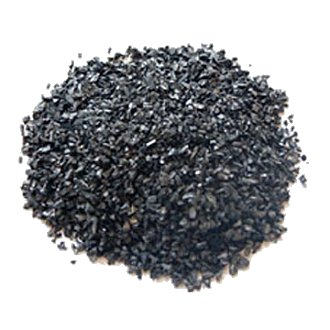
One disadvantage associated with carbon filters is that they can grow bacteria and harbour other organic matter on the carbon surface. The risk is that over time, this matter can break loose and contaminate the water, defeating the whole purpose of water treatment. Activated carbon provides a readily available source of nutrient carbon for bacteria thus encouraging the growth of massive numbers of bacteria on its surface.
Under certain conditions, the quantity of bacteria growing on activated carbon can double every 20–30 minutes. Common species of bacteria found growing in activated carbon filter media include, but are not limited to, Acinetobacter, Aeromonas, Alcaligenes, Comamonas, Enterobacter, Flavobacteria, Klebsiella, Moraxella, Pseudomonas, Sphingomonas, Stenotrophomonas, Mycobacteria and Bacillus species. For these and other reasons, it is very desirable to protect activated carbon filter media from the growth of bacteria and other microbes.
Contrary to popular belief, activated carbon cannot be reactivated by aquarium hobbyists. It can only be done in a specialised regenerative system. The most positive results of carbon regeneration are accomplished through closely controlled heating in a multiple hearth furnace. Organic matter within the pores of the carbon is oxidised and thus removed from the carbon surface. Exhausted activated carbon has to discarded and replaced with new material.
Activated carbon can be a part of an aquarium filtration system and maintenance regime when it is used regularly and correctly. However, partial water changes are still the most important factor in maintaining a successful aquarium and are probably a more efficient and cost effective way of removing dissolved organic compounds.