
Biological Filtration
The ability to maintain rainbowfishes in good health is a function of the efficiency and health of the aquarium’s biological cycle and the aquarist’s management of the system. Providing and maintaining a suitable biological filtration system, together with regular water changes, will facilitate the removal and detoxification of dissolved wastes. These dissolved compounds remain largely unidentified but include organic acids, phenolics, proteins, hormones, and other compounds. The toxicity of these dissolved wastes to fish is not completely known, however research has indicated that certain components will inhibit the growth and development of fish. As rainbowfishes breathe and metabolise feed, wastes are released into the water column. If these wastes are allowed to accumulate they will increasingly degrade the water quality.
Aquarium systems use biofilters and a continuous flow of recirculated water to bring oxygen to the fish and detoxify nitrogenous wastes. Nitrogenous wastes, particularly ammonia, can rapidly accumulate to dangerous levels unless biological filtration is properly employed. Biological filtration uses naturally occurring bacteria to detoxify nitrogenous wastes and, provided it works efficiently, it does so to the extent that nitrogenous wastes are virtually undetectable. Thus, the primary purpose of biological filtration is to remove nitrogenous wastes and is therefore, a critical component in every aquarium. There are a number of technologies available to remove nitrogenous wastes, but the most commonly used method is biological filtration.
The generation of nitrogenous wastes in aquarium systems occurs with the breakdown of proteins from excess feed, excretion from the gills of fish as they utilise feed, and decomposition of organic waste by bacteria. Fish may excrete nitrogen in the form of ammonia, urea, uric acid, amines and amino acids. Nevertheless, fish and other aquatic organisms, particularly those in freshwater, release their nitrogenous wastes primarily as ammonia (NH3) excreted across the gill membranes. Ammonia is also released through decomposition of dead animals and plants, uneaten food, bacteria and other organic matter.
Ammonia is both highly toxic and highly soluble in water. At a pH range of 6–8 approximately 90% of the total nitrogenous waste is excreted across the gills, with ammonia accounting for approximately 85% of this total. Because of its high solubility, ammonia becomes effectively diluted by the environment as soon as it is excreted and it thereby rendered harmless. However, the natural environment of rainbowfishes is a much larger aquatic system than an aquarium, and it would be difficult for ammonia to reach toxic concentrations, unless, of course, the water was polluted.
On the other hand, in an aquarium, which is far from a balanced ecosystem most rainbowfishes enjoy in nature, ammonia can build up fairly quickly, especially if overstocked and overfed. The amount of ammonia generated by fish varies with the amount of food put into the aquarium, accelerating as stocking and feeding rates increase. Generally, 1 to 3 mg of ammonia is produced for every 100 mg of feed.
results from gill hyperplasia, a condition which decreases gill surface area and thereby leads to inadequate transfer of toxic metabolites from the fish to the aquarium water. Although acute ammonia toxicity values vary between fish species, most aquatic organisms experience significant growth reductions, and lower resistance to disease at concentrations between 0.05–0.20 mg/L.
The LC50 toxicity of ammonia for Melanotaenia splendida at 96 hours is 1.99 mg/L [3.49 mg/L @ 24 hours and 2.33 mg/ L @ 48 hours]. Rainbowfish fry can only tolerate up to about 0.57–0.75 mg/L, before they all die. Therefore, ammonia concentrations must be consistently maintained below toxic levels. Preferably, levels should be lower than 0.02 mg/L.
In well-planted aquariums most of the ammonia is taken up directly by the plants (including algae), as it is the preferred nutrient form of nitrogen for most plant species. Existing research suggest that approximately 50% (± 20%) of the total ammonia load is assimilated by plants.
In the average aquarium however, most of the ammonia will be converted by nitrifying bacteria to nitrate (nitrification). If the water quality is allowed to decline or the aquarium fish population is suddenly increased, ammonia and nitrite levels can increase rapidly.
Total ammonia-nitrogen consists of ammonia (NH3) and ammonium (NH4) ions. At any given time there will be both ammonia and ammonium present. The conversion between volatile ammonia and ammonium ions strongly depends on the pH and temperature. When the pH of the water is acidic (<6.9) or neutral (7.0), the majority of the nitrogen is ammonium. When the pH increases over 8.0, the nitrogen is mostly ammonia. For a normal condition of 25°C and a pH of 7.0, ammonia amounts only to 0.6 % of the total ammonia-nitrogen present. At a pH of 9.5 and a temperature of 30°C, the percentage of total ammonia present in the ammonia form increases to 72%.
Ammonia-nitrogen is an energy source for autotrophic (nitrifying) bacteria that oxidise the ammonia-nitrogen to nitrite and nitrate. Nitrate is a stable end product with low toxicity and does not harm the fish in the concentrations typically present, but ammonia and nitrite are both highly toxic at low concentrations.
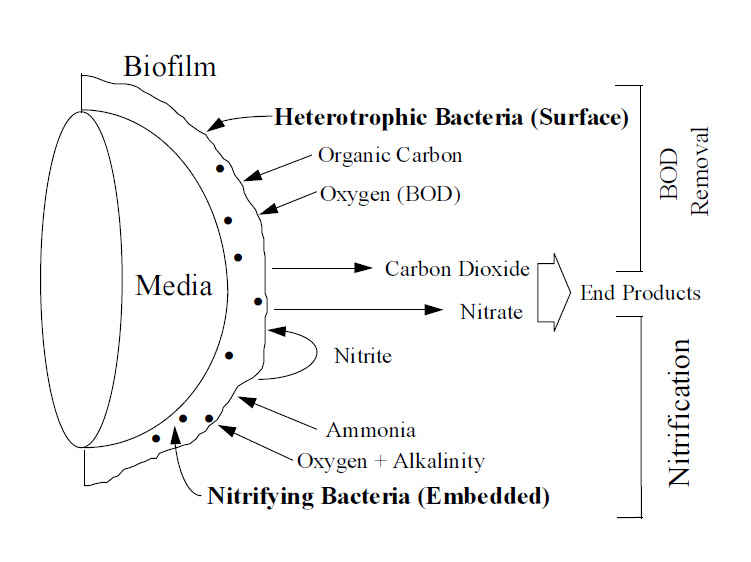
more nitrifiers, which will convert more ammonia, as long as a sufficient water flow rate is maintained that delivers ammonia, oxygen, and alkalinity to the nitrifying bacteria (Golz 1995).
Both heterotrophic and autotrophic bacteria are common bacteria found in the aquarium. Organic waste such as fish faeces, uneaten food, dead plant tissue, and other organic material serve as the primary source of nutrition for heterotrophic bacteria, which metabolise the waste into ammonia-nitrogen (ammonification). Bioconversion of organic material by heterotrophic bacteria is a precursor to nitrification as high levels of organic material can inhibit nitrification. Therefore the removal of organic wastes from the water will enhance the efficiencies of the biological filter. To prevent excess amounts of solids from accumulating in the biofilter, particulate matter is usually removed prior to, or as the first component of biofiltration.
The autotrophic (nitrifying) bacteria are particularly important because they oxidise ammonia to nitrite and ultimately to nitrate, which is comparatively innocuous except at very high concentrations. Nitrifying bacteria must remove ammonianitrogen at a rate equal to production to maintain water quality at a level adequate to prevent exposure to the fish. The rate of reduction corresponds to the rate of growth of the nitrifying bacteria. When water quality is sufficient to meet their environmental needs and they are given enough time to reproduce, the nitrifying bacteria will flourish. Their concentration in aquarium systems therefore becomes the limiting factor of biological filtration.
Nitrifying bacteria oxidises the ammonia-nitrogen (NH4 + NH3) to nitrate, allowing the aquarium water to be recycled many times before a water change is required. The nitrate can be ultimately converted to nitrogen gas and oxygen by denitrifying bacteria, thus completing total ammonia conversion. However, the denitrifying process is not well known in the aquarium hobby and also nitrate is less harmful than ammonia or nitrite in a practical point of view. Nitrates are relatively non-toxic unless the levels are extremely high, and they are typically maintained at low levels by regular water changes.
However, the biofilter is not the only place in the aquarium where nitrification takes place. Up to 30% of nitrification in a typical aquarium system takes place outside of the biofilter (e.g., in biofilms on piping, plants, substrate and tank walls). Nevertheless, the majority of biochemical reactions pertaining to heterotrophic and autotrophic bacteria occur within biofilters. Biofilters are specifically designed for concentrated bacterial attachment and nitrification via biofilms. Because of its advantages, biofilm nitrification has become the standard treatment method for recirculating aquarium systems.
Heterotrophic and autotrophic (nitrifying) bacteria compete for available surface area in biofilters. Under optimal growth conditions, heterotrophic bacteria grow very efficiently, doubling in population from about 15 minutes to 8 hours. Comparatively, nitrifying bacteria are much less efficient, and typically require 15–29 hours for ammonia oxidising bacteria and 10–21 hours for nitrite oxidising bacteria to double in population. High organic wastes can result in establishment of large heterotrophic bacteria populations on the filter media, enabling them to out-compete nitrifying bacteria for available surface area, potentially decreasing nitrification efficacy of the filter. Ammonia removal will decrease as organic loading increases. Therefore, a biofilters nitrification capacity depends first upon the amount of surface area available to the nitrifying bacteria.
The concept of biological filtration is to provide a substrate with a large surface area to encourage the growth of nitrifying bacteria. As the bacterial population develops, it coats the surface upon which it is growing. Water containing ammonia and/or nitrite flow over this media (and the bacteria attached to it). Bacteria use the ammonia as an energy source to drive their life processes. These bacterial excrete nitrite, require oxygen and produce carbon dioxide as by-products of their respiration.
A different group of bacteria use the released nitrite and convert it to nitrate. These bacteria use the nitrite to nitrate conversion for an energy source; they use nitrite and oxygen, and produce nitrate and carbon dioxide. The ammonia to nitrite conversion produces hydrogen and uses up alkalinity.
In aquarium systems, nitrification occurs at a rate of around 200 to 400 mg of ammonia per square meter of biofilter surface area per day. Thus, it is apparent that an important factor in biofilter design is to get the maximum amount of surface area into a given volume. Increasing the surface area in the filter increases the number of bacteria leading to more efficient nitrification. Therefore the nitrifying capacity of the biological filter is largely a function of the type of medium and the volume of the filter. Gravel, sand, plastic beads and rings, and plastic plates are the substrates most commonly used. Each type of biological filtration medium has a defined specific surface area per unit volume.
Predicting the performance of biofilters is an engineering challenge. The task is complicated by the wide variety of environmental conditions in the aquarium system. A myriad of biofilters designs have been generated that attempt to maximise specific surface area and oxygen transfer within the context of biological filtration. In designing biofilters, the principal concerns should be maximum surface area for bacterial growth, high dissolved oxygen levels, uniform water flow through the filter, sufficient void space to prevent clogging, and proper sizing to ensure adequate ammonia removal capability. Mechanical filtration also must be employed to ensure consistent removal of particulate matter. Particulate matter within the aquarium environment can significantly increase biofilter clogging.
There are four basic types of biofilter designs: submerged bed, rotating biowheel, trickle and fluidised bed. While all biological filters rely upon the same species of bacteria for bioconversion, its how the different filter types operate that determines their effectiveness. There are numerous aquarium filters that utilise biofiltration, ranging from the humble box filter, which gets little recognition these days, to high tech designs with computer control. However, it is helpful to remember that the filter itself only provides a suitable “home” for the bacteria to colonise. Media for biofilters can be virtually any substrate which provides maximum surface area for bacterial growth: gravel, plastic media and sponge foam pads are among popular choices.
A good biological filter should have the following criteria:
Large surface area for bacterial growth. • Adequate open area to avoid clogging. • Adequate water movement through biological filter and • around the surfaces designed for bacterial growth.
The selection of substrates on which bacteria can form colonies has led to a reduction of the size of biological filters. From the initial substrates of gravel or shell used in submerged or trickling filters, now inert fibre cushions, similar to those used in the filters of air conditioners, or small moulded pieces of plastic for packing purposes or else blocks of undulated PVC sheets are utilised.
The continuous search for ideal substrates is oriented towards materials offering the highest surface/volume ratio, limited weight, strong mechanical resistance and limited clogging characteristics in addition to being cheap and easy to maintain.
The smaller the particle size, the more the surface area per unit volume. However, when the particle size is reduced, the probability of filter clogging increases and the ability to mix the water within the biofilter decreases. In submerged-bed biofilters, such as undergravel filters, the relationship between surface area and performance is probably asymptotic, because blockage and diminished circulation increasingly hamper performance as substrate particle size diminishes. The rate of water flow through the biological filter should range from 30 to 100 percent of the volume of the entire system per hour. Higher stocking rates will require the highest turnover rate (70–100% per hour).
Basically, a biological filter is simply a surface on which the bacteria grow. While growing, the bacteria convert toxic wastes produced by the fish to less toxic wastes. However, in reality, it is a complex system comparable to a living organism. The biofilter must be “fed” and supplied with oxygen in order to remain healthy and function properly. It also releases carbon dioxide and hydrogen ions as waste products. It can take weeks for bacteria to establish or colonise a biofilter and they grow, age, and die like any other life forms. Although a larger number of water quality parameters affect nitrification.
Dissolved oxygen, pH, water temperature, ammonia concentration, filter flow rate and chemical treatment are the dominant factors affecting nitrifying bacteria efficacy. Surfaces for bacterial growth should be protected from light, which inhibits nitrifying bacteria.
When an aquarium system is first set up or restarted after cleaning, time must be allowed for colonisation of the biofilter. This is a critical time in aquarium systems, because ammonia levels may increase faster than their removal. Biofilters are often started by artificially adding ammonia, such as ammonium chloride, into the system thereby allowing establishment of the nitrifying bacteria prior to stocking with fish. This would also be expected to encourage the growth of autotrophic bacteria because without an organic load, competition for attachment surfaces from faster growing heterotrophic bacteria would be minimal. However, the effect of exogenous addition of ammonium chloride can extend the cycling time dramatically; in some cases, as much as 50–60 days (Shimura et al., 1996)
It may be advantageous to pre-activate the cycle. Pre-activation is accomplished by seeding the filter(s) with a ‘starter’ bacterial population from an established aquarium. Seeding of nitrifying bacteria has a positive effect on the nitrification process by improving performance and stability. Nitrifying bacteria are usually abundant in the gravel substrate or filters of an established aquarium; so many hobbyists use a small amount of this as a bacterial seed. Previous studies have shown that seeding freshwater systems with 3% or 10% of wet filter media from an established filter decreased the start-up time of a new filter by 48% and 81%, respectively.
The addition of 10% wet filter media from an established system can reduce the start-up time to around 4–7 days compared to 20–25 days for ammonia removal and a similar time scale for nitrite removal (Gross et al. 2003).
In recent years, pre-coating of nitrifying bacteria on filter media has also been used in aquarium biofilters to enhance nitrification, using mixed bacterial cultures from natural water and aquarium systems. However, seeding with a wet media of an established filter has a major disadvantage because it might cause transfer of diseases even after the nitrifying enrichment process, as bacteria and pathogens might survive such conditions.
As an alternative to preactivation, a staggered stocking regime can be used. Once the aquarium water is stable, you can increase the animal load to the desired level. The aquarium is stocked with a small number of fish. The bacteria will grow on the wastes from the animals and plants, and a balance will be established between the quantity of the wastes produced by the fishes, invertebrates and plants and the bacterial population. An increase in wastes will result in an increase in bacteria, but the response is not instantaneous. The time required is a function of the conditions under which the bacteria are growing and the nature of the bacteria themselves. When the biofilter bacteria populations grow to meet this ammonia load, additional fish can be added. However, when this technique is used, water changing may be required. You must monitor water quality and be able to correct any problems when and if they occur, there is not much forgiveness and catastrophic failures can happen.
Often ignored by those unfamiliar with the metabolic capabilities of bacteria is the fact that many heterotrophic bacteria and fungi are able to oxidise nitrogen compounds such as ammonia. The pathways of nitrogen transformation are very complex. The ability to denitrify ammonia is a facultative trait spread among a wide variety of physiological and taxonomic groups of nearly 130 bacterial species within more than 50 genera (Zumft 1992).
Newly discovered ‘Anammox’ bacteria have been found that convert ammonium and nitrite directly to dinitrogen gas. Anammox is an abbreviation for anaerobic ammonium oxidation (ANaerobic AMMonium Oxidation). It is a very recent addition to our understanding of the biological nitrogen cycle and is the most unexplored part of the cycle. Recent studies have also revealed the widespread existence of unique ammonia-oxidising archaea (bacteria-like organisms), belonging to the Archea domain.
New research is showing that archaea capable of ammonia oxidation are ubiquitous in marine and fresh water environments. The phylogenetic diversity and species richness of ammonia-oxidising archaea and bacteria were examined in aquarium biofiltration systems. The results showed that species richness of ammonia-oxidising archaea is greater than those of ammonia-oxidising bacteria. However, the relevance of ammonia-oxidising archaea in aquarium systems remains unknown. Thus, the nitrogen cycle is much more complex than indicated in most aquarium textbooks. Even after much intensive study, modern microbiologists still do not fully understand just how the nitrification process functions.
Under certain conditions, however, it is conceivable that the complete nitrification process could become disrupted, with elevated levels developing for one or more of the intermediates. Under normal operating conditions, there are a variety of factors that, individually or in combination with each other determines the efficiency of biofilter nitrification. These factors include fish density, ammonia concentration, flow rate, filter surface area, filter media type, temperature, pH, salinity, alkalinity, dissolved oxygen, total dissolved solids, and filter type (submerged, trickling, fluidised bed, etc.).
Loss of Biological Filtration
The ability of biological filtration to adequately control ammonia and nitrite in aquarium systems depends on a variety of factors. Under normal operating conditions, there are a variety of factors that, individually or in combination with each other, will reduce the efficiency of biofilter operation. If the causes of these problems are avoided, the operation of a biological filter will be trouble free. Several common causes of problems with the operation of biological filters include over-loading, οverfeeding and filter media change and/or chemical treatments.
Overloading — When we start a new system a certain time is required for the bacteria to establish themselves and develop an adequate population within the aquaria. The bacteria will grow on the wastes from the animals and plants, and a balance will be established between the quantity of the wastes produced by the fishes, invertebrates and plants and the bacterial population. An increase in wastes will result in an increase in bacteria, but the response is not instantaneous. The time required is a function of the conditions under which the bacteria are growing and the nature of the bacteria themselves. Suboptimal conditions for the microorganisms slow their activity and growth time. New systems should be started with less than the maximal biomass that the system is designed to handle. Once the aquarium water is stable, you can increase the animal load to the desired level.
Overfeeding — The most common problem in aquarium management is overfeeding, which generates more wastes than the biological filter can handle. This results in cloudy water, spikes, or continuously high levels of ammonia and/or nitrite, rapid mulm accumulation, excessive growth of algae and increased stress and disease susceptibility.
Loss of Biological Filtration — bacteria can grow on all surfaces within the aquarium, but the most important part of the population will be within the biological filter where water flow patterns have been designed to assure that water is rapidly renewed around the bacteria. This is particularly important because water-purifying bacteria have no significant mobility and unless the water is rapidly changed around them, they will deplete their nutrients in the microenvironment around them resulting in reductions in their growth and water purification. The water flow patterns are thus important in the design of a biological filter.
A properly designed filter should contain multiple elements, such as sponge and plastic or porous porcelain, on which the bacteria can grow. All elements should not be replaced at the same time, as this will remove most of the active water purifying bacteria and nitrification may essentially cease for a short period of time. If your filter contains multiple elements such as sponges or cartridges, to remove accumulated solids, simply rinse them off in water and return the filter element to the filter. When it is necessary to replace a worn element, replace only one of the multiple elements at the same time. In this way you will not throw out your most active population of water purifying bacteria. Studies have shown that aggressively-washed filters elements require longer intervals to produce optimal nitrification, and their performance suggests that this is due to substantial biofilm removal. Research has shown that gently-washed filters achieve their highest nitrification rates at relatively short intervals, due to the effect of a low biomass-loss rate.
Another way in which bacterial activity of the biological filter can be lost is with medications containing bactericides. Ideally, sick fish should be quarantined and treated in a separate aquarium from your main tank. If it should become necessary to treat the fishes in the main tank but not sterilise the entire system, stop feeding the fishes prior to the treatment. This will reduce ammonia production. Immediately, prior to adding medication, remove the biological filter element (cartridge or sponge), and place the element in another aquarium or container with aeration; add enough clean water or water from the aquarium to cover the filter elements. When the treatment has been completed and residual bactericidal products have been removed by activated charcoal or otherwise, the bacterial filter elements can be returned to the aquarium. Feeding can now be restarted, but slowly without overfeeding.