

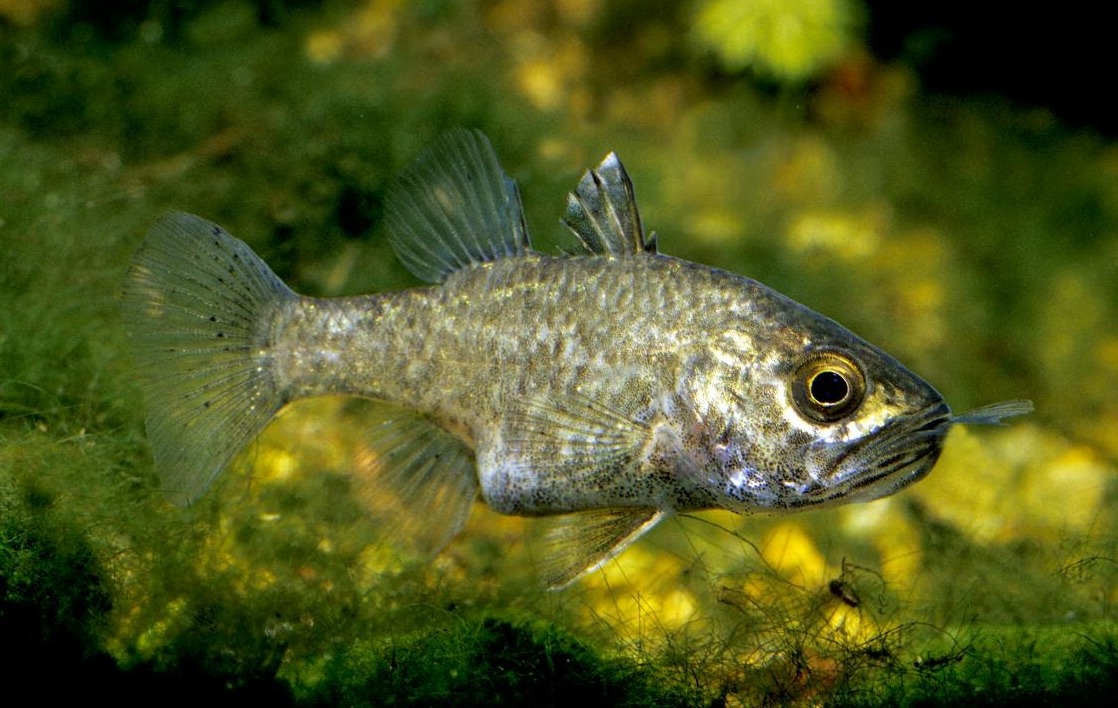
Glossamia aprion
Mouth Almighty
Species Summary
A freshwater cardinalfish in the mostly marine family Apogonidae, Glossamia aprion is far less familiar and studied than its marine relatives such as the Banggai Cardinalfish. It occurs in southern New Guinea and across northern Australian drainages, from the Kimberley region to around the Queensland/New South Wales border. An ambush predator, it favours submerged cover and shallow marginal vegetation in very slow-moving streams or the still waters of ponds, lagoons and lakes, hovering quietly before striking at aquatic invertebrates and small fish.
Description
Adults reach a maximum length of 12–18 cm, maturing while still relatively small — females around 70 mm, males around 60 mm. Females are generally larger with a deeper, more markedly oval profile, while males tend to be smaller with a more pointed jaw. Resting colouration is a dull tan to green with dark, mottled vertical bars along the body, but the sexes diverge sharply in courtship colour: females turn a lighter golden-olive with darkened bars, while males become bright golden yellow-green all over, with black markings along the edge of the operculum and outlining the upper jaw up through the eye, and black pectoral and first dorsal fins. Courting males also develop a pronounced point at the end of the lower lip, thought to help in scooping up eggs.
Breeding
Like several other cardinalfishes, Glossamia aprion is a buccal incubator. After courtship the female releases a spongy, oval egg mass that the male picks up in his mouth and incubates for about three weeks, until fairly well-developed young are released.
Keeping & Caring
At the National Aquarium in Baltimore, Glossamia aprion has been kept successfully in a 15,000-litre mixed-species exhibit alongside three turtle species, four other fish species (including Seven-spot Archerfish and Australian Lungfish) and Redclaw Crayfish, at around 28 °C and pH 7.5. Males occasionally chase each other while courting a female, but show no real aggression toward each other or tankmates. They prefer to stay close to structure such as submerged tree stumps and brush piles, and individuals tend to hold their own loose “territory” away from other Mouth Almighty — the oldest specimens on record there are at least six years old. They readily take most food offered if it falls close by, but rarely travel far to chase down a food item; a varied diet of crickets, mealworms, earthworms, krill and chopped fish or shrimp works well, with some individuals also accepting commercial gel diets, fed four to five times a week.
Breeding Behaviour & Rearing
The transfer of eggs from female to male — among the least-documented parts of this species’ biology — has been observed and described in detail at the National Aquarium, where three broods were successfully raised to maturity between 2011 and 2013. During courtship a paired male displays by hanging vertically, head down, in front of the female, periodically switching from her left side to her right while both fish tremble; eventually he moves alongside her and the pair swim together toward the bottom, sometimes “yawning” or jaw-clapping as they go. The actual transfer usually happens overnight — a pair courting in the evening will, by morning, have the male holding a mouthful of eggs while the female has moved off elsewhere. In the one transfer directly observed, the female began extruding a spongy egg mass tail-first; once it was about halfway out, the male swam up and took the whole mass straight from her in one motion. The spawning and transfer process has only been formally described once before in the wider literature.
The male then carries the mass — typically 30–40 mm long, with large orange, well-developed eggs at one end and small white, spongy, undeveloped eggs at the other — to a quiet corner, adjusting it in his mouth so the developed eggs face forward. He incubates and aerates the eggs for close to three weeks, keeping largely to himself; toward the end of this period he begins to show renewed interest in food, though he won’t actually feed again until after the fry are released. Once released, fry seek cover immediately and the male shows no further interest in them — indeed, adults often attempt to breed again right away, so once a male resumes feeding he can safely be returned to a general tank.
Fry are only 3–4 mm at release and hover in the water column rather than swimming strongly, so they cope poorly with any real current. Providing fine mesh structures such as plant pots or concentric plastic mesh rings for fry to cluster in makes them easy to collect: lifting the structure slowly (the fry tend to stay with it) while sliding a fine net underneath works well. Most fry are large enough to take small Grindal worms immediately, alongside newly hatched brine shrimp, fed up to four times a day; after about a month they graduate to black worms and eventually small cut pieces of smelt or shrimp. Separating fry by size is essential, since even a slightly larger sibling will readily eat a smaller one.
Compiled for Home of the Rainbowfish from ANGFA sources: S. Fauth, “Husbandry and Captive Breeding of Mouth Almighty Glossamia aprion (Apogonidae)”, Fishes of Sahul 31, June 2017, pp. 1118–1122.
References
- Pusey B., M. Kennard and A. Arthington (2004) Freshwater Fishes of North-Eastern Australia. CSIRO Publishing, Victoria.