
Melanotaenia sp. “Hilda”
Hilda Creek Rainbowfish
Species Summary
The Hilda Creek Rainbowfish is a striking, undescribed rainbowfish confirmed in 2020 from a single remote tributary of the upper Daintree River, in the rainforest-clad mountains below Thornton Peak, Queensland’s fourth-highest summit. A medium-sized, “stripey” fish that recalls McCulloch’s Rainbowfish as a subadult and develops bold orange-and-steely-blue striping as an adult male, it went unrecognised for decades despite being noticed, in passing, by at least three separate researchers working on entirely different projects. Preliminary genetics link it most closely to the Utchee Rainbowfish, Melanotaenia utcheensis — a surprising result, since the nearest known Utchee Rainbowfish population lies some 175 km to the southeast in an entirely different river system, and the two fish look and behave quite differently. Formal description is still pending.
A Fish Hiding in Plain Sight
The Hilda Creek Rainbowfish’s discovery reads like a slow-motion detective story, pieced together from clues scattered across nearly three decades. Early fish surveys of the area in 1993 and 1995 never actually sampled Hilda Creek itself, recording only ordinary Eastern Rainbowfish (Melanotaenia splendida) from the nearby Daintree River and from a single site at the Hilda Creek road crossing — though those surveys, focused on broader fish community data, had little capacity to flag an unusual-looking rainbowfish even if one turned up in the net. The first real hint came from an unexpected direction: a 2004 PhD thesis on rainbowfish parasites, in which researcher David Corlis found that fish he’d collected from a site he called “Kangaroo Creek” in 1994 — actually Osbourne Creek, a small tributary of Hilda Creek, based on his recorded coordinates — carried such a distinctive set of parasites that the samples had to be excluded from his main analysis altogether. He noted the fish had been field-identified as Eastern Rainbowfish but referred to them simply as “M. sp.” on account of their different colour pattern and parasite fauna — the same researcher who, by an interesting coincidence, was also the first to flag the undescribed Malanda Rainbowfish (Melanotaenia sp. "Malanda") as distinct, from its parasites alone.
A second clue surfaced through a chance phone call: researcher Andrew Mather, who had collected rainbowfish from a “CREB Crossing 1” site (Hilda Creek, as it turned out) for an unrelated comparative genetics project, described the unusual local fish to the present authors in 2016 as resembling McCulloch’s Rainbowfish. A third came in 2019, when Michael Hammer of the Northern Territory Museum relayed a conversation with researcher Brad Pusey, who recalled seeing an “utchee-like” rainbowfish at Hilda Creek. With three independent leads now pointing at the same obscure tributary, the authors — already running a long-term project mapping rainbowfish diversity across the Wet Tropics with the Northern Territory Museum and University of Canberra — finally reached the site by four-wheel-drive in November 2020.
Distribution & Habitat
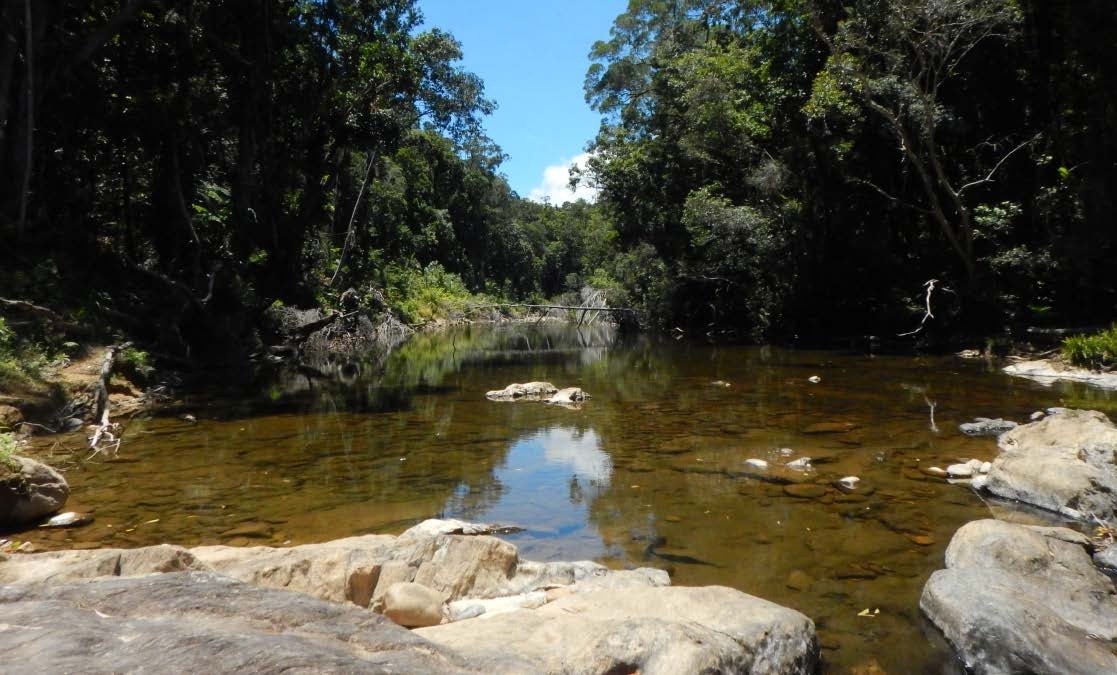
Hilda Creek is a major eastern tributary of the Daintree River, rising as a perennially-flowing stream from a high-elevation (1,260 m) wetland of national significance just northwest of the Thornton Peak summit, and joining the Daintree River some 17 km upstream of Daintree Village. The catchment is almost entirely rainforest, mostly within Daintree National Park, and is reached only via the CREB Track — a notoriously rough, steep 71 km four-wheel-drive route built to service an old regional power line, or on foot along the Thornton Peak walking track. At the CREB Track crossing, where the species was confirmed, the creek runs about 10 m wide and under a metre deep, over a substrate of sand, cobbles, silt and rock, with moderate flow and no aquatic vegetation; water quality was measured as soft and slightly acidic (pH 6.9), with a water temperature of 28.6 °C. The species has also been confirmed in the adjoining Rossiter Creek at the same crossing, is presumed to be the fish Corlis collected from Osbourne Creek, and has been reported, though not yet formally confirmed, from further upstream along the Thornton Peak walking track at 200 m elevation — though not at the higher, 1000 m summit camp. A waterfall thought to lie between the CREB Track crossing and the Daintree River junction may be what keeps Eastern Rainbowfish, the dominant species downstream, from invading Hilda Creek at all, though this barrier has not yet been confirmed on the ground. Other fish recorded alongside it include the Purple Spotted Gudgeon (Mogurnda adspersa), Roman Nose Goby (Awaous acritosus) and two species of long-armed freshwater prawn.
Description
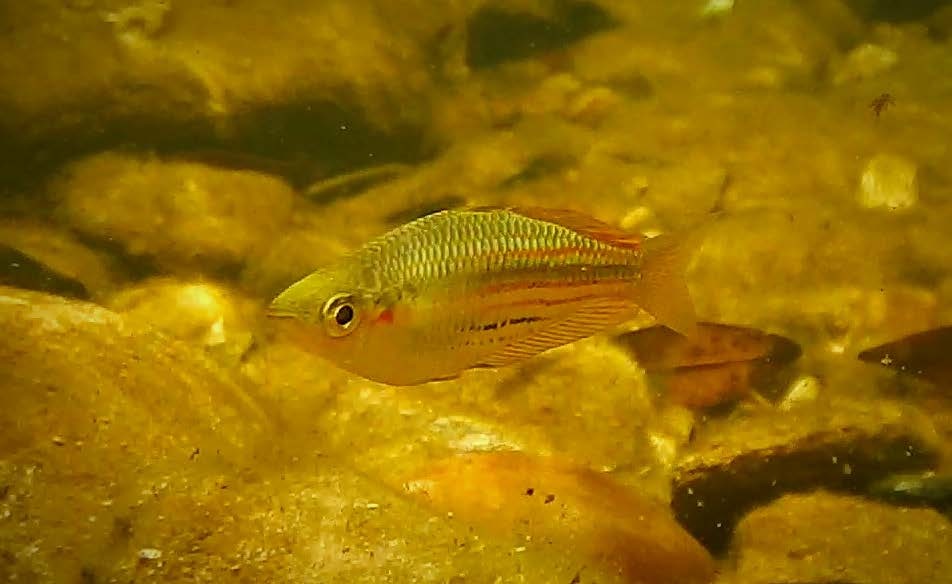
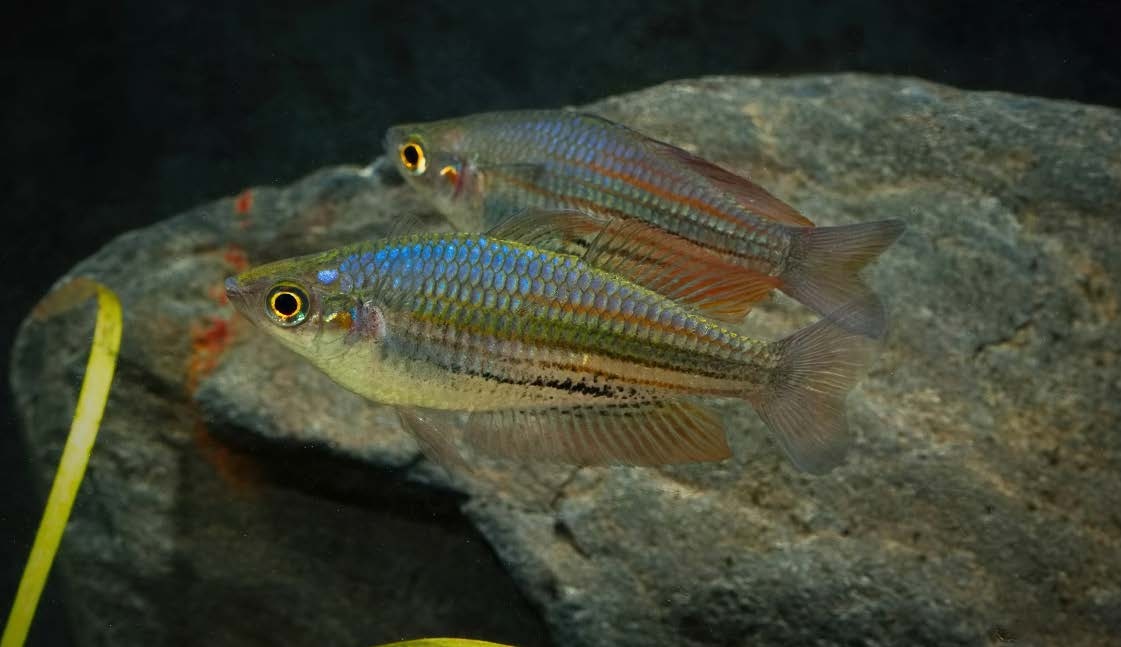
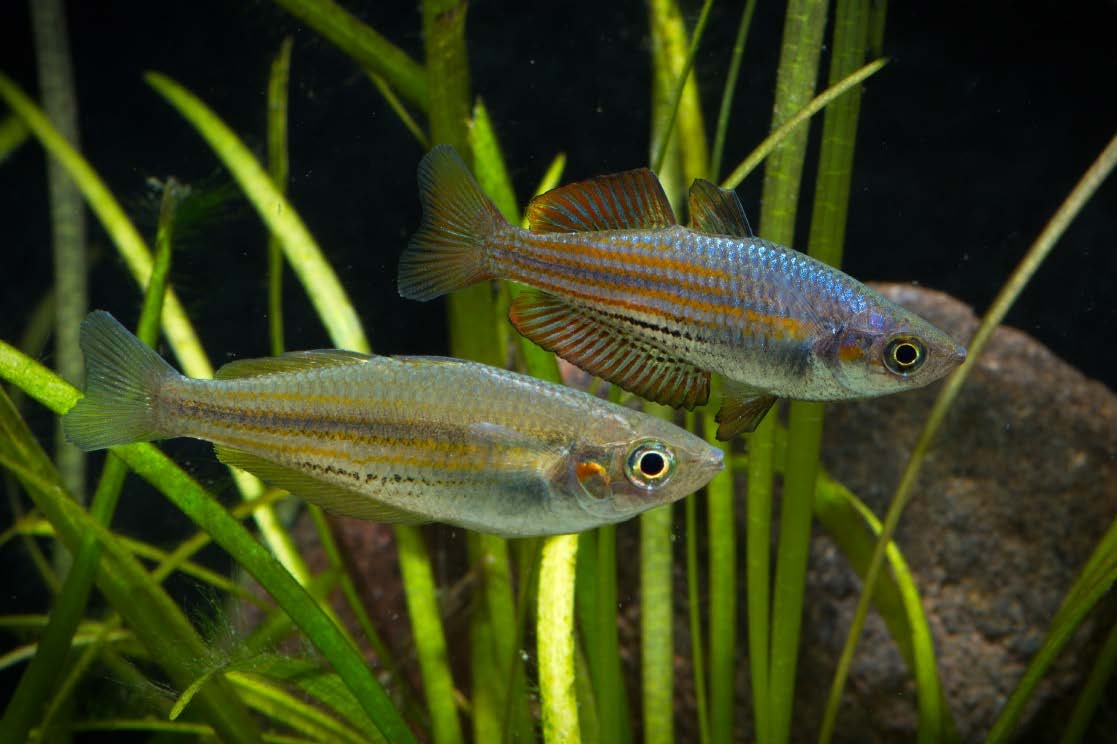
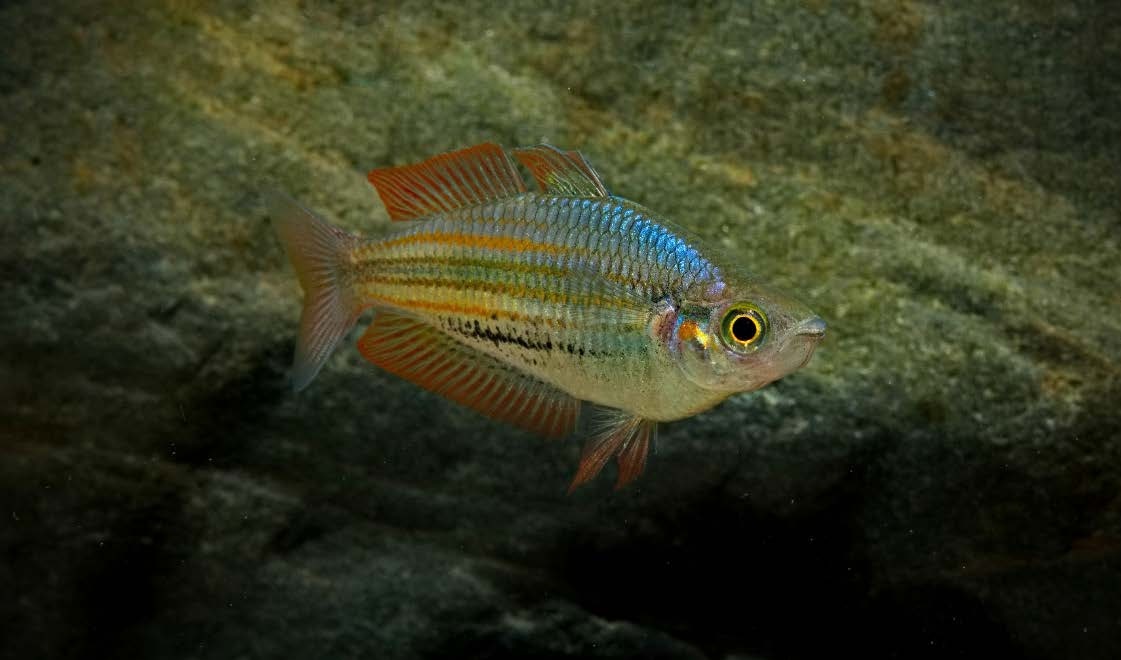
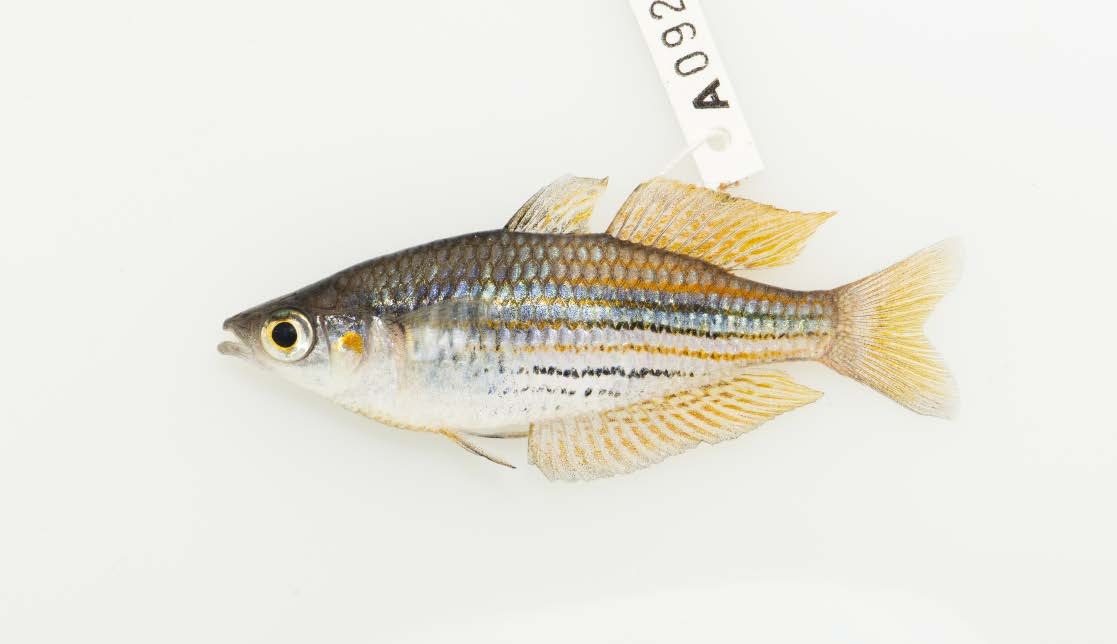
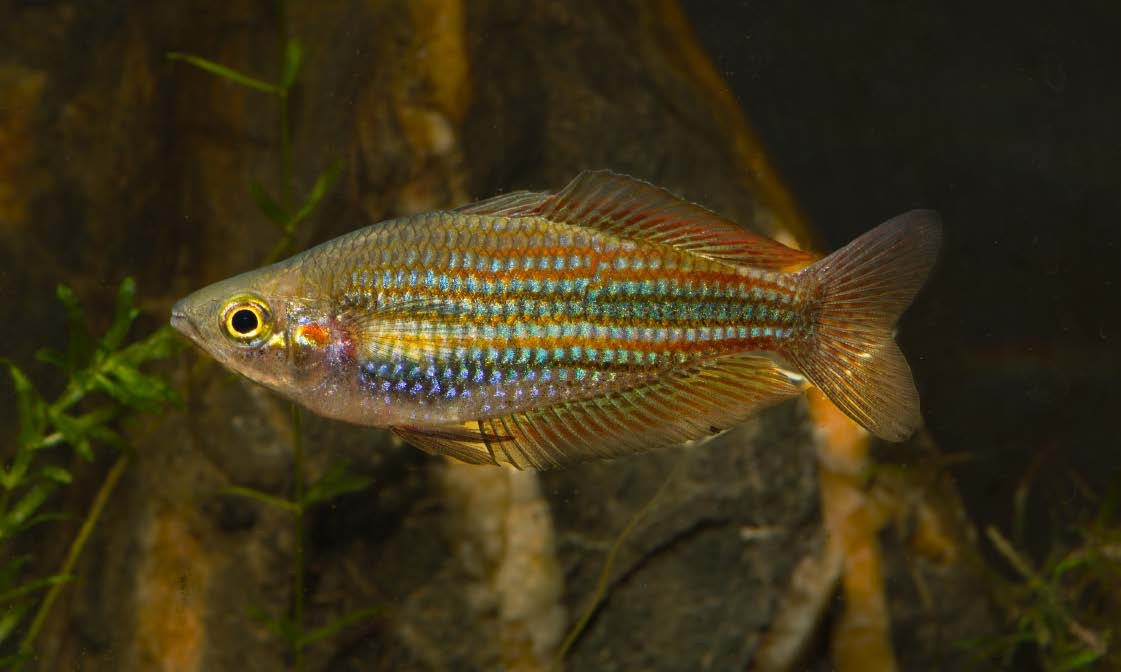
A medium-sized rainbowfish, the largest males recorded in the field reached about 90 mm total length. It is not a deep-bodied fish, with a large eye and a slightly pointed head, and moderate, low-set finnage that in males becomes more pointed with age but rarely extends past the caudal peduncle even in large adults. Living males show a steely grey body shading to yellowish towards the rear, a light metallic-blue sheen over the anterior back, and a series of increasingly bold longitudinal stripes running back along the body: a dark grey-to-black mid-lateral stripe edged in dark orange, two further orange stripes above it, a blackish-orange stripe below, and two or three jagged black stripes lower on the body, the uppermost of these the most prominent. Fins and tail are light to dark reddish with faint black edging, and the pelvic fin carries dark speckling near its base. Females are narrower-bodied, shorter-finned and far more faintly marked. Overall the fish has a distinctly “stripey” look, and subadults in particular are easily mistaken for McCulloch’s Rainbowfish (Melanotaenia maccullochi) at a glance.
In the wild, fish were seen both in sunlit open water and in well-shaded stretches of stream, schooling in shallow, rapid-flow areas over rocky substrate, swimming in midwater or grubbing for food among the rocks — behaviour typical of rainbowfishes generally.
Keeping & Caring
Wild-collected fish settled into aquarium life readily and proved easy to maintain, accepting a range of foods including ordinary flake, though some individuals were noticeably nervous, sticking close to the water surface and tank corners and startling easily. Fish moved into a well-planted outdoor pond bred without any special intervention. On the evidence gathered so far, this is a hardy, easily kept species well suited to a community aquarium.
Genetics & Relationships
Preliminary genetic analysis, led by Dr Peter Unmack at the University of Canberra, confirms the Hilda Creek fish as a true Melanotaenia, with no evidence of hybridisation with Eastern Rainbowfish, the predominant species downstream in the Daintree River. More strikingly, it places the Hilda Creek fish as most closely related to the Utchee Rainbowfish — a genuinely puzzling result. The nearest known Utchee Rainbowfish population is around 175 km to the southeast, endemic to the Johnstone River basin, and that species is a narrow habitat specialist restricted entirely to lowland, basalt-based streams, quite unlike Hilda Creek’s sedimentary geology. The two also look distinctly different in body shape and colour pattern, though detailed meristic comparison has not yet been carried out. Taken together, the genetic distance, ecological mismatch and lack of any intermediate populations point to the Hilda Creek population having been isolated for a very long time, and very likely representing a genuine undescribed species in its own right — though the authors are careful to note that further research is needed to confirm this formally. A representative sample of wild-caught specimens has been lodged with the Northern Territory Museum for ongoing taxonomic research.
A Wet Tropics Diversity Hotspot
The discovery adds real weight to Thornton Peak’s standing as a biodiversity hotspot, already recognised for threatened and endemic species such as the Thornton Peak Skink and for hosting a nationally important wetland at Hilda Creek’s own headwaters. Counting the Hilda Creek Rainbowfish, the drainages running off Thornton Peak and its surrounding ranges are now known to support five separate rainbowfish species, two of them found nowhere else: the endemic Daintree Rainbowfish (Cairnsichthys bitaeniatus) in Cooper and Hutchinson creeks; an isolated, most-southerly population of Banded Rainbowfish (Melanotaenia trifasciata) in Cooper Creek; an isolated population of McCulloch’s Rainbowfish in Forest Creek; the widespread but patchy Eastern Rainbowfish; and now the Hilda Creek Rainbowfish itself — a remarkable tally for streams draining a single mountain.
Conservation
For now the population appears reasonably secure: its entire known catchment is large, undeveloped, largely inaccessible and lies within or directly adjacent to Daintree National Park. All the same, small-range endemic fishes of this kind are recognised as particularly vulnerable to decline, and the authors recommend a formal conservation assessment be carried out. It is a sobering point of comparison that its closest known relative, the Utchee Rainbowfish, is already listed Endangered on the IUCN Red List. The Hilda Creek catchment is also the only upper Daintree River tributary the CREB Track actually crosses; numerous other streams drain the remote upper Daintree catchment but have never been sampled at all, lacking any vehicle track and being difficult to reach even by helicopter due to dense rainforest cover — leaving open the real possibility that this, or other undiscovered rainbowfish forms, may be waiting in streams nobody has yet reached.
Account compiled for Home of the Rainbowfish from K. Martin & S. Barclay (2022), “Notes on a new rainbowfish from the Daintree rainforest, north Queensland”, Fishes of Sahul 36(4): 1950–1961.