
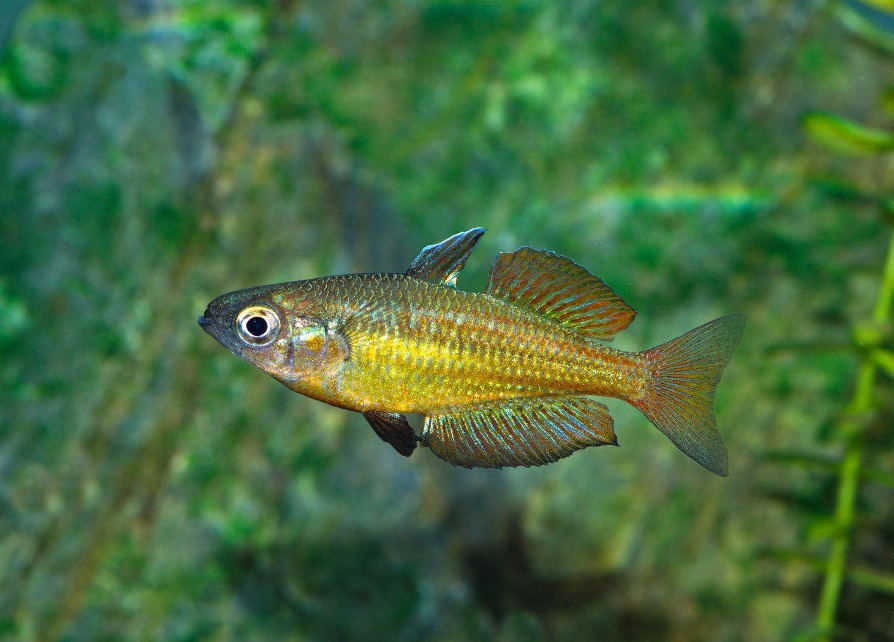
Melanotaenia sp. “Malanda”
Malanda Rainbowfish
Species Summary
The Malanda Rainbowfish is a small, gold-and-red rainbowfish endemic to the Wet Tropics of north Queensland, Australia. It is a genuinely distinct species — confirmed by genetic and meristic study — but it has not yet been formally described or named, and so is referred to as Melanotaenia sp. “Malanda”. It is one of the smallest Australian rainbowfishes and one of very few restricted to high-elevation streams, living only in a handful of cool upland creeks on the Atherton Tablelands. Long confused in the aquarium hobby with the Lake Eacham Rainbowfish (Melanotaenia eachamensis) and the Utchee Rainbowfish (Melanotaenia utcheensis), and known informally by names such as “Malanda Gold”, “Upland Utchee” and “Tarzali” Rainbowfish, it is now recognised as a member of the Australis group of rainbowfishes. It is listed as Critically Endangered on both the IUCN Red List and under Australia’s EPBC Act, and is at serious risk of extinction before it can even be named.
Appearance
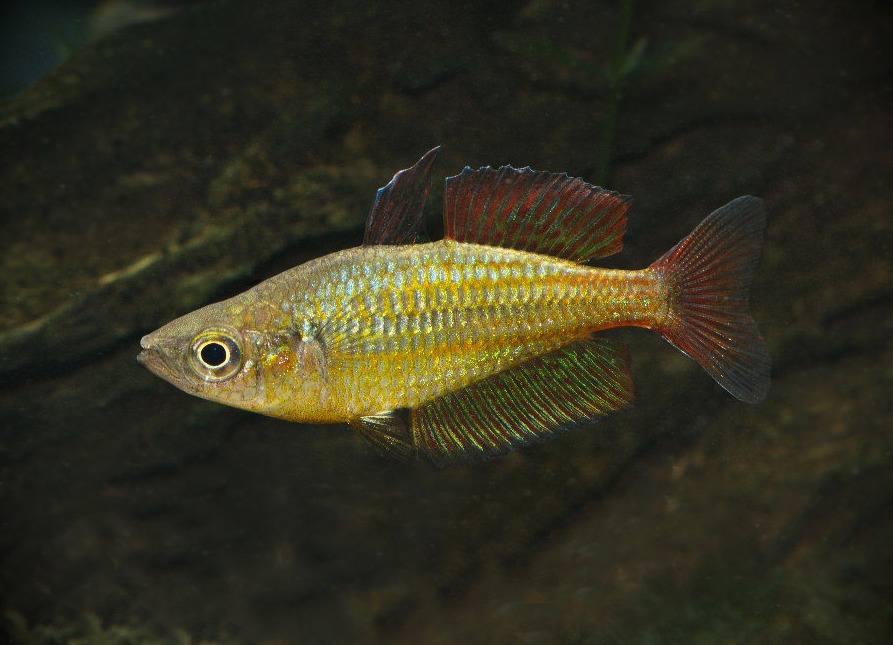
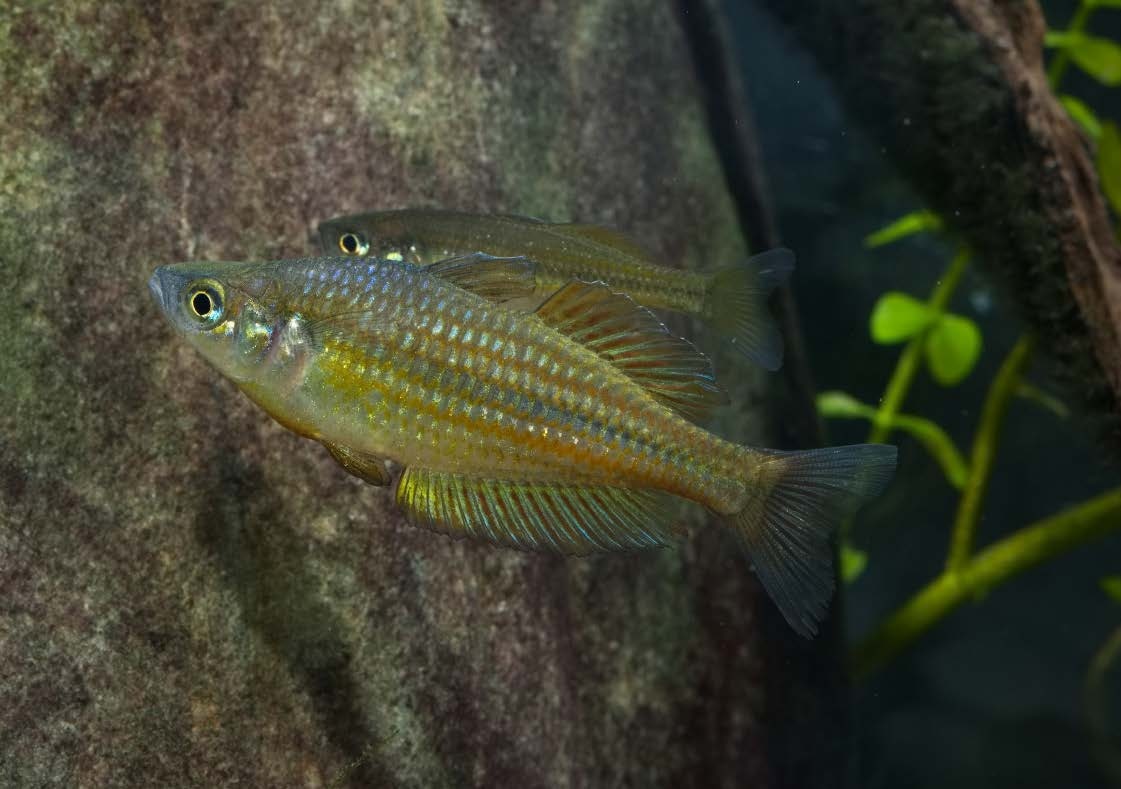
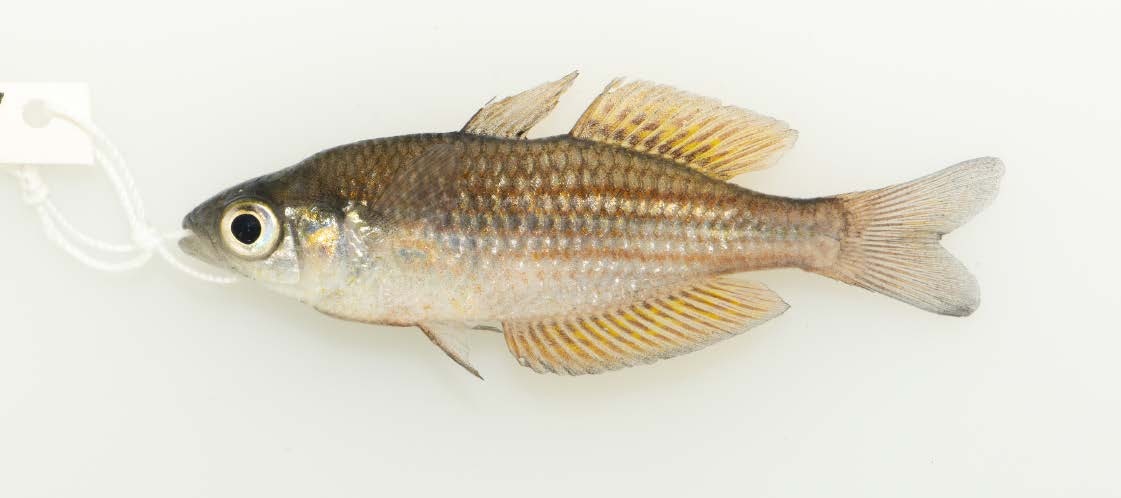
The Malanda Rainbowfish is a dwarf species with a notably short, deep body that gives it a rather stocky look, a rounded “bull-nosed” head and a large eye set close to the snout — quite unlike the pointed profile of the Eastern Rainbowfish (Melanotaenia splendida splendida). Males carry a tall, flag-like first dorsal fin and square-cut second dorsal and anal fins that, unlike those of the Lake Eacham Rainbowfish, never overlap the tail base. The body is a brown-golden colour with narrow orange to brown stripes, intensifying in the breeding season to a bright golden yellow with fine red stripes and reddish dorsal, anal and caudal fins, the fins often edged in black. Females are more oval-bodied with a triangular first dorsal fin and are silver-brown with paler orange-brown stripes.
Distribution & Habitat
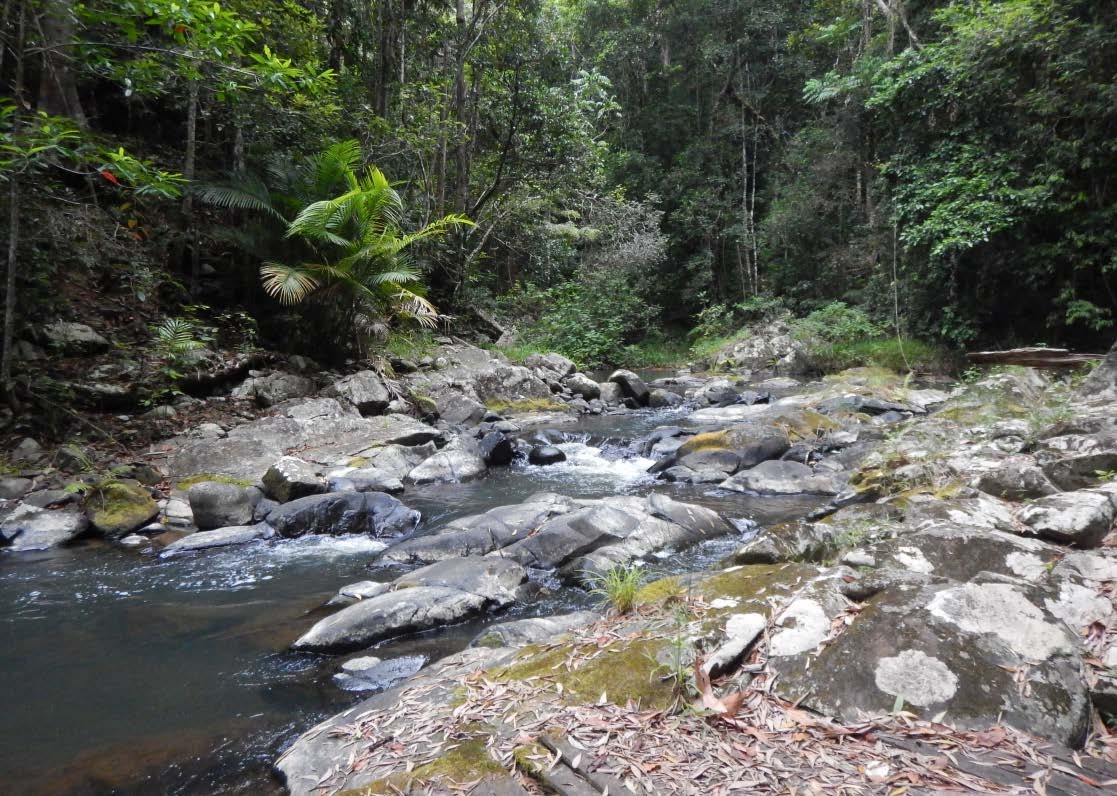
The species is named for the town of Malanda, and its core range is a small number of upper tributaries of the North Johnstone River on the southern Atherton Tablelands, at high elevations of about 650–800 m. Extensive surveys have found it in only three creek systems there — the Ithaca River and its tributaries, Williams Creek, and a small unnamed creek at Wallace Road — and its range within those has been contracting to the uppermost reaches. In December 2021 it was discovered at a fourth site, Butchers Creek, in rainforest adjoining Gadgarra National Park; this record is especially notable because Butchers Creek lies in the neighbouring Mulgrave-Russell drainage basin, entirely separate from the North Johnstone. The streams it lives in are small, cool (about 16–22 °C) and fast-flowing, over a base of basalt bedrock, boulders and cobbles with red silt, and are often broken by low vertical waterfalls. There is little aquatic vegetation beyond occasional Blyxa aubertii and the Queensland Lace Plant (Aponogeton bullosus).
Conservation
The greatest threat to the Malanda Rainbowfish is hybridisation with the Eastern Rainbowfish (Melanotaenia splendida splendida), a larger, widely translocated native fish that has invaded much of its range; where the two meet they interbreed, swamping and genetically diluting the smaller species until pure Malanda Rainbowfish survive only above barriers such as small causeways and waterfalls. Introduced fishes — Eastern Gambusia (Gambusia holbrooki), tilapia and Guppies (Poecilia reticulata) — and the clearing of the surrounding rainforest for dairy and cattle farming add further pressure. Surveys have documented a rapid, ongoing contraction of the species’ range, which is why it is assessed as Critically Endangered.
Taxonomy & Names
The Malanda Rainbowfish belongs to the Australis group, a lineage of closely related Australian and New Guinean rainbowfishes. The upper North Johnstone catchment is remarkable for holding several members of this single group — including the Eastern, Lake Eacham, Utchee and “Tully” Rainbowfishes — which do not normally co-exist without hybridising, and this tangle is a large part of why the Malanda form went so long unrecognised. Early genetic studies variously assigned its populations to the Lake Eacham Rainbowfish or, later, to the Utchee Rainbowfish, and the fish circulated under informal names such as “Upland Utchee”, “Tarzali” and “Ithaca” Rainbowfish. Modern genome-wide sequencing has since shown it to be a distinct species; a formal description is in preparation but had not been published at the time these sources were written.
Account compiled for Home of the Rainbowfish from P. J. Unmack, K. Martin, M. P. Hammer, B. Ebner, K. Moy & C. Brown (2016), “Malanda Gold: the tale of a unique rainbowfish from the Atherton Tablelands, now on the verge of extinction”, Fishes of Sahul 30(4): 1039–1051, and K. C. Martin & S. Barclay (2023), “First record of the Critically Endangered Malanda Rainbowfish in the Russell-Mulgrave drainage basin, Atherton Tablelands”, Fishes of Sahul 37(1): 1994–2000.