

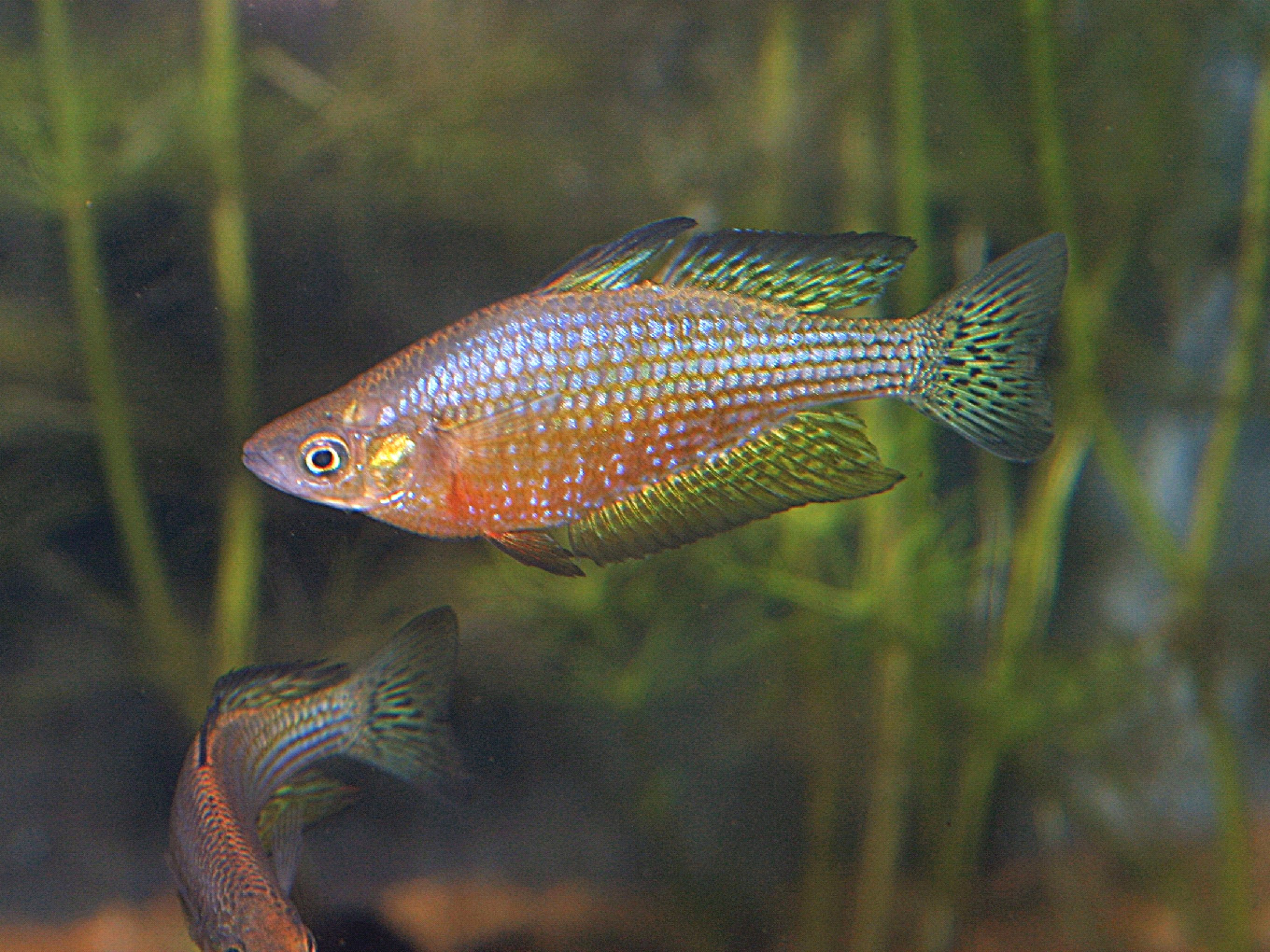
Melanotaenia splendida tatei
Desert Rainbowfish
Synonymy
- Nematocentris tatei Zietz, 1896
- Nematocentris winneckei Zietz, 1896
- Rhombatractus winneckei Ogilby, 1896
- Melanotaenia splendida tatei Allen, 1980
Species Summary
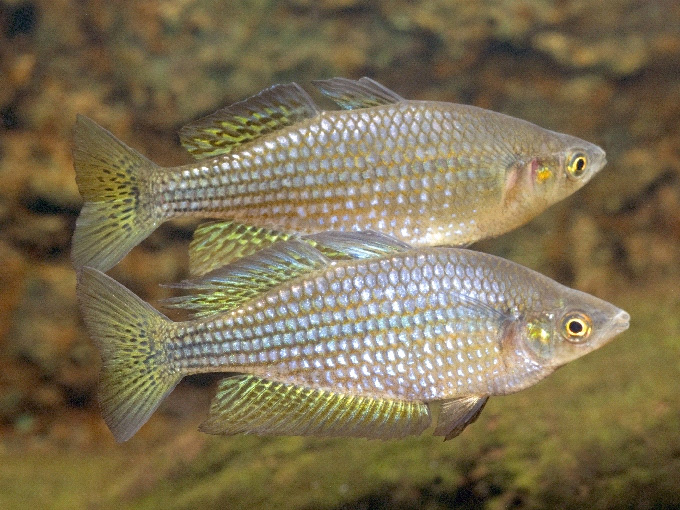
moderately large, oblique and upturned. There are two dorsal fins separated by a small gap, with the first shortbased and the second long-based. There is a long-based anal fin and the tail is moderately forked. Two colour forms exist; in one form males have a purple body with yellowgreen fins, with dark flecks and a dark border. The other form has a blue-green body with similar colouration on their fins. During spawning the belly of the male turns bright pink. Colour varies depending upon the mood of the fish, water conditions and diet.
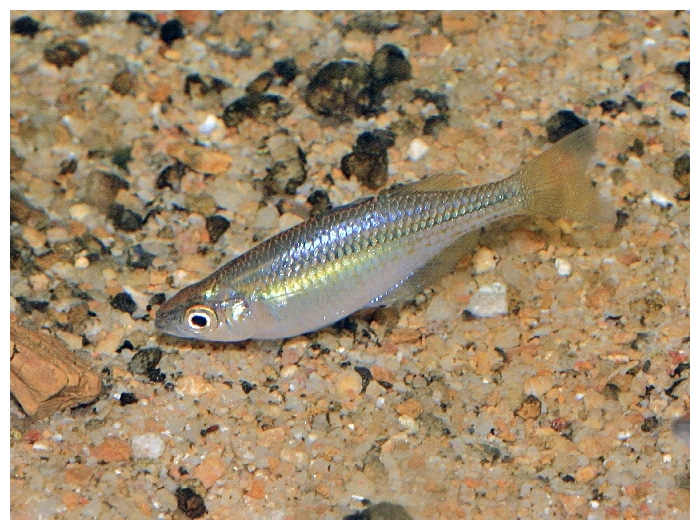
Females and juveniles have plain silvery bodies with clear fins. Males are usually more brightly coloured with pale stripes along the sides, larger, and much deeper bodied than females.
Melanotaenia s. tatei was originally named Nematocentris tatei by Zietz in 1896 after Ralph Tate (1840-1901), a geologist and botanist who was on the 1894 Horn Expedition when this species was first collected.
Etymology
The subspecies’ patronym was not identified by its author, but is probably in honour of botanist-geologist Ralph Tate (1840–1901), who took part in the 1894 Horn Expedition to Central Australia, during which the type was collected.
Etymology compiled from C. Scharpf (2022), “Fishes of Sahul: An Etymological Survey (Part 5), the rainbowfishes (continued)”, Fishes of Sahul 36(4): 1968–1992, and etyfish.org.
Distribution & Habitat
Melanotaenia s. tatei is widespread and abundant in the larger rivers of the Lake Eyre Basin and the Western Plateau of the Northern Territory. This species has only recently been identified from the Murray-Darling Basin, where it was recorded from the Paroo and Warrego rivers. Hybrids with The Murray River Rainbowfish (Melanotaenia fluviatilis) have been identified in the lowermost Warrego River and the Darling River from around the Bogan River down to at least Menindee. Any rainbowfishes captured in or near the Darling River need to be carefully examined, as confusion or hybridisation with the Murray rainbowfish is likely (P. J. Unmack pers. comm.).
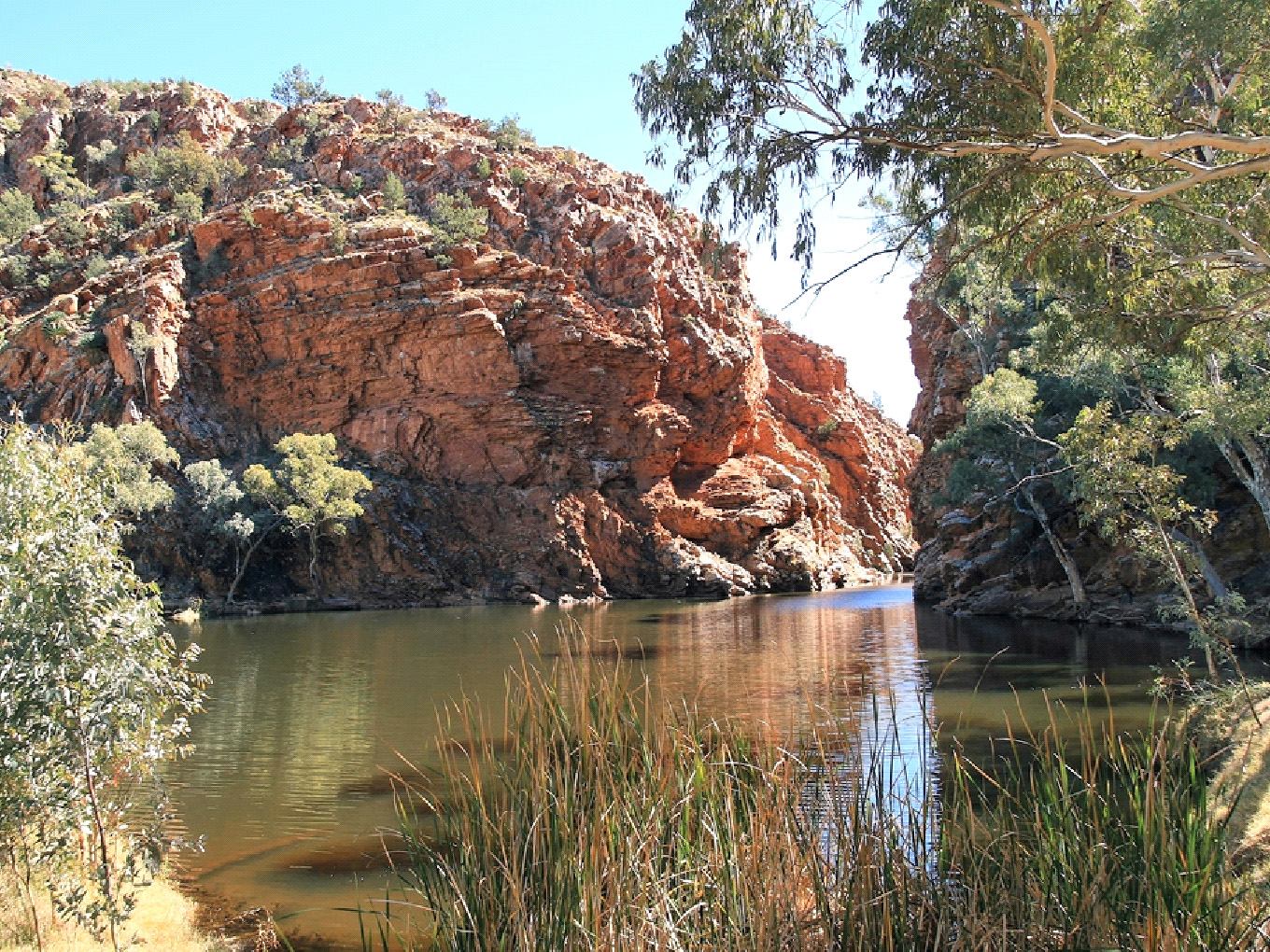
Melanotaenia s. tatei inhabit semi-permanent streams, springs, artesian bores (wells), and lagoons. During prolonged droughts the fish are confined to isolated pools. Their natural environment is subjected to seasonal variations with water temperatures ranging between 24°C during the dry season and up to 33°C in the wet season. The water is generally alkaline (pH 7.2– 8.0); however, they are occasionally found in acidic conditions (pH 6.5–6.9). They are usually found around sub -surface vegetation, submerged logs, or branches. Living in a hot and arid environment M. s. tatei have broad physiological tolerances.
Biology & Ecology
Little is known of their biology or ecology, but they have broad physiological tolerances. Strong sexual dimorphism is present in the species with males typically being larger and brighter in colouration. During spawning the ventral region of the male turns bright pink. Spawning typically takes place during the warmer months when temperatures are above 20°C, or whenever ample rain falls. Females produce between 100 and 200 small eggs (0.8-0.95 mm diameter), spawning a number of times daily for several days. Eggs adhere to water plants and hatching occurs after 6–7 days. The newly-hatched larvae are around 4–5 mm long. Spawning more commonly occurs in the morning with eggs being scattered over vegetation or aquatic debris. They probably mature within a few months at around 30–50 mm.
Balcombe et al., 2005 found that terrestrial fauna was a major food group consumed by Melanotaenia splendida tatei. Their diet consisted of terrestrial insects (67.4%), other terrestrial invertebrates (10.2%), algae (16.8%), and aquatic insects (5.6%).
In addition to the consumption of some aquatic insects and algae, this species fed chiefly upon terrestrial arthropods, many of which were flying insects (e.g., ants, wasps and dipterans). Other items included aquatic dipterans, coleopteran larvae and zooplankton. The aquatic dipterans were mostly chironomid larvae, while the zooplankton prey consisted chiefly of conchostracans and cladocerans. Terrestrial foods included isopods, scolopendridid centipedes, or a variety of alighting insects such as dipterans, hymenopterans and coleopterans. Up to 100% terrestrial insects was consumed during the dry season.
Remarks
This species has never generated much interest among Australian aquarists, except for a few dedicated rainbowfish enthusiasts and is still relatively uncommon in the international hobby.
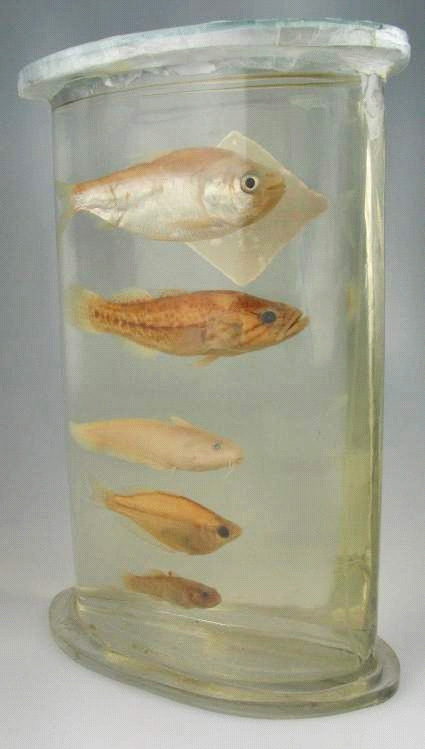
The Horn Expedition lasted only three months, but its findings in all fields of study were widely acclaimed and greatly increased knowledge about central Australia. Five fish specimens were collected during that expedition: Nematalosa erebi, Mogurnda larapintae, Neosilurus hyrtlii, Chlamydogobius eremius and Melanotaenia splendida subsp. tatei. Three new species were described by Amandus Zietz from specimens collected on the Horn Expedition: C. eremius, M. splendida tatei and M. larapintae.
Mogurnda larapintae was originally described from specimens collected on the Horn Expedition, but only recently (Allen & Jenkins 1999) accepted as a distinct species.
References
- Balcombe S.R., S.E. Bunn, F.J. Mckenzie-Smith and P.M. Davies (2005) Variability of fish diets between dry and flood periods in an arid zone floodplain river. Journal of Fish Biology, 67: 1552-1567.
- Duguid A., J. Barnetson, B. Clifford, C. Pavey, D. Albrecht, J. Risler and M. McNellie (2002) Wetlands in the arid Northern Territory. A report to Environment Australia on the inventory and significance of wetlands in the arid NT. Parks and Wildlife Commission of the Northern Territory.
- Unmack P.J. (1995) Desert fishes down under. Proceedings of the Desert Fishes Council 1994, 26: 71-95.
- Unmack P.J. (2001) Biogeography of Australian freshwater fishes. Journal of Biogeography, 28: 1053-1089.
- Wager R. & P.J. Unmack (2000) Fishes of the Lake Eyre Catchment of Central Australia. Queensland Department of Primary Industries, Brisbane. 90pp.
- Zietz A.H.C. (1896) Pisces. Report on the work of the Horn Expedition to Central Australia. Part 2. Zoology. Horn Expedition: 176-180, Appendix, pp. 410-411, Pl. 16.