

Chilatherina axelrodi
Axelrod’s Rainbowfish
Species Summary
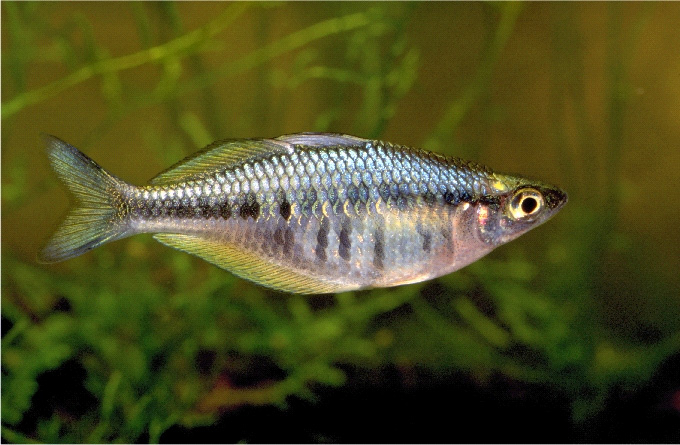
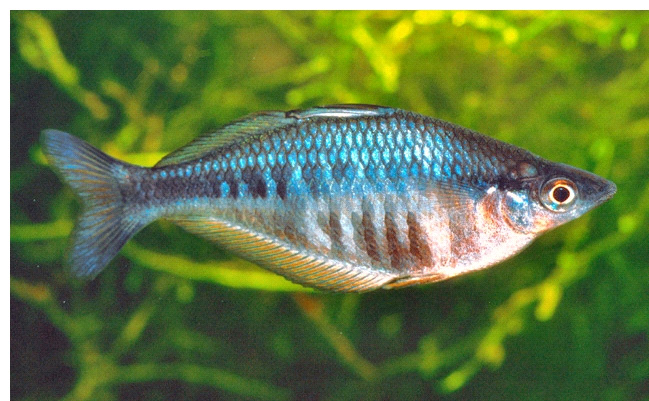
Chilatherina axelrodi males have a body colour of bluish-short bars along the middle of side (approximately every two scales) that finally merge with a more or less solid blackish stripe along the middle of caudal peduncle. There are about 6-10 faint dusky bars on lower side of the body, those on side of abdomen are particularly evident. The upper half of the body has a number of bluish stripes while the lower half has a number of faint yellow stripes, bordering each longitudinal scale row. The dorsal, anal and pelvis fins are yellowish, other fins translucent. Females are an overall silvery colour and rather plain compared to the males. Males are more brightly coloured, larger, and much deeper bodied than females. Males may reach a maximum size of 10 cm, with females usually less than 8 cm SL. Spawning usually occurs from October to January, with females producing between 50 and 150 eggs, spawning over a period of several days.
Etymology
The species is named in honour of pet-book publisher Herbert R. Axelrod (1927–2017), who generously provided collecting assistance and financial aid for the 1979 expedition to New Guinea during which the holotype was collected.
Etymology compiled from C. Scharpf (2021), “Fishes of Sahul: An Etymological Survey (Part 4), the Rainbowfishes”, Fishes of Sahul 35(1): 1706–1714, and etyfish.org.
Distribution & Habitat
Chilatherina axelrodi were first collected in 1979 from Yungkiri creek, a tributary of the Pual River (formerly Nemayer or Neumayer River), in the Bewani Mountains of Papua New Guinea. This location is about 40 kilometres inland from the north coast town of Vanimo, which is close to the West Papuan border. Chilatherina axelrodi were found around sub-surface vegetation, submerged logs and branches in a small, narrow slow flowing rainforest stream. The water at the collection site was slightly turbid with a temperature of 28.5°C and pH 7.8 being recorded. Other rainbowfishes found in the stream included C. crassispinosa and Melanotaenia affinis. Chilatherina fasciata and C. lorentzii have also been collected from the Paul River.
Remarks
A number of live specimens were collected by Gerald Allen, Brian Parkinson and Peter Neusinger in September 1979, but unfortunately they all died soon after arriving in Australia. However, Gerald Allen returned in 1982 and together with Heiko Bleher they collected more live specimens, which were later bred and distributed in the hobby. In 1983 further live specimens were collected by Barry Crockford and returned to Australia. Although a rather attractive species, it has never achieved much popularity in the hobby, and could be considered rare. The species was named in honour of Herbert R. Axelrod who provided funding for the first collecting expedition.
References
- Allen G.R. (1980) Chilatherina axelrodi, A New Species of Rainbowfish (Melanotaeniidae) From Papua New Guinea. Tropical Fish Hobbyist 28 (5): 48-55.
- Allen G.R. (1981) A revision of the rainbowfish genus Chilatherina (Melanotaeniidae). Record of the Western Australian Museum 9(3): 279-299.