

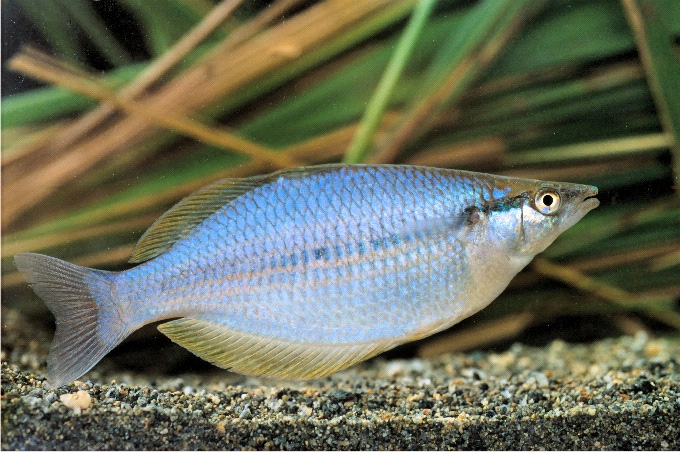
Chilatherina lorentzii
Lorentz's Rainbowfish
Synonymy
- Rhombatractus lorentzii Weber, 1908
- Rhombosoma lorentzii Regan, 1914
- Chilatherina lorentzii Regan, 1914
Species Summary
Chilatherina lorentzii have a basic bluish body colour grading to silvery-blue ventrally and a broad darker blue midlateral band, with clear to yellowish fins. They may attain a length of about 12 cm with a body depth of around 3-4 cm. Females are brownish-green on the upper body and silvery-white on lower half with a diffuse bluish mid-lateral band that extends from the eye to the middle of caudal fin base. The dorsal, caudal and anal fins are darkly-faded with the anal fin having a pale yellowish colour. The pelvic and pectoral fins are translucent.
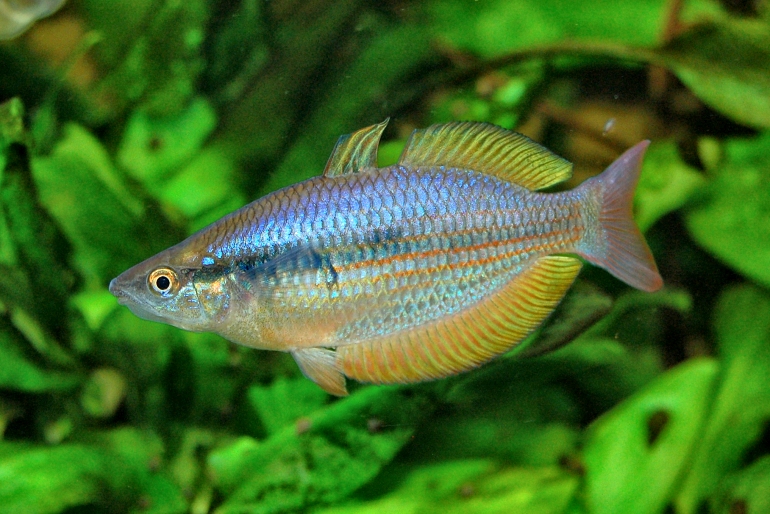
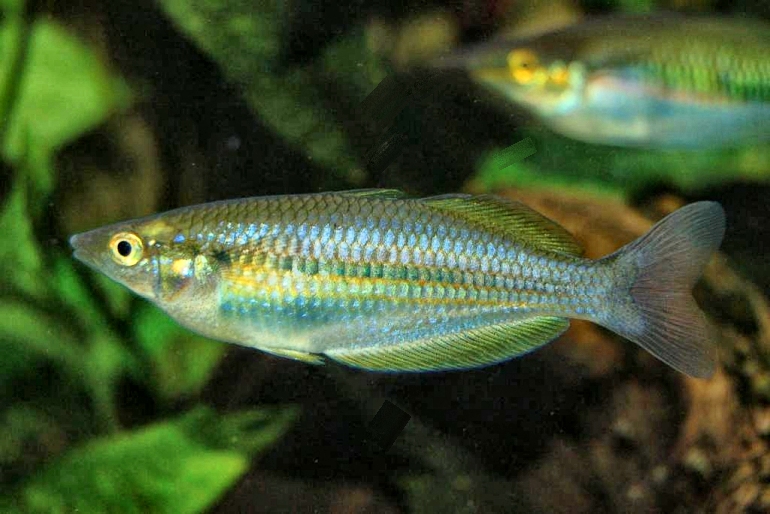
Munro (1964) considered C. fasciata to be a junior synonym of C. lorentzii, but comparison of the respective types at the Zoological Museum of Amsterdam by Gerald Allen revealed important differences between these species. Chilatherina fasciata is a much more slender fish; males seldom exceed a maximum depth of 35% of the SL compared with frequent values exceeding this figure and sometimes over 40% in C. lorentzii. The caudal peduncle depth also reflects this difference with most specimens of C. fasciata under 11.3% whereas the values in C. lorentzii ranged from 11.3–13.6% SL.
Counts for the anal rays and preopercle-suborbital scales are also useful for separating these species, although there is some overlap in the ranges. Additionally, the upper jaw of C. lorentzii is longer and reaches the level of the anterior edge of the eye, whereas that of C. fasciata fails to reach eye level. However, recent genetic evidence suggests this species should be placed in the genus Melanotaenia rather than Chilatherina.
Etymology
The species is named in honour of Dutch explorer Hendrikus Albertus Lorentz (1871–1944), one of two zoologists on the expedition during which the holotype was collected; Weber praised him and his colleague for the excellent state of preservation of the fishes they collected and for providing precise locality data.
Etymology compiled from C. Scharpf (2021), “Fishes of Sahul: An Etymological Survey (Part 4), the Rainbowfishes”, Fishes of Sahul 35(1): 1706–1714, and etyfish.org.
Distribution & Habitat
Chilatherina lorentzii have been collected in the Sermowai, Tawarin and Mamberamo rivers in northern West Papua, and from Puive Creek, a tributary of the Pual River, near Vanimo, Papua New Guinea. They were collected from moderatelyflowing stream that was enclosed by dense rainforest. The bottom was covered entirely with leaf litter. The fishes were confined in the deeper sections of the stream in the vicinity of waterplants and woody debris. Temperature 28° Celsius and pH 7.8.
In February 2008 a survey by Conservation International and the Papuan State University at Manokwari found Chilatherina lorentzii in tributary streams of the Tariku River (Rouffaer) near Haya Village (02º48.951’S and 138º05.903’E). Three species of rainbowfishes were collected during these surveys which included Chilatherina fasciata, C. lorentzii and Glossolepis multisquamata. Glossolepis multisquamata was found in the lake-marsh habitats, C. fasciata was found in creeks near the village, and C. lorentzii were found in clear rocky streams about 6 km from the village.
References
- Allen G.R. (1991) Field guide to the freshwater fishes of New Guinea. Christensen Research Institute, Madang, Papua New Guinea.
- Eschmeyer, W. N., R. Fricke, and R. van der Laan (eds). Catalog of Fishes: Genera, Species, References. Electronic version accessed 21 May 2016.
- Weber M. (1907) Süsswasserfische von Neu-Guinea ein Beitrag zur Frage nach dem früheren Zusammenhang von Neu-Guinea und Australien. In: Nova Guinea. Süsswasserfische Neu-Guinea 201-267.
- Yoseph W. (2008) Pandangan dan Prinsip Pengelolaan Alam Masyarakat Adat Kampung Haya di Mamberamo. Conservation International Indonesia Papua Program 47 Halaman.