
Glossolepis incisus
Salmon-Red Rainbowfish
Species Summary
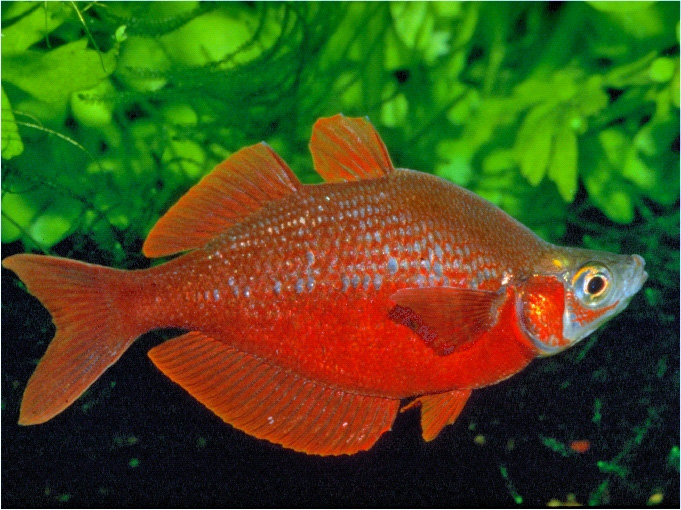
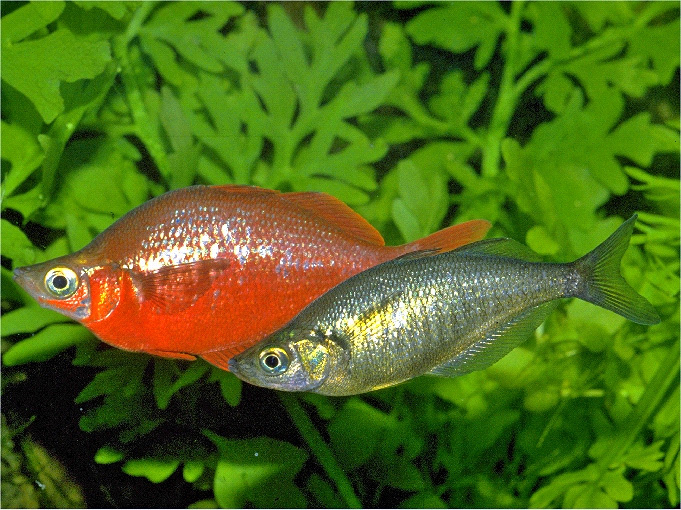
Female Glossolepis incisus have a yellowish olive body colour with a golden iridescence to the scales, and clear fins. The males on the other hand are brilliant, the entire body and fins are a bright salmon-red colour. Some of the scales have a silvery sheen, which creates a most unusual effect over the red background colour. Young fish are all rather dull in colour, being an overall olive greenish colour with a trace of silvery sheen. However, once the fish reach a length of 4 to 5 cm the males begin to colour up. Once the colour change begins to occur it progresses quite rapidly. By the time the fish are 7 to 8 cm long the males should have their full intense red colouration. Males are typically deeper bodied than females and have a high rounded back which gives them the appearance of having a relatively small head and disproportionately large eyes. Males may reach a maximum size of 15 cm, but females are usually less than 12 cm.
Glossolepis differ from other melanotaeniids by a combination of characters which includes distinctly crenulate scale margins, a high gill raker count, spine at the beginning of the second dorsal fin taller than first spine of first dorsal fin, relatively elongate pectoral fins, a unique premaxillary dentition and characteristic profile of the head, nape, and dorsal and anal fins.
Etymology
The species name incisus is Latin for notched, referring to the tongue-shaped incisions (crenulated margins) on its scales.
Etymology compiled from C. Scharpf (2021), “Fishes of Sahul: An Etymological Survey (Part 4), the Rainbowfishes”, Fishes of Sahul 35(1): 1706–1714, and etyfish.org.
Distribution & Habitat
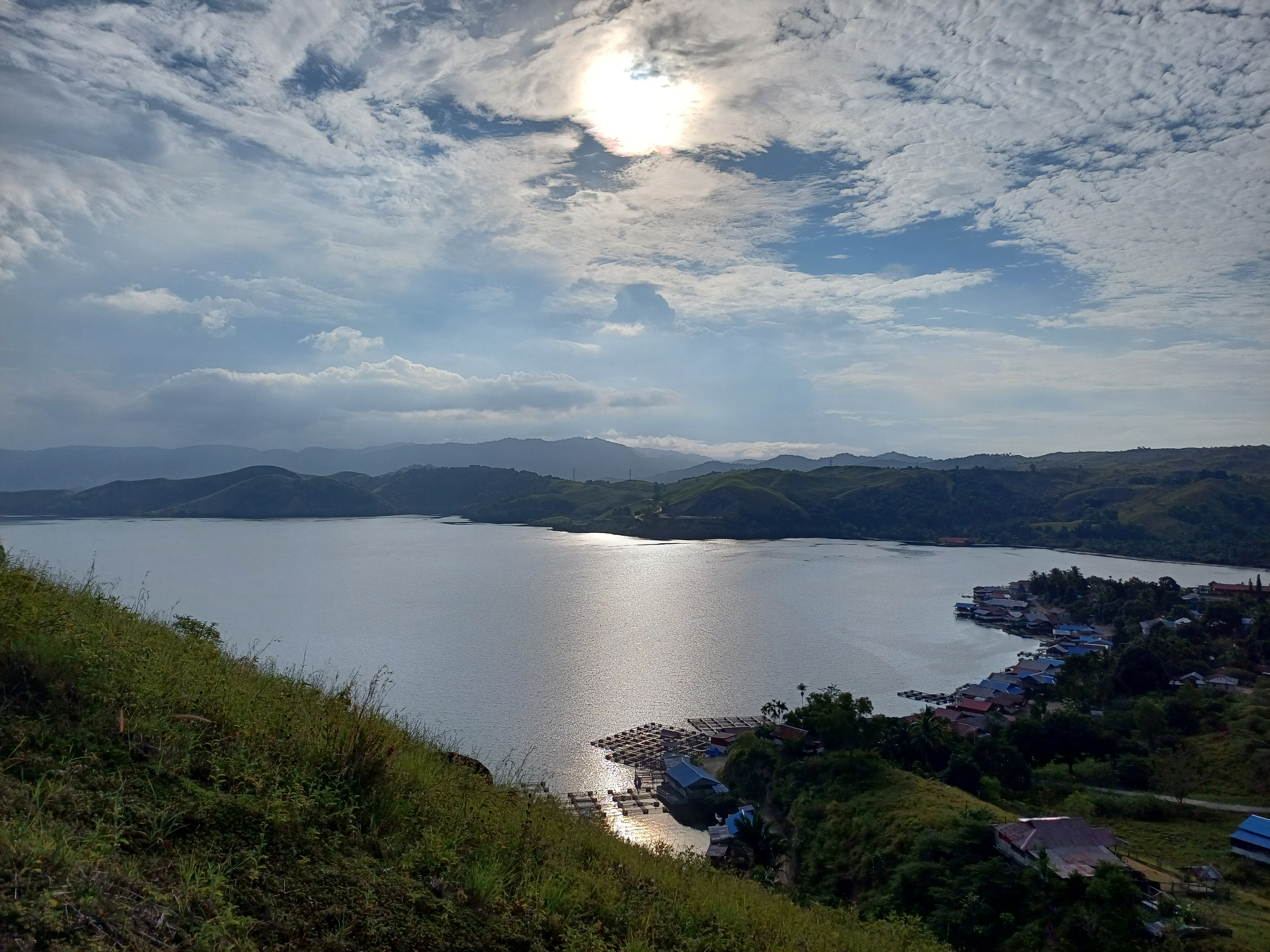
Glossolepis incisus are found only in Lake Sentani. Lake Sentani is located some 10 kilometres west of Jayapura at the NE extremity of West Papua. It is an irregularly shaped lake with approximate dimensions of 28 km (E-W) by 19 km (N-S) and a surface area of 104 km2. Its blue-green waters are dotted with at least 16 small islands, and it is surrounded by hillsides in the south and the Cyclops Mountains in the north, which separate the lake from the Pacific Ocean. Lake Sentani is by far the largest of the West Papuan lakes and has a catchment area of about 600 km2. About 35 small rivers flow into the lake, and there is one natural outlet in the south-eastern tip, via the Jafuri and Tami rivers to the Pacific Ocean near the Papua New Guinea border. The lake is divided into three main sections with recorded depths of 7 to 52 metres. According to surveys in 1970-71, 1984 and 1987 the lake is thermally unstratified, with surface temperatures of 29–32° and pH 6.2–6.8. Rainbowfishes are generally found around the margins of the lake. Large numbers are found congregating around submerged aquatic vegetation, fallen tree branches etc.
Remarks
Glossolepis incisus was originally collected from Lake Sentani during the 1899–1900 Siboga Expedition to the Dutch East Indies (West Papua). The discovery and collection of rainbowfishes in remote places in New Guinea has always been very difficult and it wasn’t until 1973 before live specimens of this species were collected. In 1973, A. Werner, Jr. of Munich, and E. Frech of Memmingen, Germany collected live specimens during a collecting trip to Java, Celebes, and West Papua. They took a number of colourful fishes back to Europe, including Glossolepis incisus. Werner and Frech are also credited with the introduction of another beautiful and appealing rainbowfish to the aquarium hobby — Iriatherina werneri. Glossolepis incisus came into the Australian hobby in 1977.
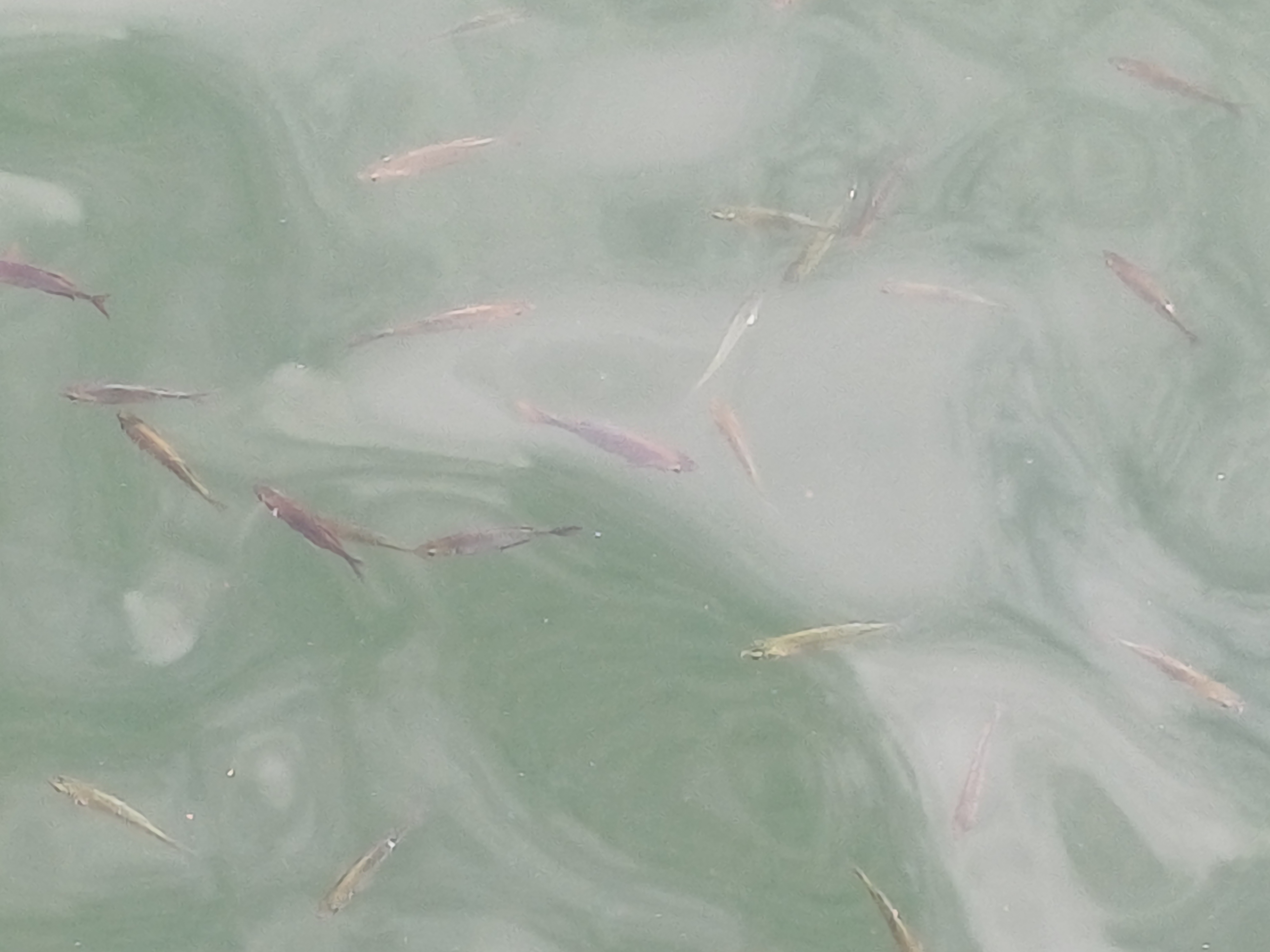
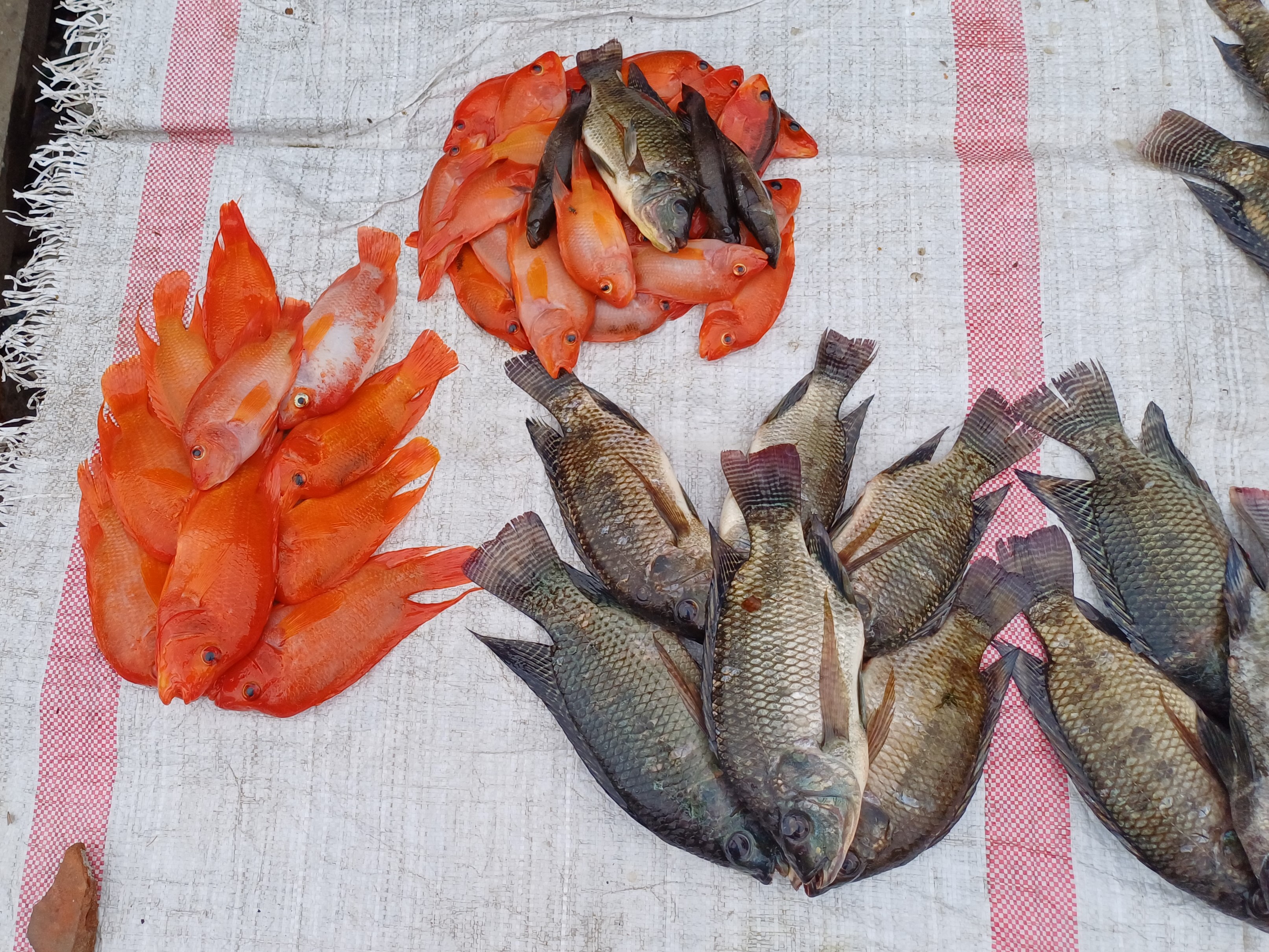
The endemic fish fauna of Lake Sentani is increasingly threatened by pollution and introduced species such as Channa sp., Tilapia/Oreochromis sp. and “Red Devil” cichlids (Amphilophus sp.), that have escaped from artisanal aquaculture cages into Lake Sentani. During a visit in 2023 by a collecting party of German, Dutch, Indonesian and French aquarists, thousands of cichlids could be observed in the shallows of the lake. Only a few rainbowfish were swimming at the surface of the lake, visibly emaciated and affected by parasites such as Lernaea sp.
| Character | G. pseudoincisus | G. incisus |
|---|---|---|
| Horizontal scale rows | 12–16 | 16–20 |
| Vertical scale rows | 38–43 | 50–60 |
| Predorsal scales | 27–34 (x = 31, N = 39) | 30–36 (x = 36, N = 13) |
| Preopercle scales | 21–29 (x = 25, N = 39) | 26–38 (x = 31, N = 13) |
| Predorsal-Preanal distance | Predorsal > Preanal | Predorsal < Preanal |
| Pectoral fin colour | uniformly pale | outer portion dusky brown |
| Pelvic fin colour | mainly pale | mainly dusky brown |
References
- Allen G.R. & N. J. Cross (1980) Descriptions of five new rainbowfishes (Melanotaeniidae) from New Guinea. Records of the Western Australian Museum 8 (3): 377-396.
- Ferreira A.V. et al. (2009) Consumo de vitelo durante o desenvolvimento embrionário de Melanotenia-maçã, Glossolepis incisus, Weber, 1907. Ciência Animal Brasileira 10: 721-729.
- Ohee H.L. (2013) The Ecology of the Red Rainbowfish (Glossolepis incisus) and the Impact of Human Activities on Its Habitats in Lake Sentani, Papua. Dissertation, Georg-August Universität Göttingen.
- Polhemus D.A., R.A. Englund and G. Allen (2004) Freshwater Biotas of New Guinea and nearby islands. Conservation International, Washington DC. 62pp.
- Said D.S., W.D. Supyawati and Noortiningsih (2005) Effect of Feeding Type and Light Intensity to The Colour Appearance of Male Red Rainbow Fish, Glossolepis incisus. Jurnal Iktiologi Indonesia 5(2): 61-67.
- Siby L.S., M.F. Rahardjo and D.S. Sjafei (2009) Reproductive biology of red rainbowfish (Glossolepis incisus Weber 1907) in Sentani Lake. Jurnal Iktiologi Indonesia, 9(1):49-61.
- Weber M. (1907) Süsswasserfische von Neu-Guinea ein Beitrag zur Frage nach dem früheren Zusammenhang von Neu-Guinea und Australien. In: Nova Guinea. Süsswasserfische Neu-Guinea 201-267.