

Glossolepis kabia
Sepik Rainbowfish
Synonymy
- Melanotaenia kabia Herre, 1935
- Melanotaenia rosacea Herre, 1935
- Lomanetia multisquamata Whitley, 1936
- Glossolepis multisquamatus Allen, 1980
Species Summary
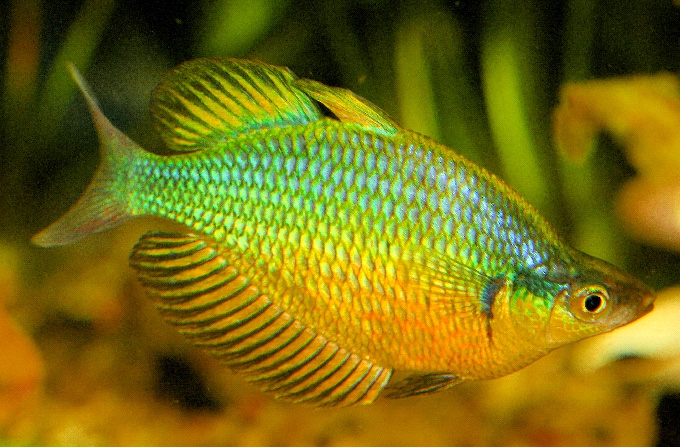
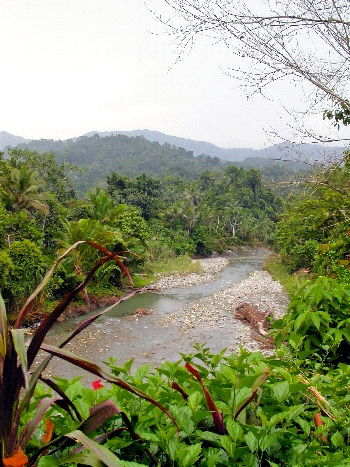
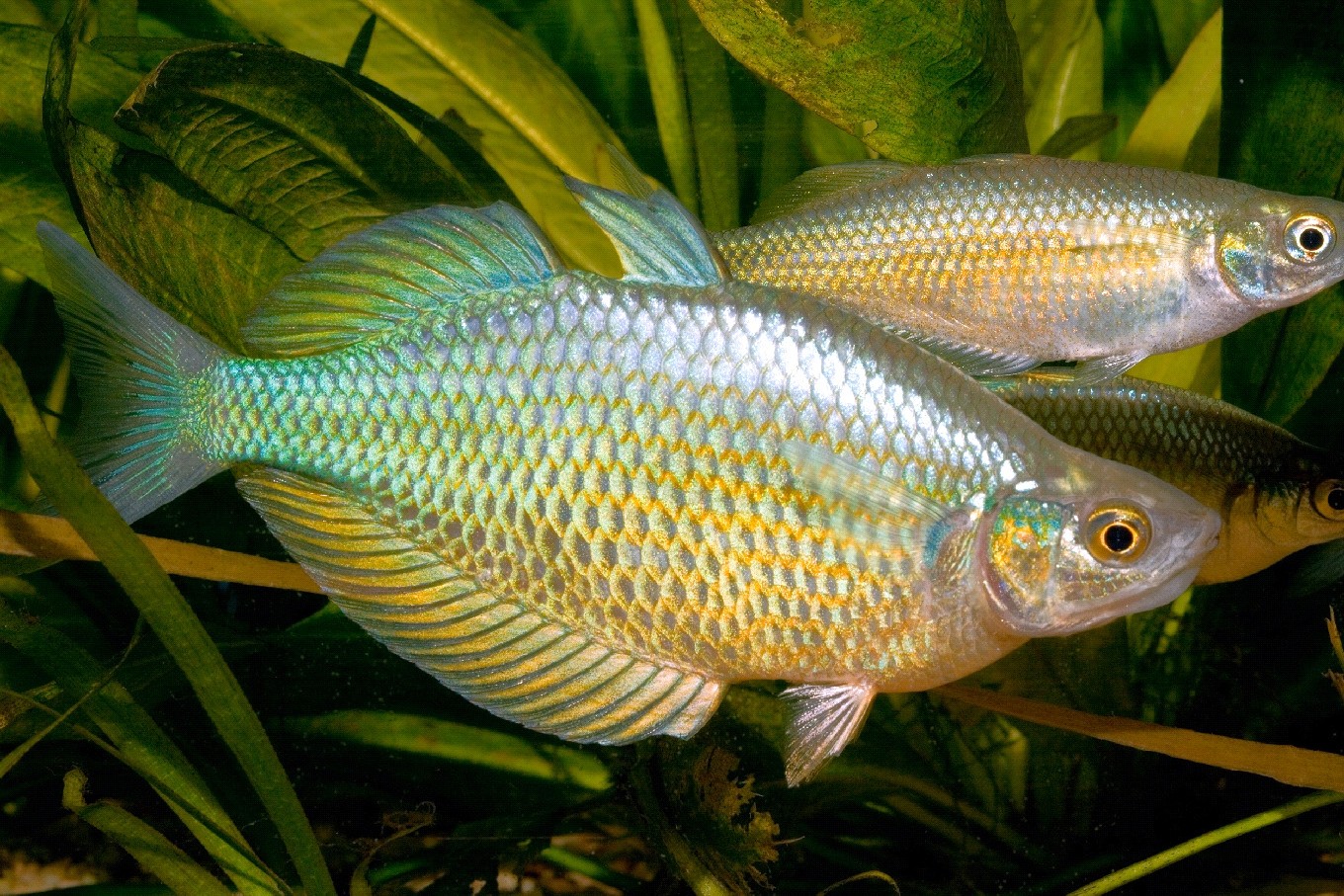
Glossolepis kabia have an overall body colouration of greenish or olive to silvery with a rosy glow across the sides. There is a series of narrow orange stripes between each scale row and the fins are usually clear or greenish but sometimes nearly black. They may reach a maximum size of 12 cm, but are usually less than 10 cm. Most fish collected have been within the range 610 cm. Adults become very deep bodied especially the males (6-8 cm), although this difference is not obvious in young adults less than about 6 cm SL. The orange stripes on the sides are brighter in mature males and their dorsal and anal fin membranes often have a silvery to yellow sheen. Named kabia, from kabi, the native name at Koragu.
The original description described their living colours as dusky silvery above, the lower half with alternate vertical stripes of golden orange or deep orange and silver or steely blue, with an orange band at the caudal base. The top of the snout and interorbital are black, the opercles and preopercles silvery with yellow or golden. The fins are more or less dusky in some, in others the membranes of the dorsal and anal are orange, wholly or only basally, the rays and outer part blackish.
Etymology
The species name comes from kabi, the native name for this rainbowfish at Koragu, New Guinea.
Etymology compiled from C. Scharpf (2021), “Fishes of Sahul: An Etymological Survey (Part 4), the Rainbowfishes”, Fishes of Sahul 35(1): 1706–1714, and etyfish.org.
Distribution & Habitat
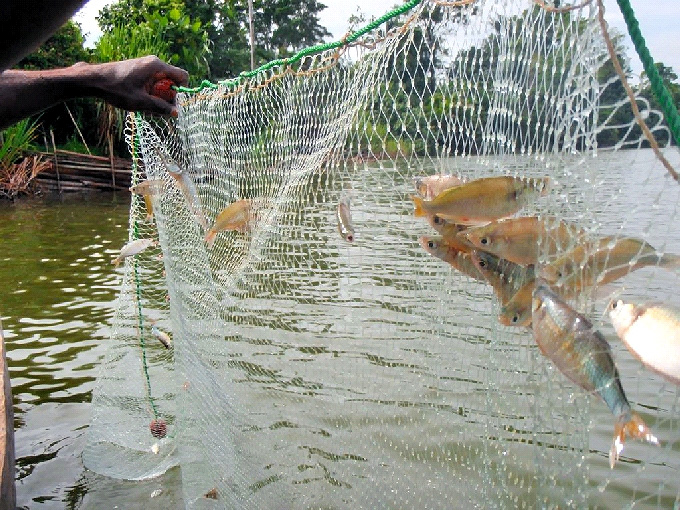
Glossolepis kabia is found in the Sepik and Ramu river systems in New Guinea. They are found in floodplains and swampy lagoons, lakes, and small tributary streams. It is the only rainbowfish that is abundant in the extensive floodplain regions of the Sepik River. They are usually found where there is an abundance of aquatic vegetation in moderate turbid to clear, still to slow-flowing water. Young fish form aggregations around submerged logs and branches or among reeds and other shoreline vegetation.
The Sepik River (formerly known as the Kaiserin Augusta River) is the second largest river in Papua New Guinea (PNG). The river is about 1100 kilometres long with a catchment area of approximately 80,000 km2. It is the largest river system in PNG in terms of catchment area, but has a lower discharge than the Fly River. Biologically, the region holds some of the most diverse and least described ecosystems on Earth, and is probably the largest uncontaminated freshwater wetland system in the Asia-Pacific region. There are no large mining projects, no industrial plants and no large timber extraction projects operating within the region and, compared to other areas of New Guinea, much of the area has a low rate of population growth.
The Sepik begins in the Victor Emanuel Range in the central highlands. It leaves the mountains abruptly near Yapsei on the border with West Papua where it becomes a strongly braided channel flowing in a north-westerly, then northerly direction. Turning east it follows the great Central Depression, receiving numerous tributaries draining from the Bewani and Torricelli
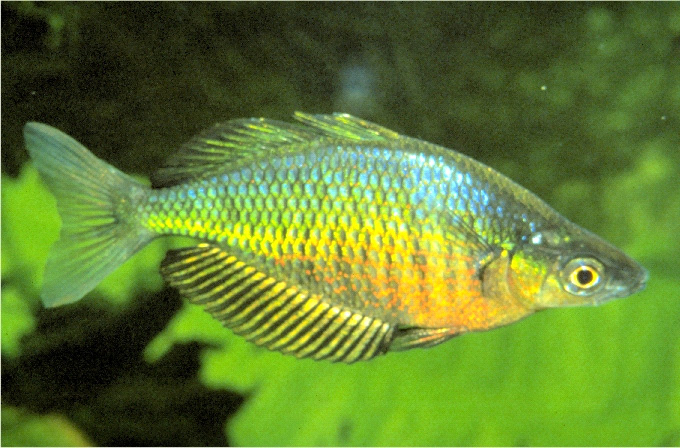
Mountains in the north and the Central Range in the south before entering the Bismarck Sea. For most of its lower course the river meanders through a wilderness of swamps and lagoons with large floating islands of vegetation.
The water temperature at lower elevations on the Sepik River usually remains within the range 27–29°C. It is thought that average temperatures in the Sepik tributaries stay relatively low at lower altitudes than in most equatorial regions. This is partly due to the unusual topography of the basin in which lowland swamps are surrounded on most sides by relatively steep mountains resulting in cooler water being transported rapidly into the lowlands. Secondly, the degree of riparian shade covering feeder streams and rivers is pronounced in the Sepik in comparison with many other regions which have lost much of their vegetative cover through human activity. Surface water temperature commonly varies between 28°C and 35°C, and the bottom waters between 24.8°C and 30°C. Conductivity levels in the Sepik are high (110–250 µS/cm) although this is most likely related to hardness and dissolved organic matter, rather than to nutrients. The Sepik water chemistry is dominated by calcium and bicarbonate ions. In the Middle Sepik water conditions were reported as conductivity 103–125 µS/cm and total hardness 45–56 mg CaCO3; slightly acidic pH and low alkalinity. Seasonal of the lakes have different water chemistry.
Formerly called the Ottilien River, the Ramu is one of the longest rivers in Papua New Guinea, rising in the southeast on the Kratke Range and flowing northwest through the great central depression, where it receives numerous streams draining the Bismarck (south) and Finisterre and Adelbert (north) ranges. For the last 100 km of its approximately 720-kilometre long course, it flows directly north. This swampy portion receives the river's principal tributary, the Sogeram River. The Ramu enters the Bismarck Sea just 32 km southeast of the mouth of the Sepik. The lower reaches of the Sepik and Ramu rivers are now inter-connected by numerous channels that pass through an area of low-lying alluvium. The freshwater ichthyofaunas of the Sepik and Ramu basins are very similar, although there is a modest degree of species endemicity in both regions.
Biology
Glossolepis kabia generally become sexually mature at about 6 cm (females) and 7 cm (males). Individuals with either ripe or spent gonads are rarely found below this size, which is relatively large compared with most rainbowfishes. Males and females in spawning condition have been found throughout the wet and dry seasons indicating that Glossolepis kabia breed all year round. However, fish in spawning condition was significantly lower in the dry season in both sexes which suggests a reduced reproductive rate at that time. The dry season is defined as May to October and the wet season as November to April.
The reproductive capacity of Glossolepis kabia is considered to be high compared with most other Sepik River fish species spawning in freshwater. Fecundity in Glossolepis kabia is perhaps twice that of equivalent sized, stream dwelling, Melanotaenia fluviatilis. One factor increasing fecundity in Glossolepis kabia is egg size which is much lower than reported for other rainbowfish species. Most rainbowfishes have egg diameters of greater than 1.0 mm and up to 2.0 mm. The eggs of Glossolepis kabia (0.69 ± 0.052 mm) are, therefore, between about 4% and 35% of the size of eggs from other species on a volume basis. Reduced egg size results in a much higher fecundity than occurs in stream dwelling rainbowfish species.
The diet of Glossolepis kabia appears similar to observations on other species of rainbowfish and the species exhibits little feeding specialisation within this group. A similar diet has been recorded for four other species of rainbowfishes which inhabit the Sepik River streams. This generalised feeding habit is also confirmed for several Australian rainbowfishes and one species from the Fly River in southern Papua New Guinea. They are carnivorous, feeding predominantly on a wide variety of small invertebrates taken mainly from mid-water or from the water surface. The percentage of insect larvae and insects from terrestrial sources increase slightly in the wet season, with reductions in the percentage of these and slight increases in the percentage of crustaceans, detritus and ‘other material’ in the dry season. Food intake increases during the wet season and decreases during the dry season.
Remarks
Glossolepis kabia was originally collected during the Crane Pacific Expedition in May, 1929. The Crane Pacific Expedition was sponsored by Cornelius Crane for the Field Museum in Chicago, USA. The expedition left Boston on November 16, 1928, in the yacht Illyria and spent January to May 1929 visiting a variety of countries and island groups in the Pacific region, including the Marquesas, Tahiti, Fiji, Vanuatu (then the New Hebrides), New Britain and New Guinea. Their longest stay was in northern Papua New Guinea, where they sailed up the Sepik River and stopped at several villages and mission stations, then continued on up the May River, visiting two or three more villages. On their return, they look a short detour to the Keram River then revisited a few settlements on the Sepik. Very few fish were obtained but many of those collected were new. Among the fish collected were some rainbowfishes, later described by Albert W. Herre as Melanotaenia kabia, M. rosacea, and Rhombosoma sepikensis. The type specimens of Glossolepis kabia were collected from the Sepik River at Nyaurangai, about 300 kilometres from the sea. Additional specimens were also collected at Koragu and the Kerame River.
In 1979, Gerald Allen collected a number of live rainbowfishes while collecting in the Sepik-Ramu River region, and brought them back to Australia where they were subsequently bred and distributed in the hobby. He later identified them as Glossolepis multisquamatus. Heiko Bleher also collected live specimens from the same area and another collection near the Ramu River and took them back to Europe. However, it is thought that none of these fish still remain in captivity.
In 1992, Heiko Bleher collected a number of Glossolepis specimens from the Mamberamo River area in West Papua. It was unclear whether these specimens represented an undescribed species or perhaps just a colour variation of G. multisquamata.
Heiko Bleher had collected this form a couple of times and reported that in his opinion they are quite different from the Sepik/Ramu form. However, the specimens collected from the Mamberamo River are the true G. multisquamata.
The Mamberamo River specimens are quite different, but the most obvious difference is they have quite large anal fins, which are reminiscent of G. wanamensis. They also have a really bright red eye too which seems somewhat unique in rainbows (P. J. Unmack 2009, pers. comm.). These species were bred and distributed in Australia under the common name of “Red-eyed Tiger Rainbowfish”. In Europe, they were generally known as Glossolepis sp. (Mamberamo). The fish from the Mamberamo River system are G. multisquamata while those from the Sepik-Ramu River system are considered as G. kabia.
Additional live specimens of G. Kabia were collected by Kent Webster in 2002 from Paro Village in the middle Sepik River region and introduced to the aquarium hobby.
References
- Allen G.R. (1980) A Generic Classification of the Rainbowfishes (Family Melanotaeniidae). Records of the Western Australian Museum 8 (3): 449-490.
- Allen G.R. & D. Coates (1990) An ichthyological survey of the Sepik River, Papua New Guinea. Records of the Western Australia Museum Supplement 34: 31-116.
- Allen G.R. (1991) Field guide to the freshwater fishes of New Guinea. Christensen Research Institute, Madang, Papua New Guinea.
- Allen G.R. & S.J. Renyaan (1998) Three new species of rainbowfishes (Melanotaeniidae) from Irian Jaya, Indonesia. aqua 3(2):69-80.
- Coates D. (1990) Biology of the rainbowfish, Glossolepis multisquamatus (Melanotaeniidae), from the Sepik river floodplains, Papua New Guinea. Environmental Biology of Fishes 29(2):119-126.
- Coates D. (1993) Fish ecology and management of the Sepik-Ramu, New Guinea, a large contemporary tropical river basin. Environmental Biology of Fishes 38(4):345-368.
- Graf J. & H.L. Ohee (2009) Glossolepis from Northern New Guinea. Fishes of Sahul 23(2): 502-512.
- Herre A.W. (1935) New fishes obtained by the Crane Pacific Expedition. Field Museum of Natural History, Zoological Series, 18(12): 383-438.
- Herre A.W. (1936) Fishes of the Crane Pacific Expedition. Field Museum of Natural History, Zoological Series, 21: 1-472.
- Kailola P.J. (1987) The fishes of Papua New Guinea. Research Bulletin No. 41. Dept of Fisheries and Marine Resources, Port Moresby PNG.
- Weber M. & L.F. de Beaufort (1922) The Fishes of the Indo-Australian Archipelago. IV. E. J. Brill, Leiden, 4: 1-410.