

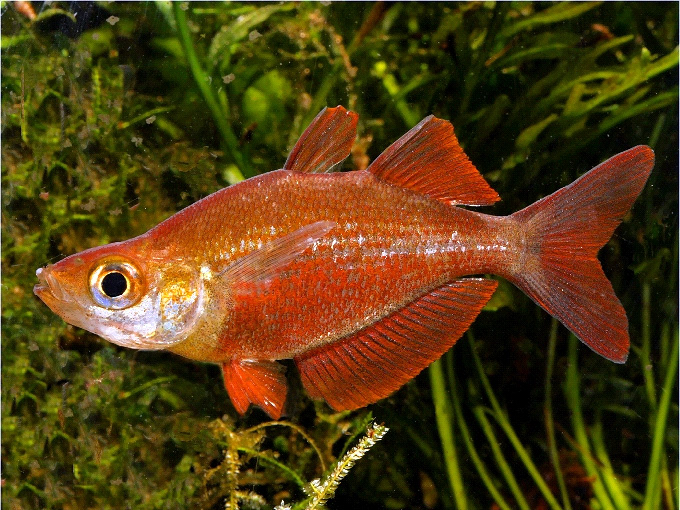
Glossolepis pseudoincisus
Tami River Rainbowfish
Species Summary
From October 1954 through to May 1955 Marinus Boeseman took part in a collecting expedition for the Rijksmuseum van Natuurlijke Historie to Netherlands New Guinea (West Papua). His task was to provide a thorough knowledge of the fish fauna by intensively surveying as many rivers and lakes as was possible. This task was taken to heart and in a relatively short period many localities were visited, resulting in a rich collection for the museum in Leiden. Among the places he visited was Lake Sentani, Tami River, Biak Island, Lake Jamoer (Yamur), Wissel Lakes, Ajamaroe (Ayamaru) Lakes, Lake Aytinjo, Merauke and the Digul River. This collection included many rainbowfishes, but a thorough study of this material or descriptions of any new species was never made by Boeseman.
As part of his preparation for the revision of the rainbowfish family, Gerald Allen studied the Boeseman collection of 1954– 55 during 1975 and 1977. He discovered no less than four new rainbowfish species, which he described in 1980 together with Norbert Cross. These species were Melanotaenia boesemani, M. ajamaruensis, M. japenensis and Glossolepis pseudoincisus.
Glossolepis pseudoincisus is most closely related to G. incisus. They differ from the other members of the genus by possessing more gill rakers on the first arch (26–32 vs. 19–23) and by having more pronounced crenulations on the scale margins. These species differ from one another on the basis of the characters presented in Fig. 1.
Etymology
The species name combines the Greek pseudo, false, with the name of its close relative G. incisa: although this species resembles G. incisa, and lives in close proximity to it, such an appearance is false.
Etymology compiled from C. Scharpf (2021), “Fishes of Sahul: An Etymological Survey (Part 4), the Rainbowfishes”, Fishes of Sahul 35(1): 1706–1714, and etyfish.org.
Distribution & Habitat
Specimens of G. pseudoincisus were collected by Boeseman in November, 1954 in an ox-bow lake of the Tami River, about 30 kilometres to the east of Lake Sentani. They are also known from Lake Ifaten, Lake Iwom and Lake Yaniruk. The species was named ‘pseudoincisus’ with references to its similar appearance and geographic proximity to G. incisus.
Remarks
Gerald Allen and Heiko Bleher went looking for this species in 1982, but were not able to find it. However, in January 2001, Heiko collected some Glossolepis species from Lake Ifaten, an isolated crater lake situated in the mountains near Lake Sentani in West Papua. Lake Ifaten is about 300 metres above sea level. The lake has a diameter of around 250 metres. Water temperature 28°C, pH 9.0.
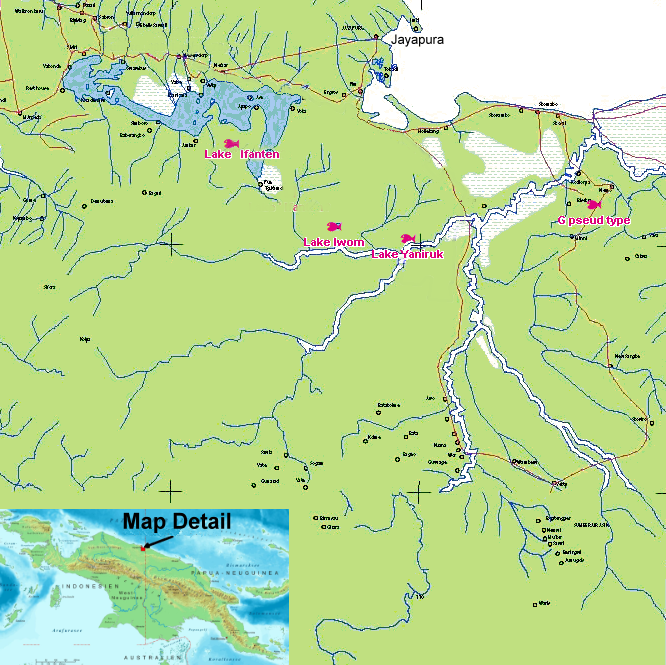
Fig. 1
| Character | G. pseudoincisus | G. incisus |
|---|---|---|
| Horizontal scale rows | 12–16 | 16–20 |
| Vertical scale rows | 38–43 | 50–60 |
| Predorsal scales | 27–34 (x = 31, N = 39) | 30–36 (x = 36, N = 13) |
| Preopercle scales | 21–29 (x = 25, N = 39) | 26–38 (x = 31, N = 13) |
| Predorsal-Preanal distance | Predorsal > Preanal | Predorsal < Preanal |
| Pectoral fin colour | uniformly pale | outer portion dusky brown |
| Pelvic fin colour | mainly pale | mainly dusky brown |
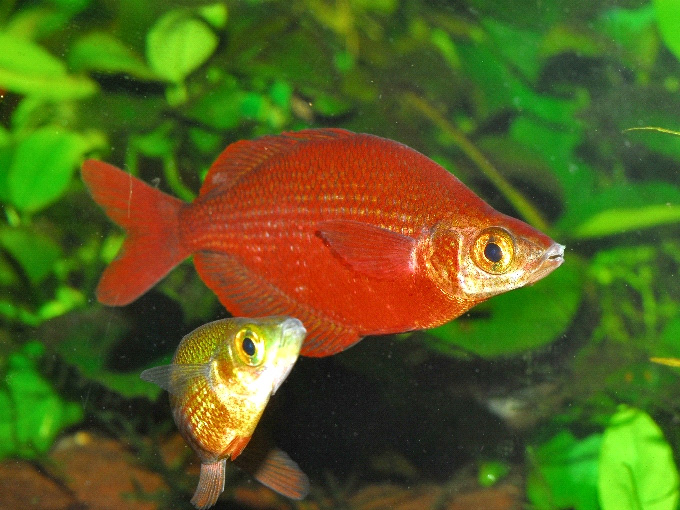
Only five specimens (4 males/1 female) survived the long journey back to Europe. The fish look similar to G. incisus, but the scales are different (they’re smaller and differently aligned).
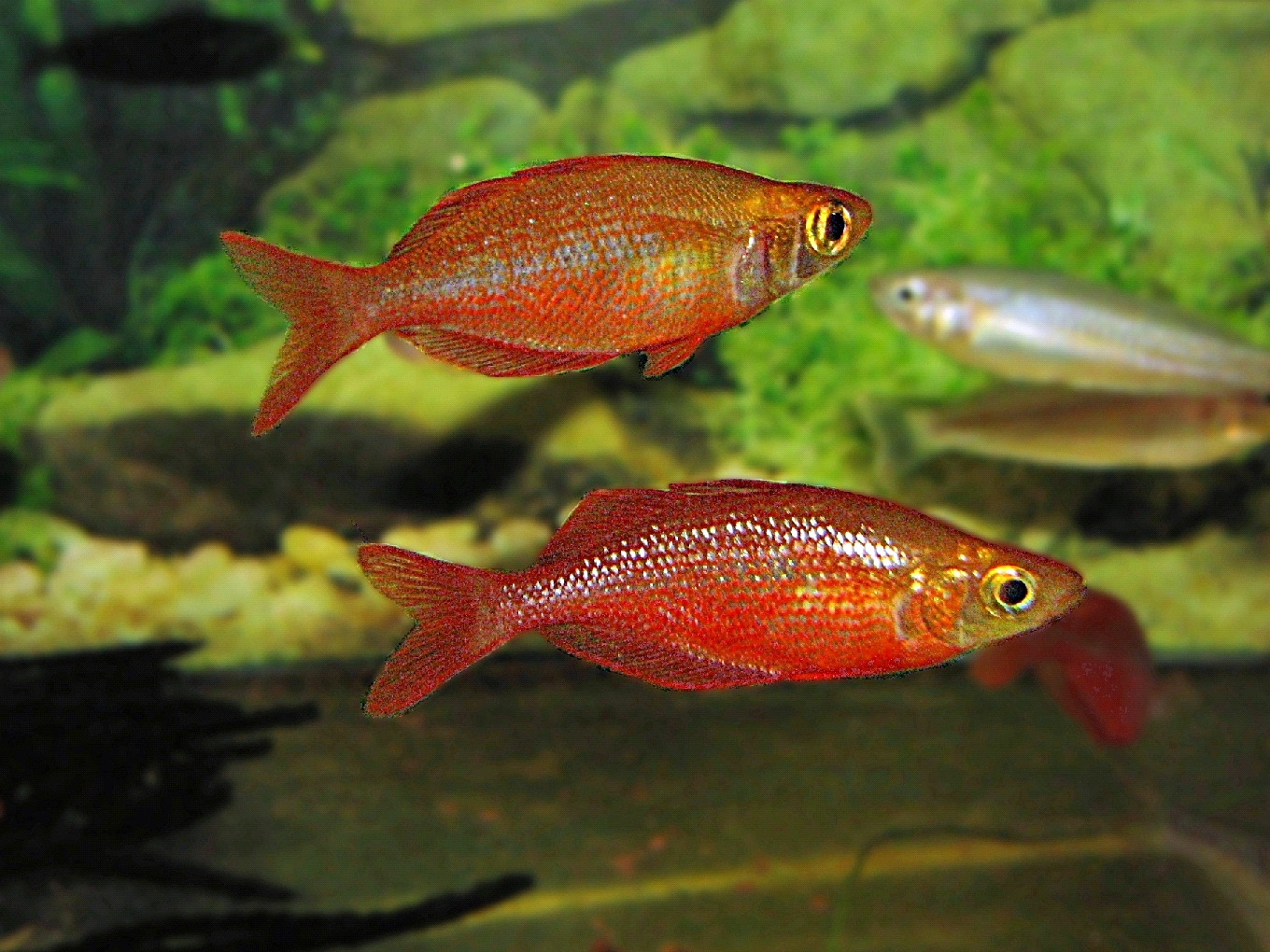
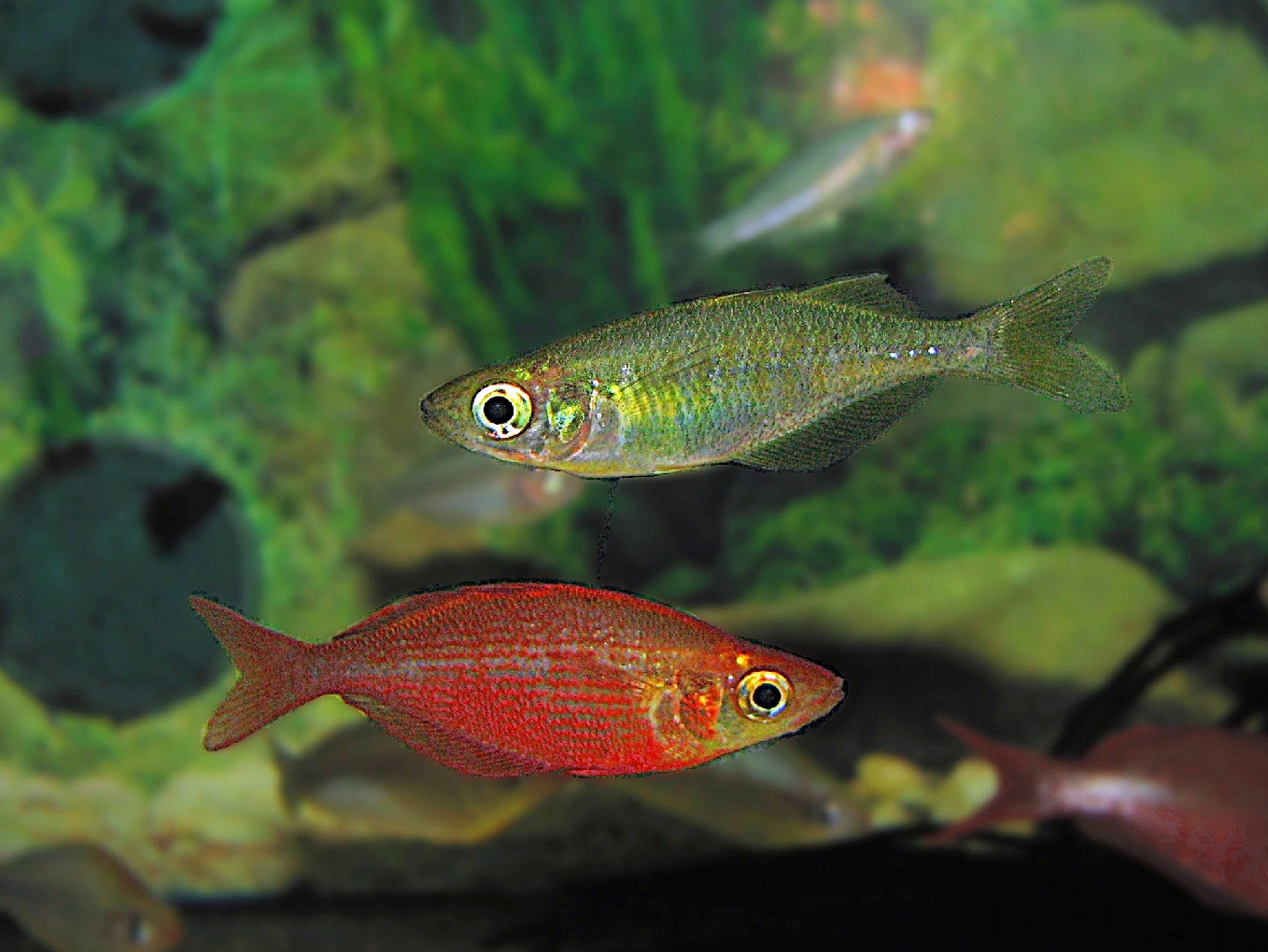
The Lake Ifaten rainbowfish is not as big as G. incisus; the body shape is more compact; the red coloration is more intense and the fin marking and shape is more pronounced. Also the Lake Ifaten rainbowfish shows colour after three month of age (G. incisus needs nearly a year before they show proper colours). At the age of four months and with a body size of hardly more than 4 cm, they showed the full colour (H. Bleher, pers. comm.).
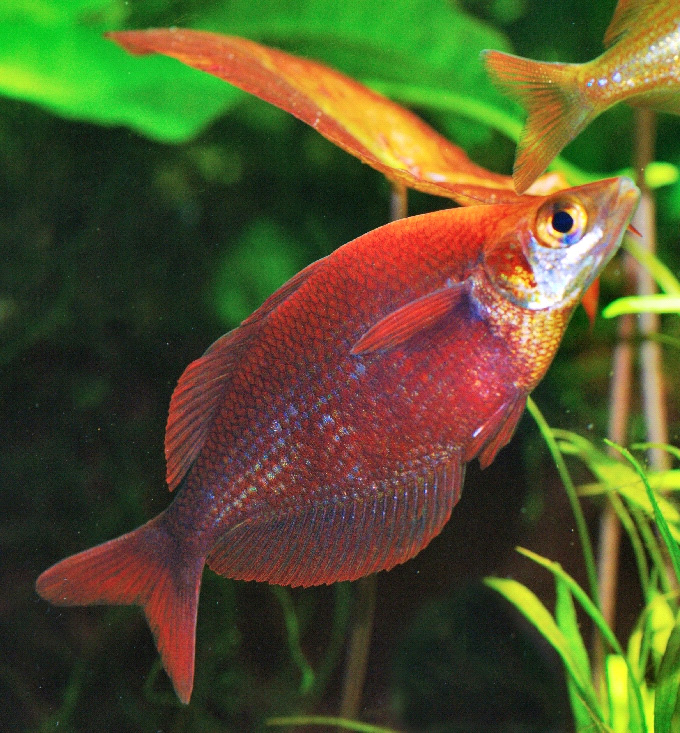
The Lake Ifaten Rainbowfish has a very typical Glossolepis head. Very prominent at an age of one year, are the marks on the gill plate. A unique pattern of red lines that - so it appears - are drifting criss-cross. The females of the Lake Ifaten Rainbowfish are differently coloured. They have strong horizontal zigzagging yellow stripe colouration across the whole body. They also remain small - up to 6 cm total length.
References
- Allen G.R. & N.J. Cross (1980) Descriptions of five new rainbowfishes (Melanotaeniidae) from New Guinea. Records of the Western Australian Museum 8 (3): 377-396.
- Boeseman M. (1956) The Lake Resources of Netherlands New Guinea. South Pacific Commission Quarterly Bulletin 6(1): 23-25.