
Melanotaenia vanheurni
Van Heurn’s Rainbowfish
Synonymy
- Rhombatractus vanheurni Weber & de Beaufort, 1922
- Melanotaenia vanheurni Allen, 1980
Species Summary
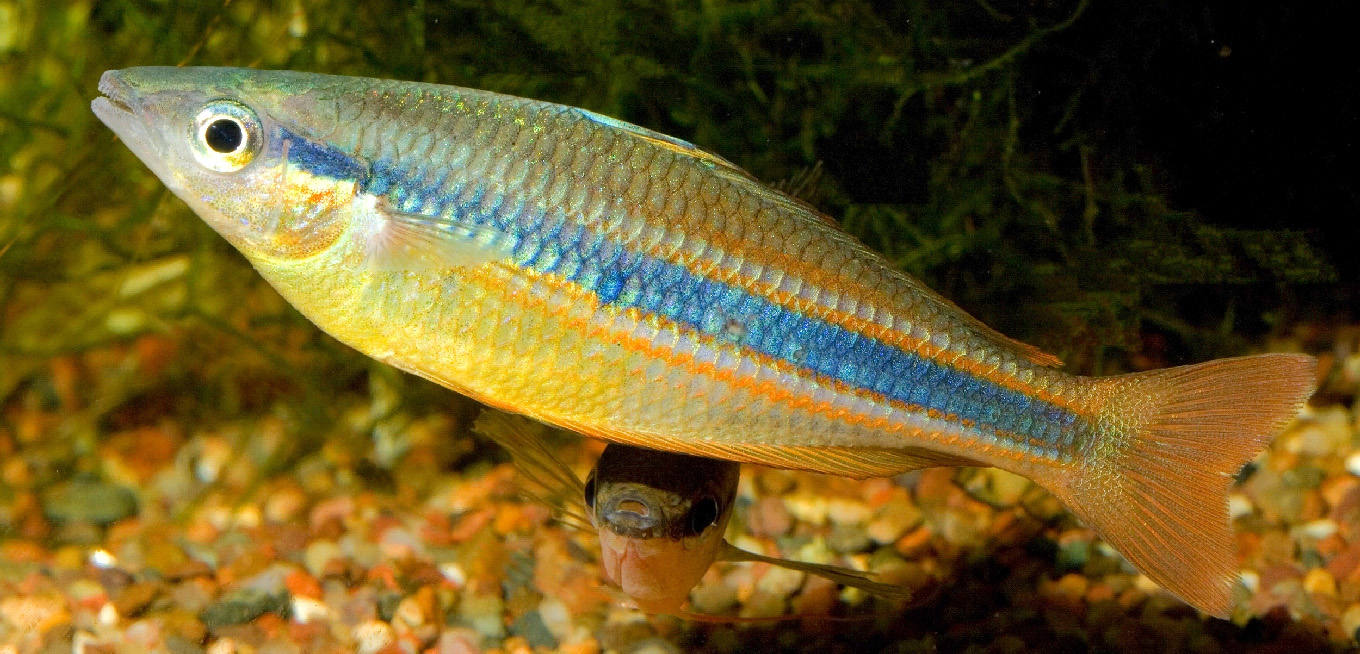
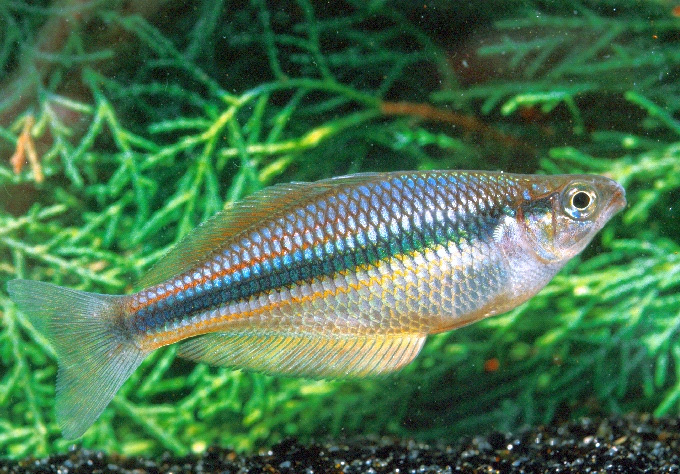
Melanotaenia vanheurni are brown or olive on the back and yellow on the lower sides. There is a prominent blue-black, midlateral band with a broad pale yellow to white line along its upper and lower margin. Spawning males display a pulsing glow of golden yellow on top of the head. They may reach a maximum size of 16 cm, but usually less than 12 cm. It is the largest member of the rainbowfish family.
Etymology
The species is named in honour of Willem Cornelis van Heurn (1887–1972), the “indefatigable” zoologist of the Dutch New Guinea Expedition (1920–1921), during which the holotype was collected.
Etymology compiled from C. Scharpf (2023), “Fishes of Sahul: An Etymological Survey (Part 6), the rainbowfishes (continued)”, Fishes of Sahul 37(1): 2006–2022, and etyfish.org.
Remarks
Melanotaenia vanheurni were first collected in the Mamberamo Valley by W. C. van Heurn in 1920 during the Dutch Northern New Guinea Expedition (Mamberamo Expedition) of 1920–1921. It was not seen again until David Price collected it 70 years later.
Live specimens were reportedly imported into Germany during 1992 by Heiko Bleher. However, the status of this population in the hobby today is uncertain. Further live specimens were collected in 2008 near Faowi (Fauwi) Village, located at the upper reaches of the Tariku River. The Tariku River flows from Sudirman Mountains in the west to the east and combines with Taritatu River in the middle of Mamberamo River Catchment. In 2010 additional live specimens were collected near Gidomen Village.
Distribution & Habitat
Plains.
and 7.1–7.5.
References
- Allen G.R. (1991) Field guide to the freshwater fishes of New Guinea. Christensen Research Institute, Madang, Papua New Guinea.
- Allen G.R. (1995) Rainbowfishes in Nature and in the Aquarium. (Tetra-Verlag: Germany).
- Weber M. and L.F. de Beaufort (1922) The fishes of the Indo-Australian Archipelago. IV. Heteromi, Solenichthyes, Synentognathi, Percesoces, Labyrinthici, Microcyprini. E.J. Brill, Ltd. Leiden.