
Melanotaenia senckenbergianus
Senckenberg Rainbowfish
Species Summary
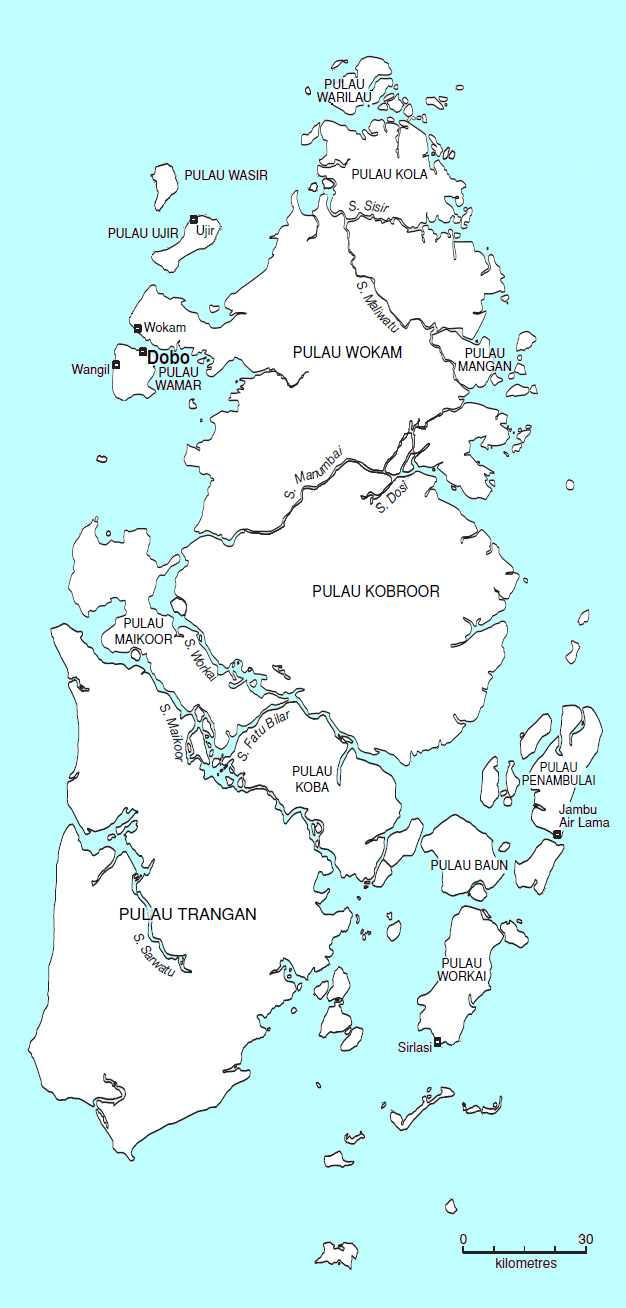
The Aru Archipelago, a cluster of islands on the shallow continental shelf between New Guinea and northern Australia, was largely overlooked by ichthyologists for a century after Dutch collectors first sampled its rivers in 1907–09. Aquarium enthusiast Heiko Bleher brought Aru rainbowfishes to hobbyist attention after visits in 2004 and 2007, and two expeditions in 2013 (organised by Gerald Allen, Mark Erdmann and colleagues, with genetic work by Peter Unmack) revealed the islands to be an unexpected hotspot of rainbowfish speciation: seven species in all, most found nowhere else. Melanotaenia senckenbergianus was the second of two rainbowfishes collected on the Aru Islands by Dutch naturalists in the early 1900s and described by Max Weber in 1911, but like M. patoti it was subsequently dismissed as a synonym — in this case of the New Guinea mainland species M. goldiei. The 2015 revision confirmed it as a distinct, valid species restricted to the Aru Islands.
Etymology
The species name is a suffix meaning belonging to; the allusion was not explained by Weber, but presumably refers to the Senckenberg Natural History Society of Frankfurt, Germany, in whose journal the description was published.
Etymology compiled from C. Scharpf (2022), “Fishes of Sahul: An Etymological Survey (Part 5), the rainbowfishes (continued)”, Fishes of Sahul 36(4): 1968–1992, and etyfish.org.
Distribution & Habitat
Melanotaenia senckenbergianus is the most widespread rainbowfish on the Aru Islands, occurring in nearly every freshwater stream sampled on Trangan and southern Kobroor, the two largest islands of the main group. It lives in creeks and small rivers through primary and secondary forest, gardens, and tree-lined savannah, often alongside M. albimarginata, M. aruensis or M. patoti.
Description & Comparison with Similar Species
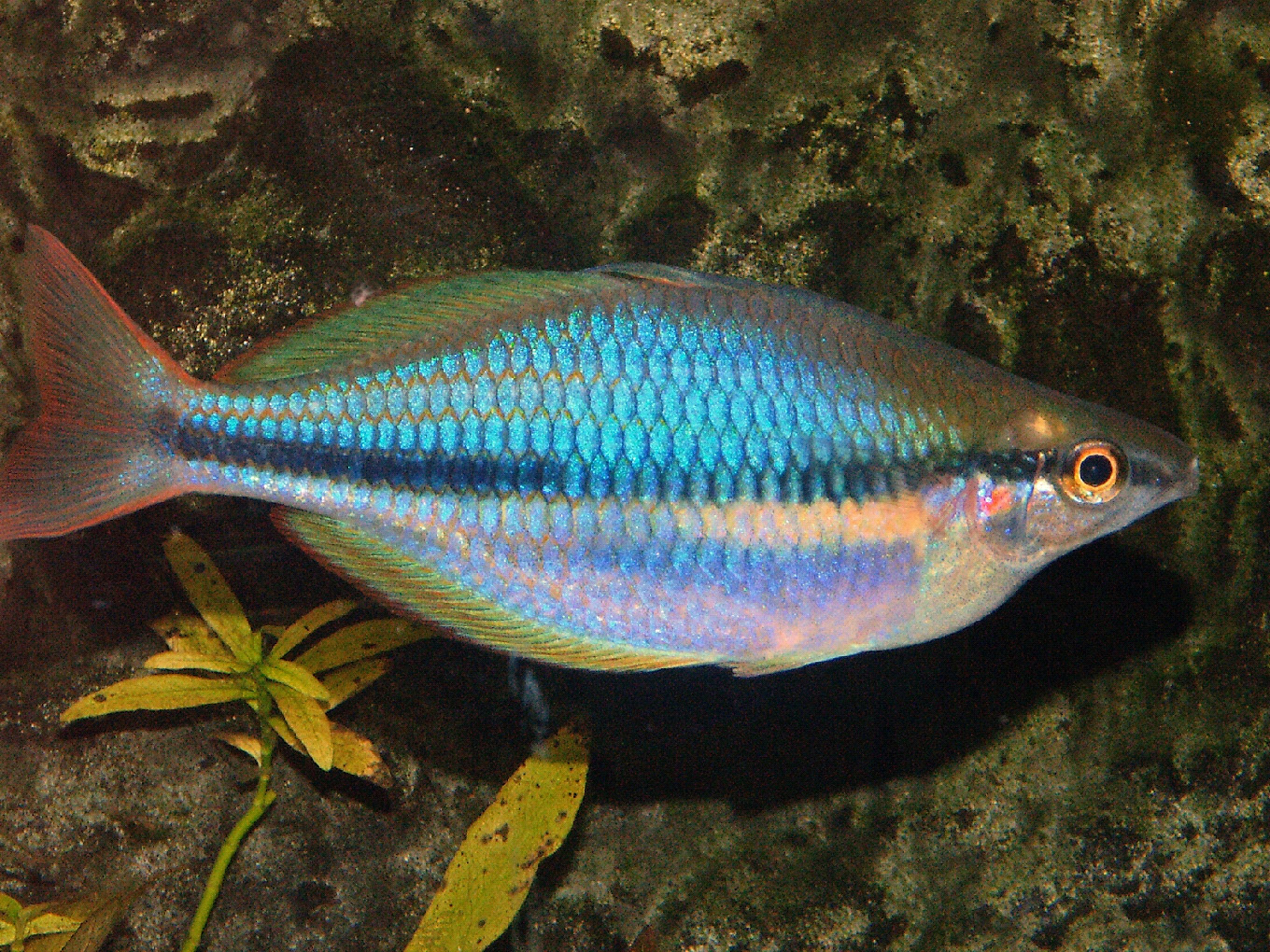
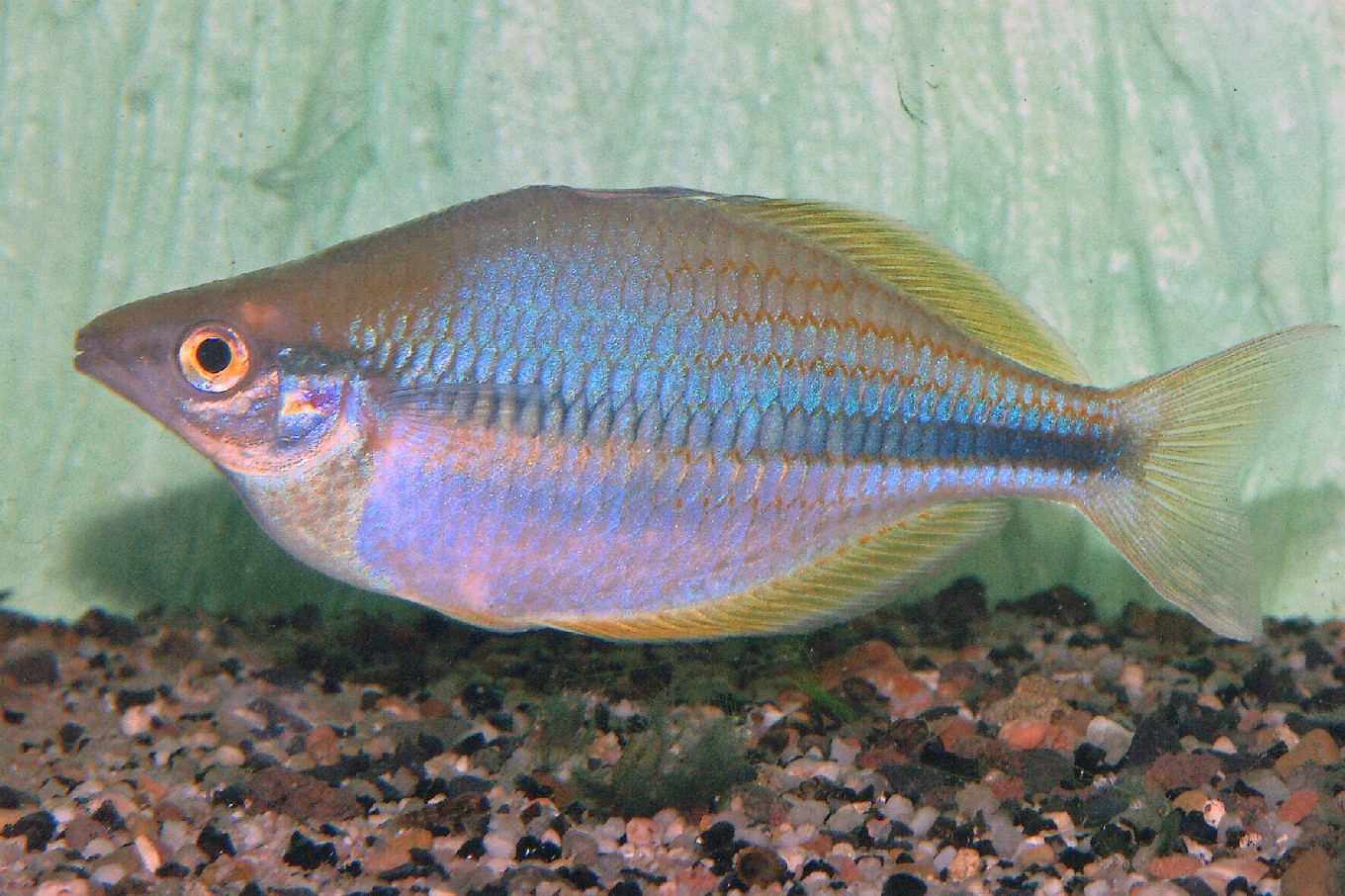
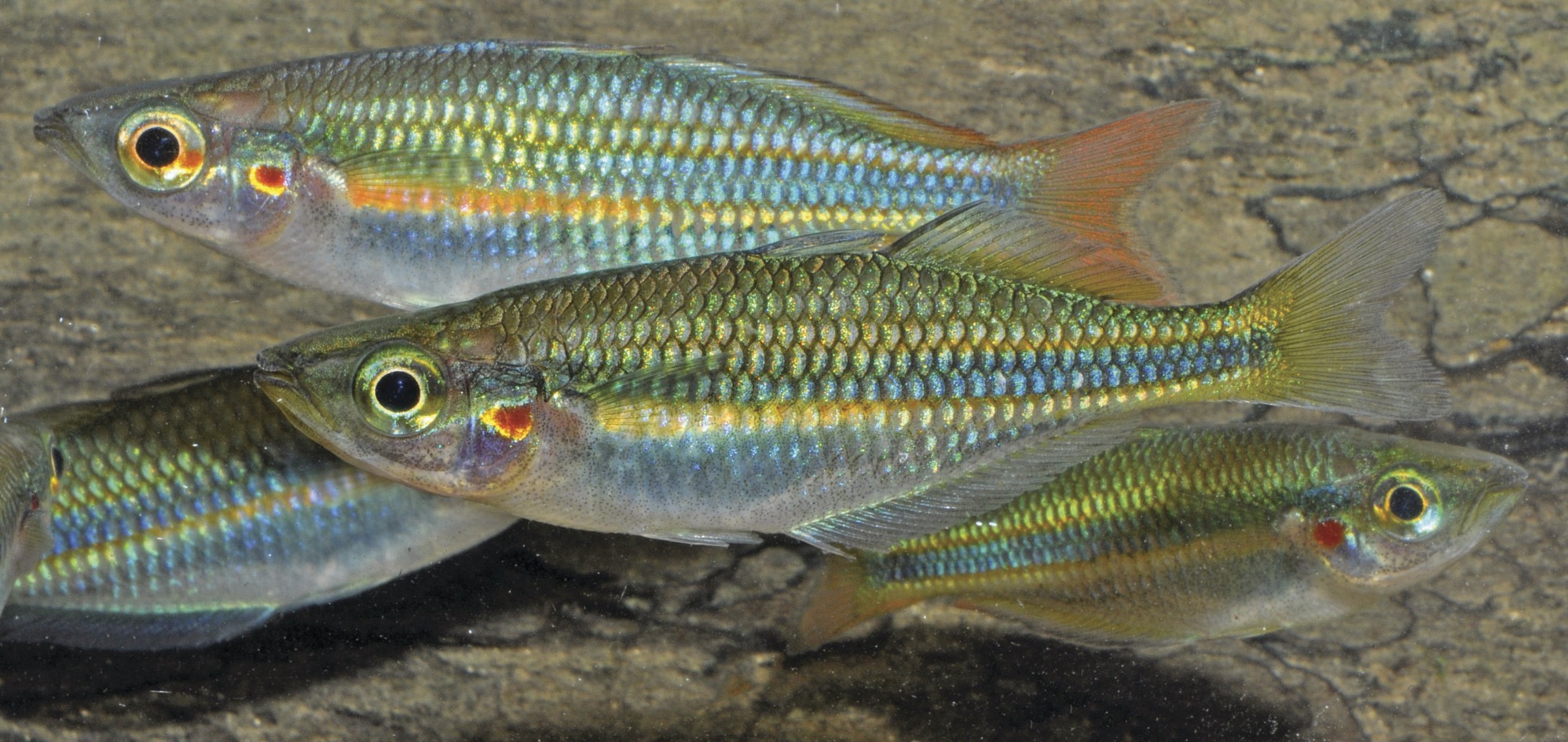
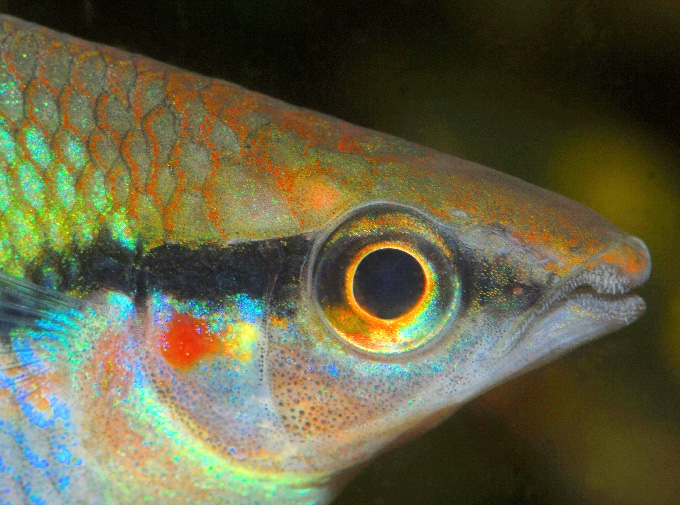
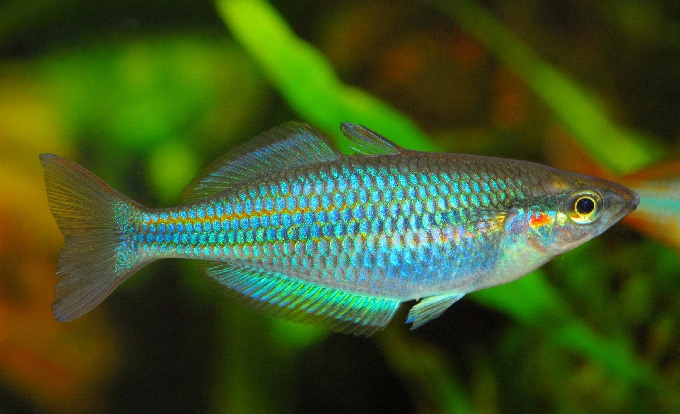
Live fish are greenish brown above, shading to silvery white or pale yellow below, with a dark blue mid-lateral stripe (often faint or broken at mid-body) and a red spot, smaller than the pupil, on the operculum. Together with M. kolaensis, M. picta and M. wokamensis it forms the Aru ‘Goldiei’ group, all four sharing a broadly similar bluish pattern with narrow red-orange stripes and a dark mid-line, best told apart by colour intensity, stripe width and body depth rather than any single diagnostic measurement — adult males of Melanotaenia senckenbergianus run moderately deep-bodied (around 31% SL) but never reach the extremes of M. kolaensis (deepest of the group) or the slenderness of M. picta.
Account compiled for Home of the Rainbowfish from G. R. Allen, R. K. Hadiaty, P. J. Unmack & M. V. Erdmann (2015), “Rainbowfishes of the Aru Islands, Indonesia with descriptions of five new species and redescription of M. patoti Weber and M. senckenbergianus Weber”, aqua, International Journal of Ichthyology, 21(2): 71–106.
References
- Allen G.R., R.K. Hadiaty, P.J. Unmack and M.V. Erdmann (2015) Rainbowfishes (Melanotaenia: Melanotaeniidae) of the Aru Islands, Indonesia with descriptions of five new species and redescription of M. patoti Weber and M. senckenbergianus Weber. aqua, International Journal of Ichthyology 21(2): 66-108.
- Weber M. (1911) Die Fische der Aru- und Kei-Inseln. Ein Beitrag zur Zoolographie dieser Inseln. Abhandlungen der Senckenbergischen Naturforschenden Gesellschaft Frankfurt-a.-M. 34(1): 1-49.