

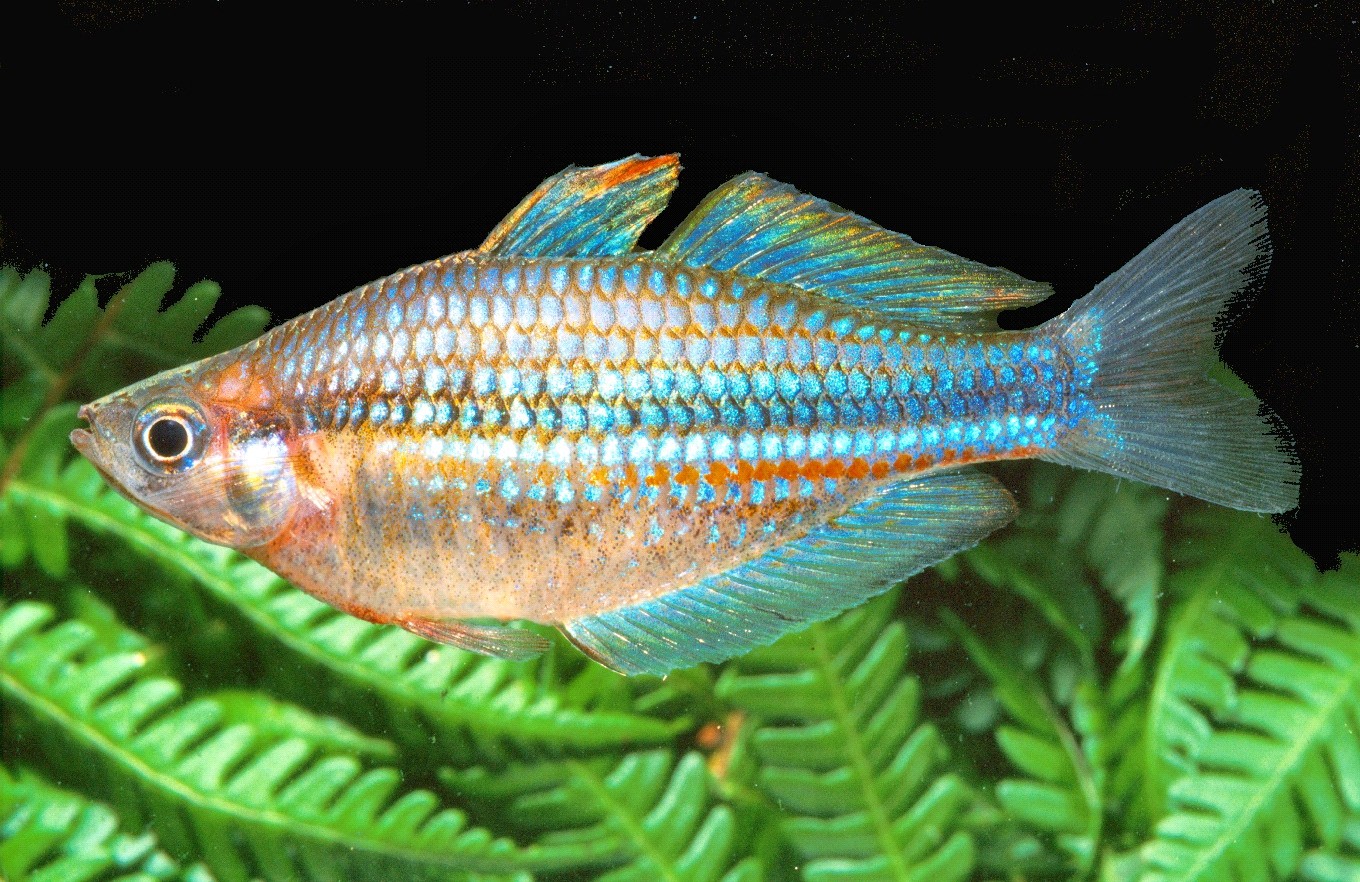
Melanotaenia caerulea
Blue Rainbowfish
Species Summary
Melanotaenia caerulea have a body colour of bright iridescent blue on the sides and back, becoming whitish or pinkish ventrally. There is a faint dark blue midlateral band on the posterior half of body, about one scale row wide. Each horizontal scale row on blue portion of body is separated by narrow pinkish-orange stripe. There is a short brown stripe about pupil width from the rear of the eye to the area just above the pectoral fin, frequently continuing as a pair of narrow brown stripes on the upper and lower edge of the midlateral band, and linking posteriorly with the dark blue midlateral band mentioned above. Fins are bluish to translucent, anterior edge of first dorsal fin and outer portions of second dorsal and anal fins sometimes reddish or dusky blackish in males. Pelvis fins mainly grey to reddish, but sometimes slightly dusky grey to reddish. Pectoral fins translucent. Males may reach a maximum size of 8 cm, but females are usually less than 6 cm. Males are generally deeper bodied and have more elongated, somewhat pointed shape posteriorly on the soft dorsal and anal fin rays. Females have smaller rounded dorsal and anal fins.
Etymology
The species name caerulea is Latin for blue, referring to the iridescent blue on the sides and back of living specimens.
Etymology compiled from C. Scharpf (2022), “Fishes of Sahul: An Etymological Survey (Part 5), the rainbowfishes (continued)”, Fishes of Sahul 36(4): 1968–1992, and etyfish.org.
Distribution & Habitat
Melanotaenia caerulea was collected in Papua New Guinea at several sites in the lower and middle Kikori drainage system, spanning a distance of approximately 125 km. They inhabit small tributary streams flowing through rainforest, except at one location where it was collected in a small tidal creek-fed pond in open sunlight. The Kikori River rises in the central mountains of southwestern Papua New Guinea and flows southward for nearly 250 km before forming a major delta at the head of the Gulf of Papua. The river mouth is situated about 340 km northwest of Port Moresby, and approximately 140 km northeast of the Fly River entrance.
The water quality of the mainstream rivers of the TagariHegigio and Lake Kutubu-Digimu-Mubi sub-basins are typical of other mainstream rivers in Papua New Guinea that are near neutral to mildly alkaline (pH 7.4–8.2) and calciumbicarbonate dominated. Water hardness in all rivers except the Ai'io River (31 mg/L CaCO3) is moderate (60–119 mg/L CaCO3) to hard (120–179 mg/L CaCO3). Conductivity values are generally similar in all streams, with median values ranging between 167 and 267 µS/cm.
Remarks
Two significant meristic differences were noted between the downstream (Kopi) and upstream (Kantobo) populations. Fish from the Kantobo area most frequently have 6 spines in the first dorsal fin and 11 pectoral rays, compared with 5 spines and 2 pectoral rays for Kopi fish. Genetic exchange between the areas does not seem likely due to a series of large, spectacular waterfalls and rapids immediately downstream from Kantobo. The river loses approximately 350 m of elevation over a distance of 6–7 km.
Melanotaenia caerulea was named caerulea (Latin: blue) with reference to the characteristic colour pattern. This species is not currently available in the aquarium hobby.
References
- Allen G.R. (1996) Two new species of rainbowfishes (Melanotaenia: Melanotaeniidae), from the Kikori River system, Papua New Guinea. Revue française d'Aquariologie. 23(1-2): 9-16.