

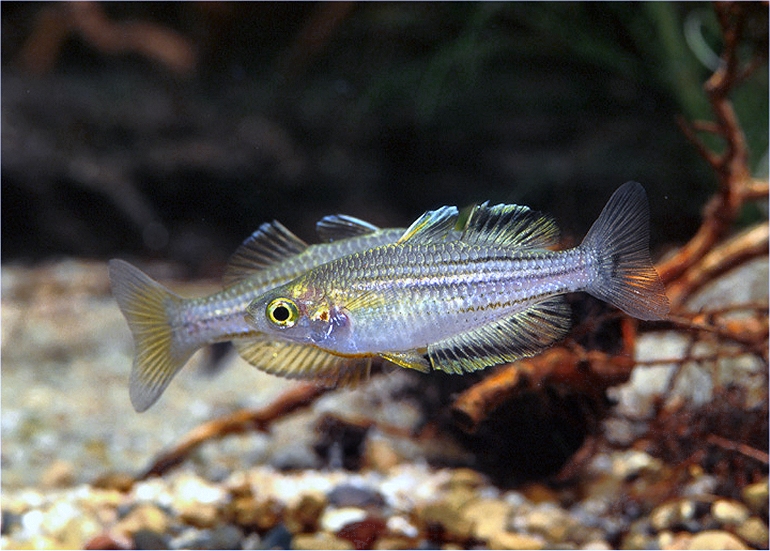
Melanotaenia wilsoni
Little Rainbowfish
Species Summary
Melanotaenia wilsoni, the Little Rainbowfish, is the smallest known species of rainbowfish, the second of two new species split in 2019 from the broadly defined M. maccullochi. It is confined to a tiny area below the sandstone escarpment of the Tabletop Range, in and around Litchfield National Park, Northern Territory — over 1,000 km from the nearest relative in Queensland. The population was discovered by David Wilson in Burton Creek in 1988.
Etymology
The species is named in honour of David Wilson, the first person to document the presence of this small, isolated population in the Northern Territory, and who has worked tirelessly and generously to promote the sustainable use and conservation of native aquatic animals, especially rainbowfishes.
Etymology compiled from C. Scharpf (2022), “Fishes of Sahul: An Etymological Survey (Part 5), the rainbowfishes (continued)”, Fishes of Sahul 36(4): 1968–1992, and etyfish.org.
Distribution & Habitat
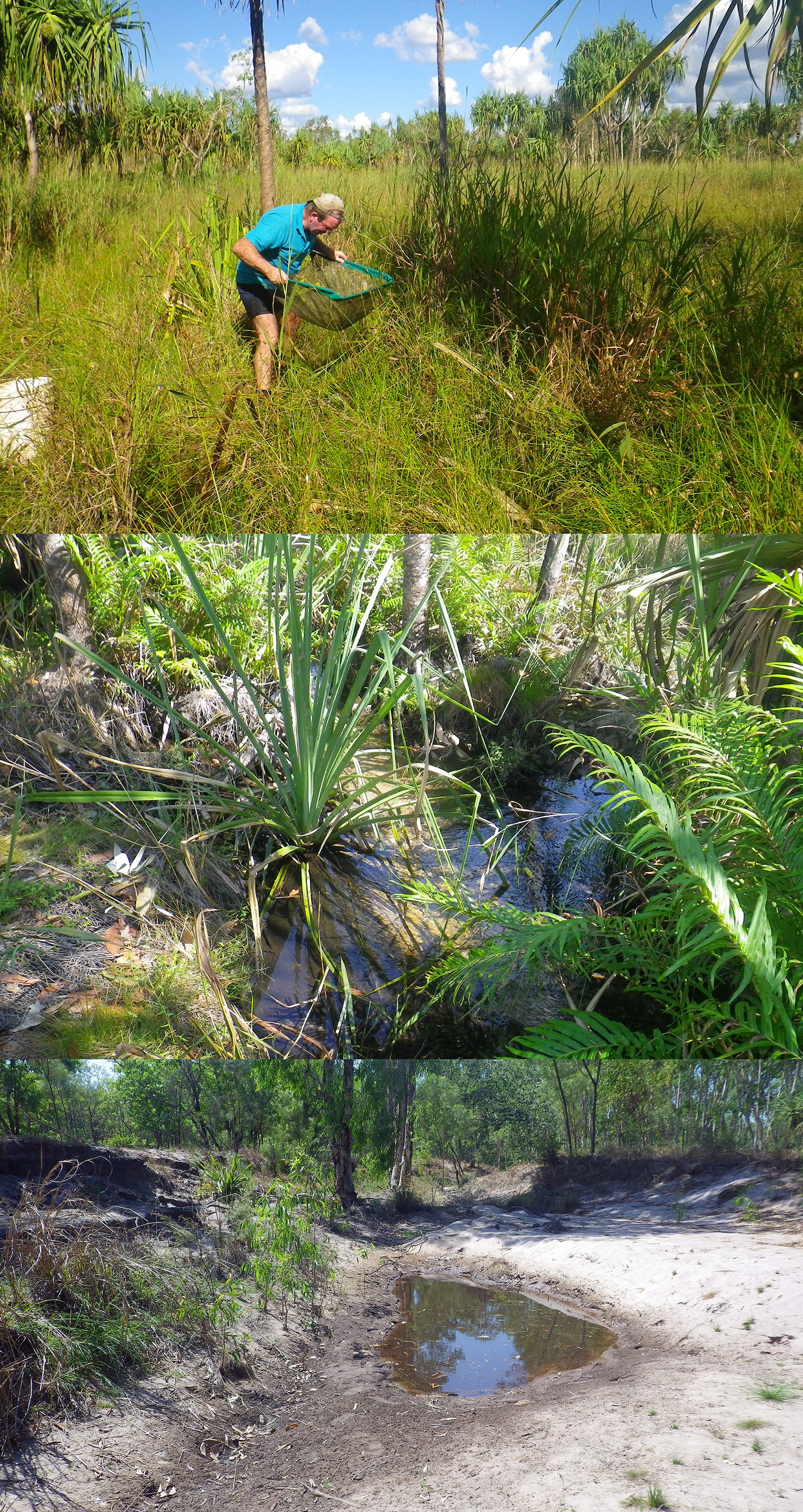
Melanotaenia wilsoni is known only from three small streams draining west off the Tabletop Range — Burton Creek in the Finniss River system, and Tolmer and Sandy creeks in the Reynolds River system — an extent of occurrence of only about 26 km². It lives in shallow (under 50 cm) Pandanus-lined, spring-fed sandy creeks with strong lateral connection to dense peat swamp and side-channel habitat that can dry back seasonally to isolated refuge pools. Typical water quality is soft and only mildly acidic (pH about 6–6.5), 23–24 °C. It co-occurs with Melanotaenia nigrans and other swamp-dwelling species including Pseudomugil gertrudae.
Description
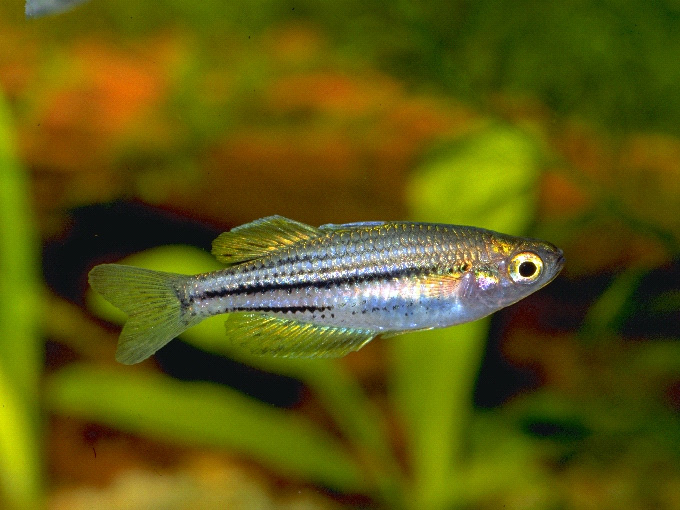
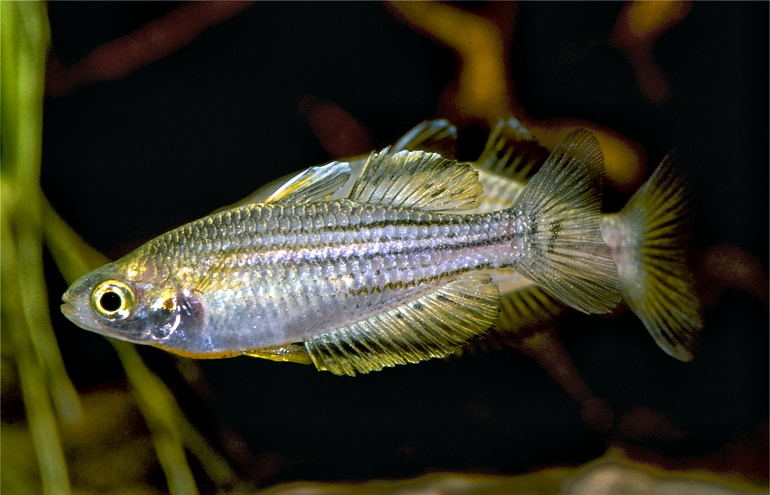
The smallest rainbowfish species known, wild fish reaching only about 33 mm SL (to about 40 mm SL in captivity). Body pale brown to whitish, with a prominent, dark purple-hued mid-lateral stripe that is bolder than the other body stripes, which are often broken. Fins are pale with a diffuse pattern, most developed in nuptial males, which also develop an overall whitish sheen. It has fewer lateral scales, vertebrae and anal-fin rays on average than either of its relatives, and the male’s folded first dorsal fin reaches only to the base of the second dorsal-fin spine, a distinctive trait.
Comparison with the Other Former ‘Maccullochi’ Populations
Melanotaenia wilsoni is easily distinguished from both M. maccullochi and M. sahulensis by its much smaller maximum size and its bold, dark purple mid-lateral stripe, together with fewer lateral scales, vertebrae and anal-fin rays. Its extremely restricted Northern Territory range is also far removed from either other species.
Remarks
This dwarf form was recognised as genetically distinct well before its formal description, having appeared in earlier studies simply as ‘Melanotaenia sp. NT’. There are no known current threats, and its range lies within or adjacent to Litchfield National Park, though its small, specialised spring-fed habitat could be affected by future changes to dry-season water flow. In captivity it has a reputation as an extremely shy fish, likely an adaptation to its shallow, exposed habitat.
Account compiled for Home of the Rainbowfish from M. P. Hammer, G. R. Allen, K. C. Martin, M. Adams & P. J. Unmack (2019), “Two new species of dwarf rainbowfishes (Atheriniformes: Melanotaeniidae) from northern Australia and southern New Guinea”, Zootaxa 4701(3): 201–234.
References
- Hammer M.P., G.R. Allen, K.C. Martin, M. Adams and P.J. Unmack (2019) Two new species of dwarf rainbowfishes (Atheriniformes: Melanotaeniidae) from northern Australia and southern New Guinea. Zootaxa 4701(3): 201-234.