

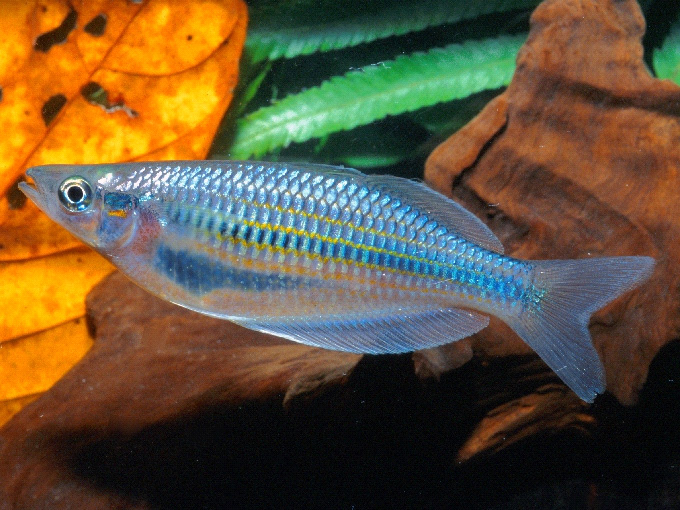
Melanotaenia batanta
Batanta Rainbowfish
Species Summary
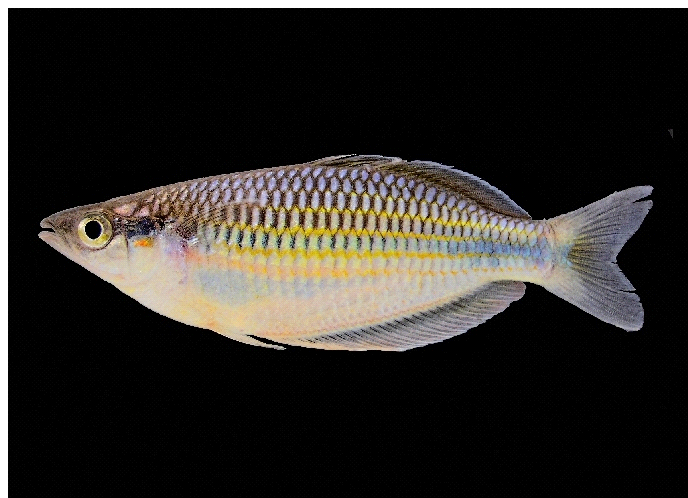
immediately behind eye on uppermost part of operculum. Fins mainly translucent except dorsal, anal, and caudal, frequently with bluish tint. There is little difference between male and female, an unusual feature for rainbowfishes. Unlike most Melanotaenia there is a lack of pronounced sexual dimorphism. Males, in particular, lack the pronounced elongation of the posterior dorsal and anal fin rays, but rather the anterior or middle rays tend to be longest. Moreover, they have poorly developed palatine teeth or lack them entirely. Males may reach a maximum size of 10 cm, but females are usually less than 8 cm.
Melanotaenia batanta is most closely related to M. fredericki, but there is a modal difference in number of dorsal fin rays and it possesses fewer cheek scales (11–13 vs. 17–20).
Etymology
The species is named for Batanta Island, Irian Jaya (now Papua), Indonesia, the type locality.
Etymology compiled from C. Scharpf (2023), “Fishes of Sahul: An Etymological Survey (Part 6), the rainbowfishes (continued)”, Fishes of Sahul 37(1): 2006–2022, and etyfish.org.
Distribution & Habitat
Known only from Batanta Island in the Raja Ampat Islands lying immediately west of the Vogelkop Peninsula, West Papua. Batanta Island is home to three separate species of rainbowfishes.
Remarks
This species was named batanta, with reference to the type locality. No live specimens have so far been collected for the aquarium hobby. This species should not be confused with another rainbowfish distributed in the hobby as the “Batanta Island Rainbowfish” (Melanotaenia synergos).
References
- Allen G.R. & S.J. Renyaan (1998) Three new species of rainbowfishes (Melanotaeniidae) from Irian Jaya, Indonesia. Aqua, Journal of Ichthyology and Aquatic Biology 3(2): 69-80.