

Melanotaenia fasinensis
Fasin Rainbowfish
Species Summary
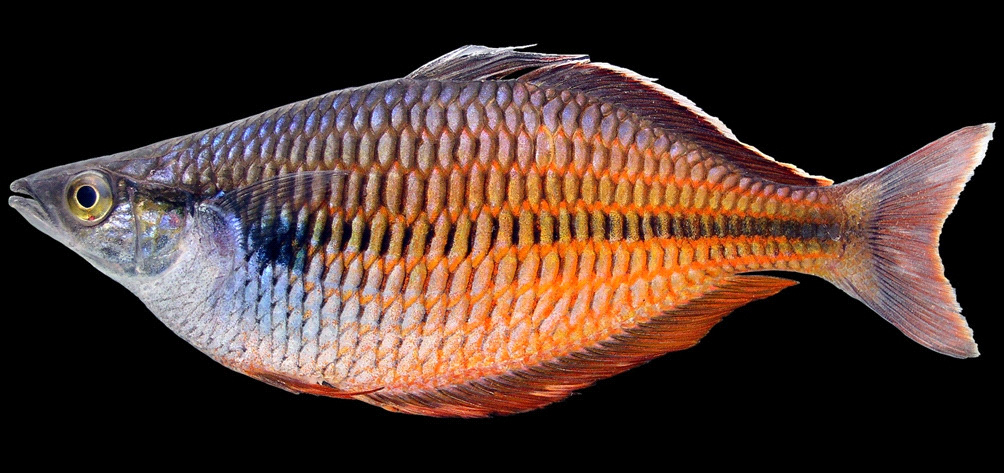
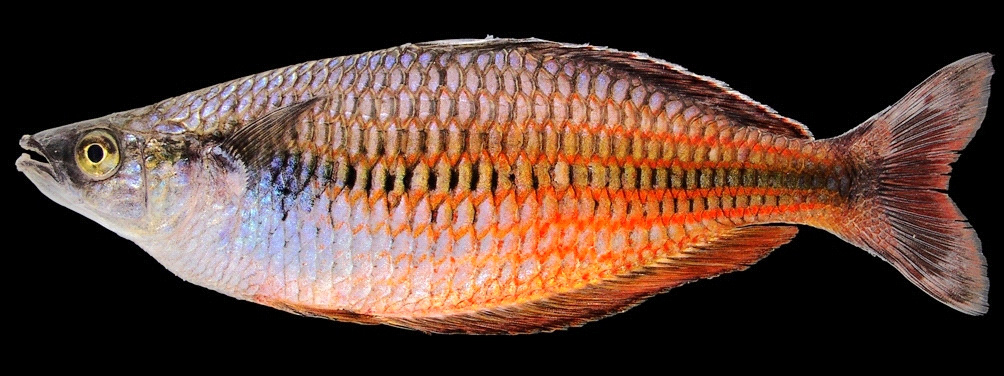
Melanotaenia fasinensis have a basic body colour that is generally bright red on the sides of the body with a series of alternating broad pink to red stripes corresponding with horizontal scale rows and narrower orange stripes between each scale row; bluish dorsally from nape to dorsal-fin origin and ventrally directly behind pectoral fin base and above abdomen; intense dark blue blotch just behind pectoral-fin base of male; a midlateral black stripe from upper edge of preopercle to caudal-fin base covering one scale row (sometimes faint in middle part of body); pectoral fin translucent; remaining fins reddish with a prominent white margin on entire dorsal fin.
The colour of mature males is an overall bluish colour dorsally from the nape to the base of the second dorsal fin and bright orange-red on the side of the body; the operculum is steel-blue with a golden patch on the upper part; a large dark-blue patch is directly above the abdomen and behind the pectoral fins; lateral flanks have seven or eight pinkreddish stripes, corresponding with horizontal scale rows, alternating with narrower bright orange stripes; a black midlateral stripe about one scale wide extends from the upper edge of the preopercle to the caudal-fin base; mainly formed by dark scale margins and sometimes faint in the middle part of the body; a dusky blackish stripe from near the edge of the eye to the upper rear margin of operculum; pectoral fin translucent; pelvic and anal fins blood-red; both dorsal fins dark purple with red reflections and marked with a white margin; caudal fin blood-red with purple reflections at base, and along dorsal and ventral margin. Colour pattern of mature females is similar to that of male except red hues of body are generally less vivid.
Similar to most Melanotaenia, mature males are deeper bodied than females (34–38 vs. 32–34% SL). Males have a more elongate and pointed shape posteriorly on the soft anal and dorsal fins. The longest soft dorsal-fin rays of males are located in the posterior extremity of the fin, in contrast to that of females, which are situated in the anterior part of the fin.
The distinctive colour pattern of M. fasinensis is unique among congeneric species. Melanotaenia ajamaruensis has an overall orange-red coloration and similar pattern of alternating broad red stripes and narrower bright orange stripes on the posterior part of the body. However, the former is distinguished from M. fasinensis by the presence of 2-5 diffuse bars of darker purple on the lower half of the pectoral region (vs. a blue patch for M. fasinensis) and by a series of four faint darker yellow-orange stripes, one per scale row, directly below the midlateral stripe on the pectoral and ventral regions (vs. absent for M. fasinensis).
Melanotaenia ajamaruensis and M. boesemani are the closest geographic neighbours to M. fasinensis. Morphologically, M. fasinensis differs from M. ajamaruensis and M. boesemani by more transverse scales (9 vs. usually 7-8), more predorsal scales (17-19 vs. 14-16), a longer snout (9.2-9.5 vs. 7.2-8.7% SL), a longer anal-fin base (40.6-48.4 vs. 32.2-40.4% SL) and a shorter pre-anal length (45.6-48.4 vs. 49.4-57.6% SL). Moreover, M. fasinensis can be distinguished from M. boesemani by more anal soft rays (24-27 vs. 17-23), more dorsal soft rays (14-17 vs. 10-14), a shorter head (23.1-25.0 vs. 25.5-28.5% SL), a smaller eye diameter (6. 4-8.1 vs. 8.610.7% SL), a shorter pre-pelvic length (34.5-38. 8 vs. 40.042.0% SL), longer pelvic fins (17.0-19.5 vs. 13.8-16.7% SL), a longer dorsal-fin base (39.0-42.2 vs. 33.5-37. 4% SL) and a longer second dorsal-fin base (25.9-29.5 vs. 22. 1-24.7%
Etymology
The species name fasinensis is a suffix denoting place, referring to Fasin Creek, Birds Head Peninsula, West Papua, Indonesia, the type locality.
Etymology compiled from C. Scharpf (2023), “Fishes of Sahul: An Etymological Survey (Part 6), the rainbowfishes (continued)”, Fishes of Sahul 37(1): 2006–2022, and etyfish.org.
Distribution & Habitat
Melanotaenia fasinensis was collected from Fasin Creek, a small tributary of the Kladuk River, in the vicinity of Ween Village, 25 km west of Lake Ayamaru. It is important to note that the Fasin Creek is only connected to the main river by subterranean outlets.
This region, north-west of Teminabuan, consists of a vast karstic formation, which includes poorly known and complex systems of rivers and lakes (e.g., Aitinyo, Ayamaru). The species occurs in nearby streams connected to the Fasin River but was not observed elsewhere in the basin, probably because streams in the area drain mainly underground after flowing for relatively short distances on the surface, thus limiting its geographic distribution.
Due to these geologic and topographic features, it seems that M. fasinensis has a restricted geographic distribution and is confined to the vicinity of Ween village. The type locality consists of a crystalline, narrow (to about 4-5 metre wide), relatively shallow (up to about 1 metre) stream with gradual gradient flowing through secondary forest. The type specimens were collected over gravel and limestone boulder bottom with substantial dead tree branches. This small river is also home of various species of eleotrids, small freshwater gobies and several varieties of crayfishes (Cherax sp.). Physical water parameters at the type locality on May 2007 were water temperature 25.3°C, pH 7.7 and conductivity 281 µS/cm.
Remarks
Melanotaenia fasinensis was collected during an ichthyological survey in the central part of the Bird’s Head Peninsula in May
References
- Evers H. and J. Christian (2014) News from the Vogelkop Peninsula. AMAZONAS 3(6): 40-48 [English edition].
- Kadarusman, Sudarto, E. Paradis & L. Pouyaud (2010) Description of Melanotaenia fasinensis, a new species of rainbowfish... Cybium 34(2): 207-215.