

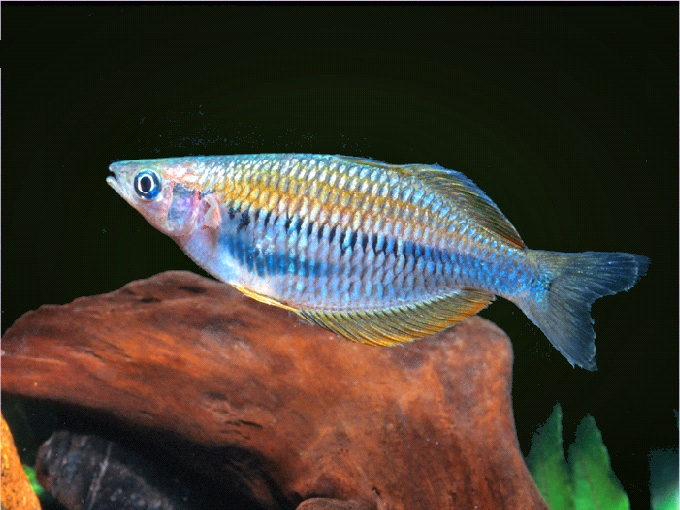
Melanotaenia misoolensis
Misool Rainbowfish
Species Summary
Melanotaenia misoolensis was described from 23 specimens collected from Misool Island off the western extremity of New Guinea. Adult males are bluish with a bronze or golden sheen, and silvery white on the lower half. The upper back and sides often reflect bronze or golden sheen and there is a series of narrow oranges lines on the sides between each horizontal row of scales. There is also a diffused midlateral band extending from the upper corner of the opercula margin to the middle of the caudal fin base, often consisting of blotches. The fins are translucent to light yellow. Males grow to a length of around 6 cm and are usually deeper bodied than females.
They are closely related to Melanotaenia catherinae which is endemic to Waigeo Island, a large island lying approximately 160 km north of Misool. Both species are similar in colour; however, the mid-lateral stripe of M. catherinae is significantly wider, having a maximum width of about three scales compared with 1½ scales for M. misoolensis. Moreover, the midlateral stripe of M. misoolensis is nearly covered entirely by the pectoral fin, whereas it is broadly exposed (at least one scale row) above the pectoral fin of M. catherinae. In addition, the latter species lacks the dusky spot on the fin membrane behind the last dorsal spine and has a dusky soft dorsal fin which is often blackish in adult males. Melanotaenia misoolensis, in contrast, has a dusky spot behind the last dorsal spine and the soft dorsal fin is yellowish-orange. The only meristic difference noted is related to counts for the soft anal rays. Melanotaenia misoolensis usually has 22 to 25 rays compared with 19 to 21 rays for M. catherinae.
Etymology
The species name misoolensis is a suffix denoting place, referring to Misool Island, West Papua, Indonesia, where it is endemic.
Etymology compiled from C. Scharpf (2023), “Fishes of Sahul: An Etymological Survey (Part 6), the rainbowfishes (continued)”, Fishes of Sahul 37(1): 2006–2022, and etyfish.org.
Distribution & Habitat
Melanotaenia misoolensis is currently only known from Misool Island. Misool Island is the second largest (approximately 90 x 38 km) of the four Raja Ampat Islands. It covers an area of about 2034 km2 and is separated from the mainland by a distance of 32 kilometres. Its geographical remoteness from continental Papua and rugged, deeply bisected and heavily forested, predominantly limestone karst terrain make this one of the wildest and most visually stunning places in the entire Raja Ampat archipelago. To the north, a coastline of dense and deep mangroves shelter some villages located on the rare beaches fringed with coconut palms. To the east, a labyrinth of toadstool-shaped limestone islets and pinnacles, deeply undercut below the high-tide water surface and covered in luxuriant vegetation, spreads out into a turquoise sea.
Melanotaenia catherinae (Batanta and Waigeo Islands); M. fredericki (Salawati Island) and M. synergos (Batanta Island).
Remarks
reference to the type locality.
Melanotaenia misoolensis have been found in moderately fast-flowing clear-water streams running through primary rainforest. Other rainbowfishes have been collected from several other islands in the Raja Ampat group of islands: M. batanta (Batanta Island);
In October 1948, a Dutchman by the name of Maurits Lieftinck collected some rainbowfishes from a tributary of the Wai Tama River near Fakal Village on Misool Island. The collection remained unstudied in the Zoological Museum of the University of Amsterdam in the Netherlands until officially described by Gerald R. Allen in 1982. The species was named misoolensis in
In 2000 Heiko Bleher collected what he described as two different species. They are currently known in the hobby as Melanotaenia misoolensis “Kasim” and Melanotaenia misoolensis “Ifaupan”. However, genetic analyse has failed to find any difference between the two different varieties. Melanotaenia misoolensis were also collected by Gerald Allen from the Wai Tama River
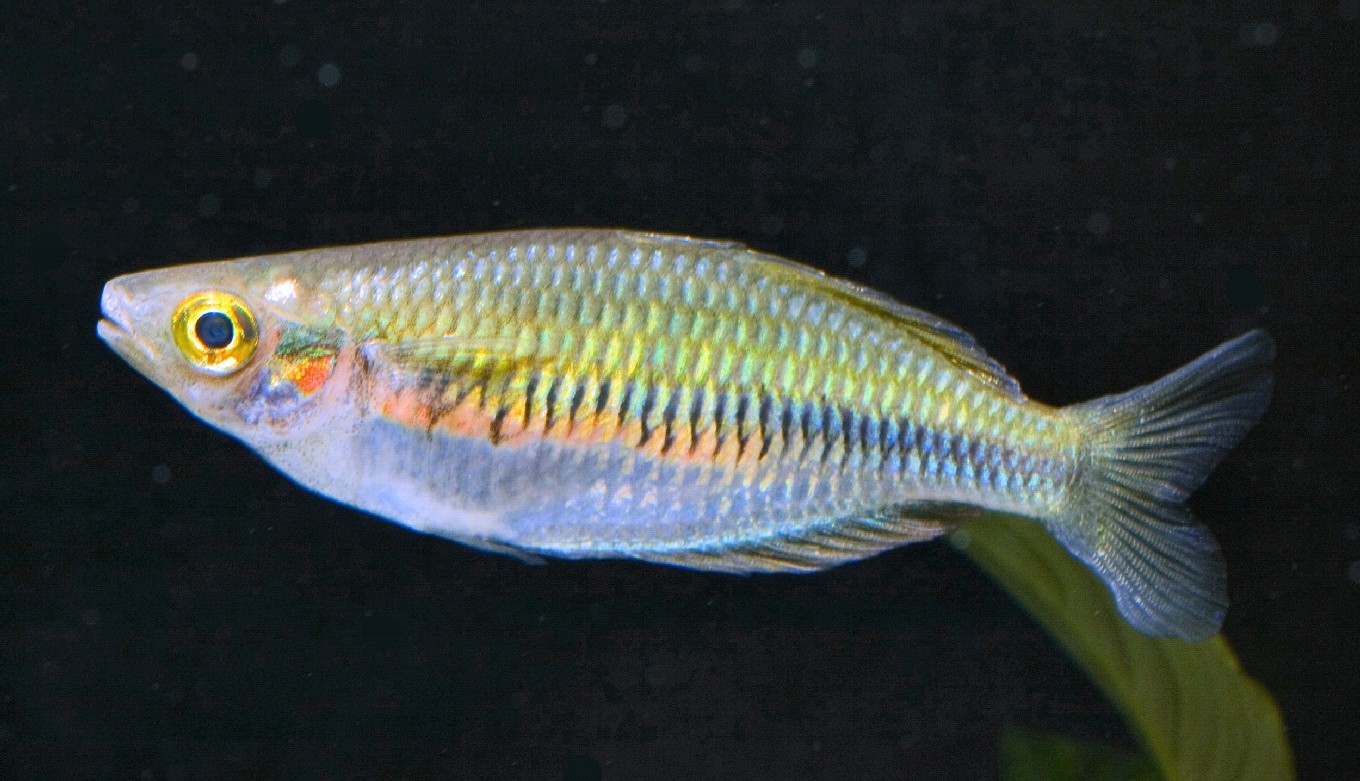
Male ▲ Female ▼ “Ifaupan” (Gam River) variety. This variety was collected by Heiko Bleher on Misool island in 2000, and distributed into the
References
- Allen G.R. (1982) A new species of freshwater rainbowfish (Melanotaeniidae) from Misool Island, Indonesia. Records of the Western Australian Museum. 10(2): 105-109.
- Allen G.R. (1991) Field guide to the freshwater fishes of New Guinea. Christensen Research Institute, Madang, Papua New Guinea.