

Melanotaenia ammeri
Ammer’s Rainbowfish
Species Summary
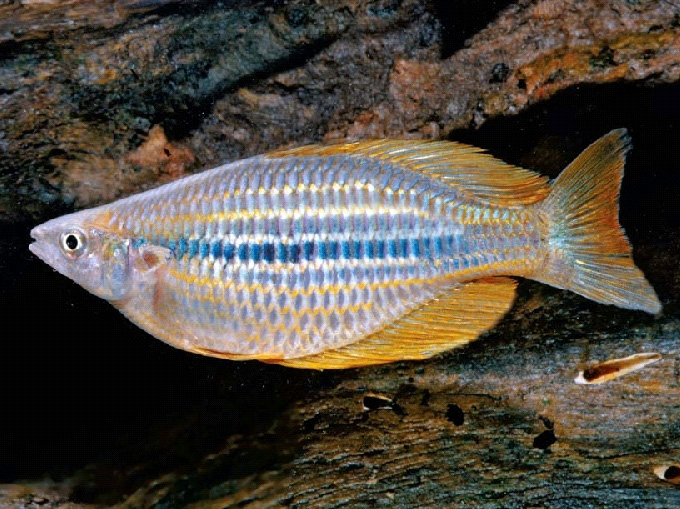
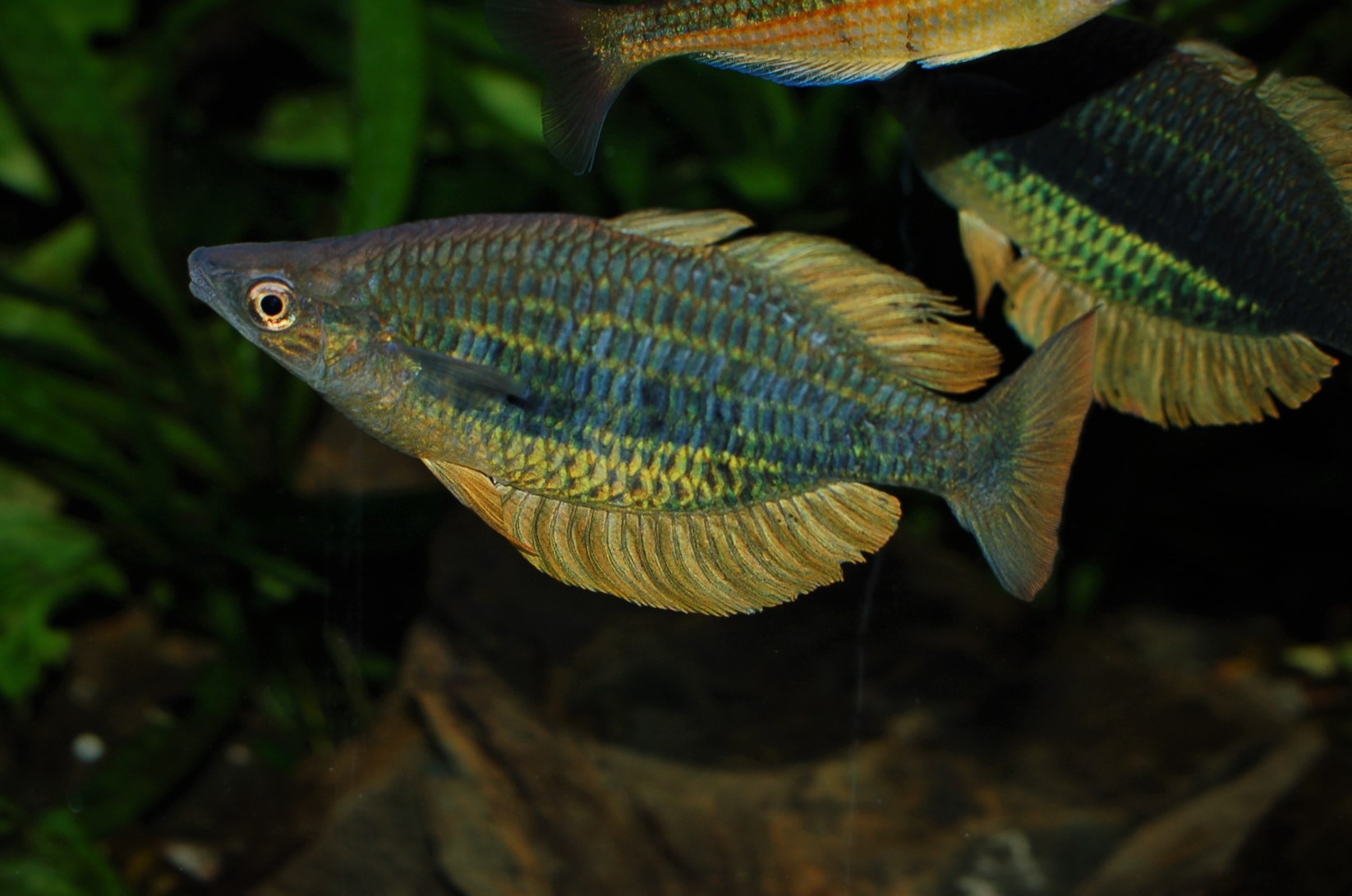
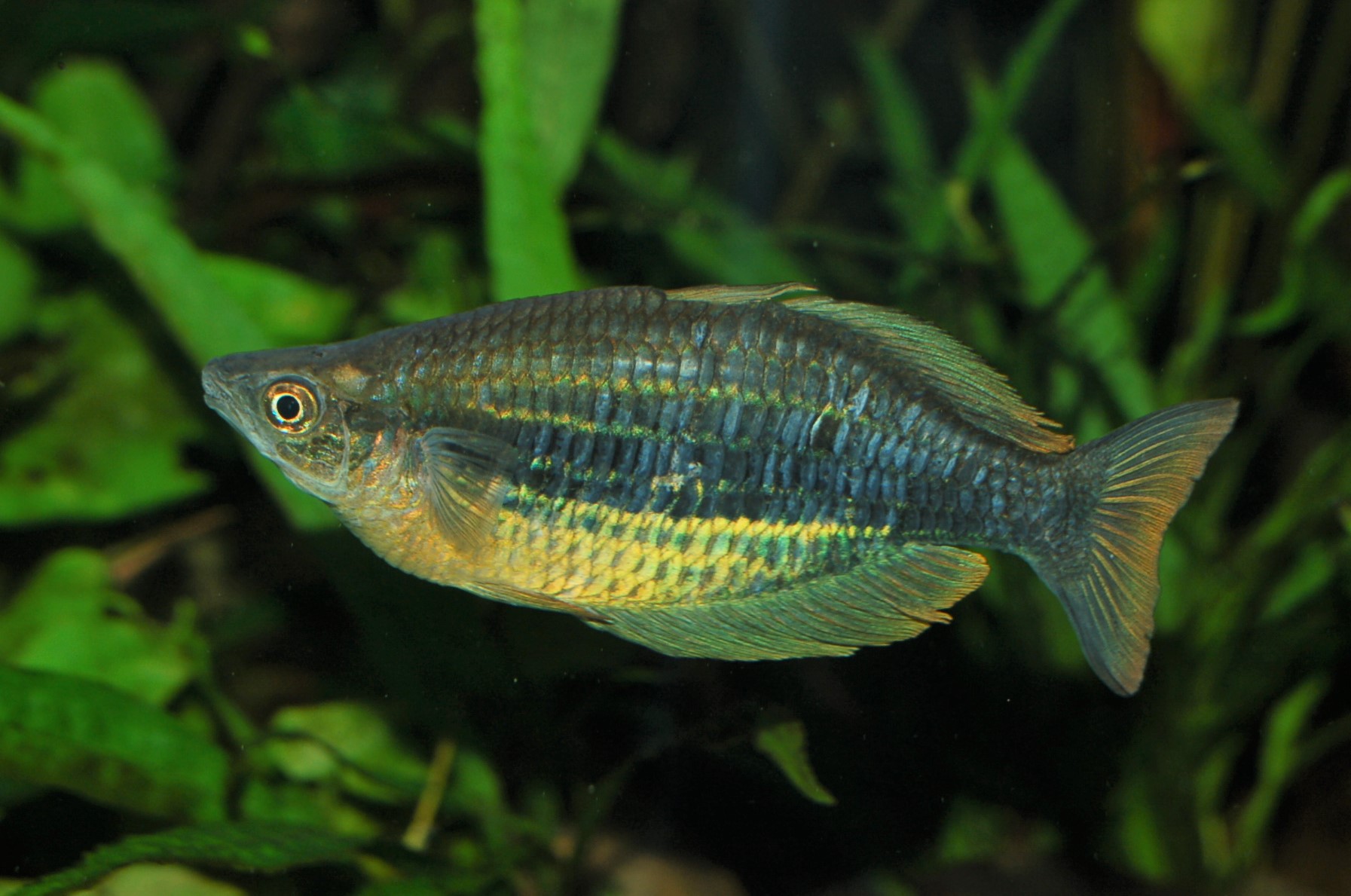
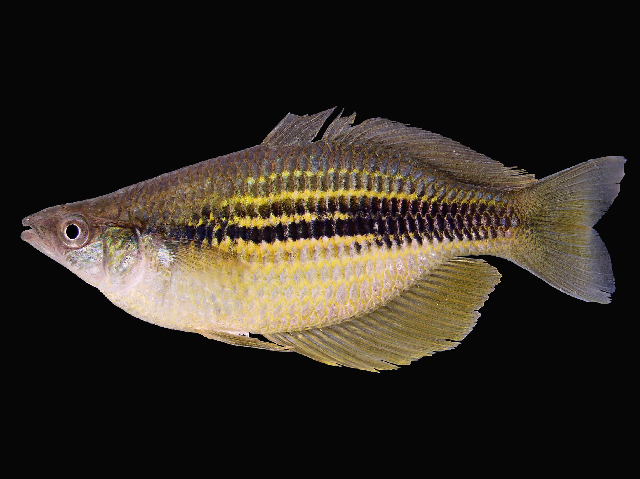
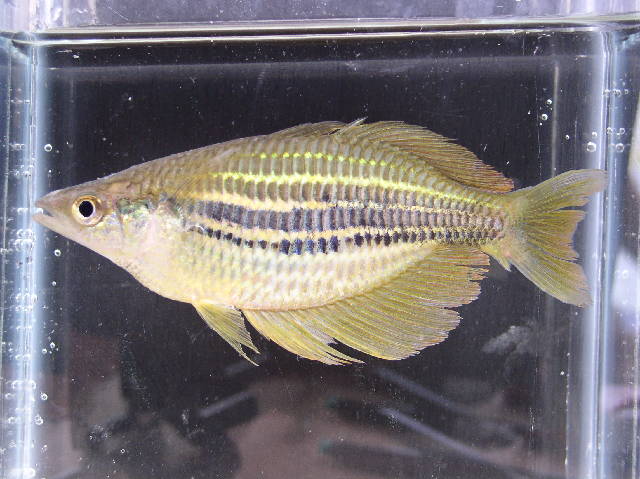
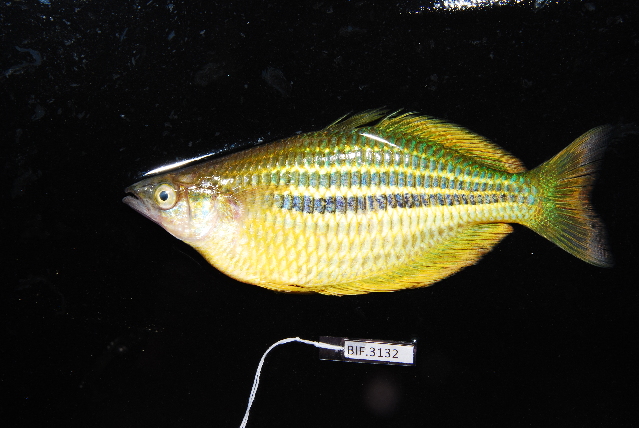
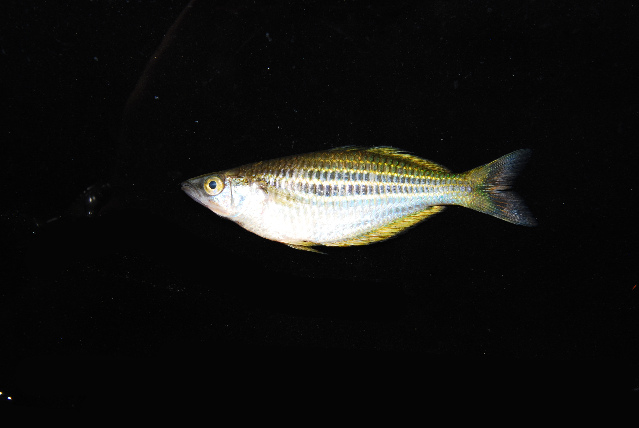
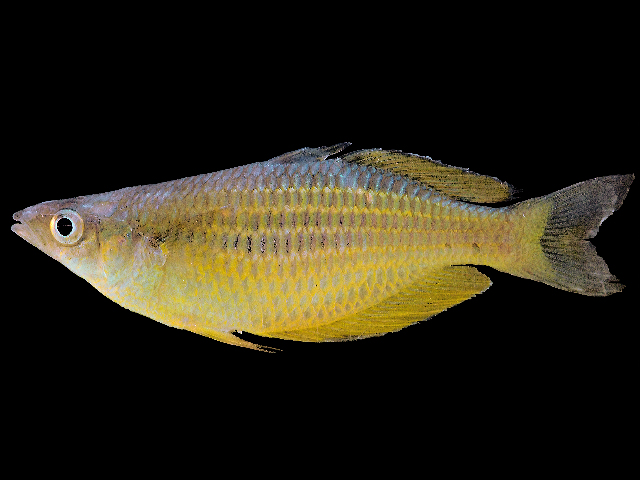
The male colouration of Melanotaenia ammeri is generally bluish on the upper body with a series of alternating mauve to blue-grey and pale yellow stripes corresponding with each of the horizontal scale rows on the side of the body. The midlateral stripe, at the level of the upper pectoral-fin base is usually much darker than the others. The blue stripes below become progressively more inconspicuous and forming interrupted dotted lines. A broad, horizontally bluish streak immediately above the abdomen. The upper portion of the head is blue or greyish, while the lower half is silvery white. The dorsal, anal, pelvic and caudal fins are pale yellow. The pectoral fins translucent with a white base. The colour pattern of the females are similar to that of the males except the blue and yellow hues of the body stripes are generally less vivid and the median fins are mainly translucent, only slightly yellow. The distinctive pattern of alternating mauve to blue-grey and yellow stripes is unique among species of Melanotaenia.
Males are generally deeper bodied than females and have a more elongate, pointed shape posteriorly on the soft dorsal fin. The longest soft dorsal-fin rays of males are located in the posterior-most portion of the fin, in contrast to that of females, which are situated in the anterior half of fin. In addition, the depressed first dorsal fin of adult males extends to the base of the second or third soft ray of the second dorsal fin, compared with the spine of first ray in females. This species was named “ammeri” in honour of Max Ammer of Sorong, West Papua.
Etymology
The species is named in honour of Max Ammer (b. 1961), of Papua Diving Resorts, whose enthusiasm for nature exploration and invaluable logistic support, beginning in 1998, enabled extensive travel and collecting around the Birds Head region of western New Guinea.
Etymology compiled from C. Scharpf (2023), “Fishes of Sahul: An Etymological Survey (Part 6), the rainbowfishes (continued)”, Fishes of Sahul 37(1): 2006–2022, and etyfish.org.
Distribution & Habitat
The type specimen for Melanotaenia ammeri were collected from a small creek flowing into the northern part of Arguni Bay near Gusimawa Village. Several populations of rainbowfish closely resembling M. ammeri were collected over the years by the Indonesian-French “Lengguru Expeditions” as well as in 2019 in the Lengguru valley by Graf, Heemskerk, Lange and Salossa. Specimens from the Lengguru Valley as well as from other localities around Arguni Bay are currently listed as M. ammeri on the online database BOLD.
The type locality consisted of a narrow (2–3 metre wide), relatively shallow (to about 0.5 metre) stream with gradual gradients flowing through second growth forest, about one kilometre upstream from the sea. The type specimens were collected over sand and gravel bottoms with substantial leaf litter and dead tree branches. The fish currently known as M. spec. “Lengguru” were collected in small tributaries of the Lengguru River together with M. spec. “Kali Tawa” and another rainbowfish of the so-called “goldiei-group,” currently known in the hobby as M. spec. “Lobo.”
Remarks
Melanotaenia ammeri was originally collected from a small creek near Gusimawa Arguni Bay, West Papua by G. R. Allen and M. Ammer in 2008. This population is not currently available in the aquarium hobby. Fish from the Lengguru valley have become available in the aquarium hobby as M. spec. “Lengguru.”
References
- Allen G.R., P.J. Unmack & R.K. Hadiaty (2008) Two new species of rainbowfishes (Melanotaenia: Melanotaeniidae), from western New Guinea (Papua Barat Province, Indonesia). aqua, International Journal of Ichthyology, 14 (4): 209-224.