

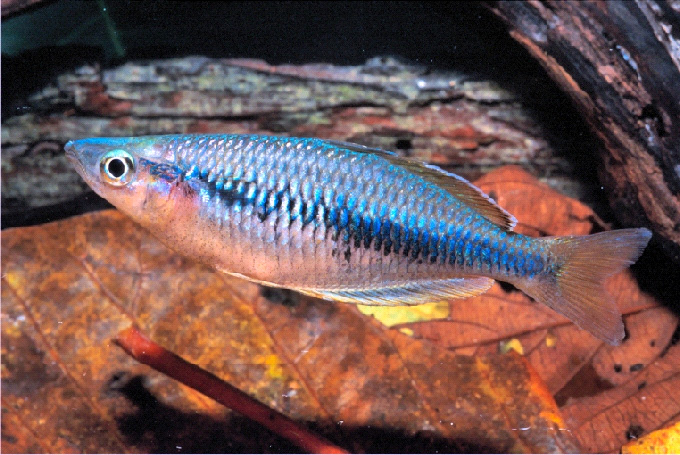
Melanotaenia irianjaya
Irian Jaya Rainbowfish
Species Summary
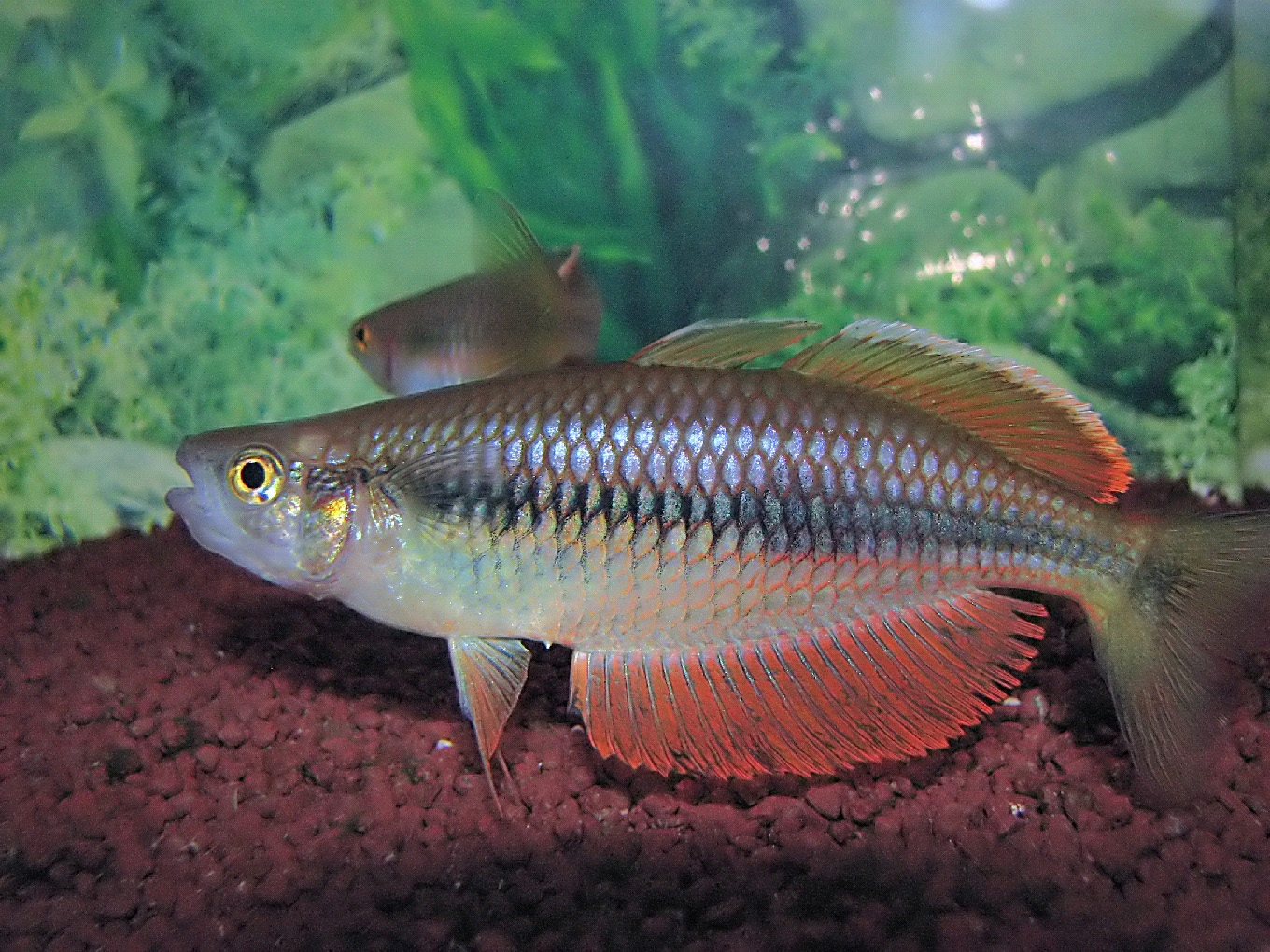
Male specimens of Melanotaenia irianjaya have a bluishgrey or slightly violet on the upper half of the body while the lower half of the body is silvery-white with a slight yellow hue posteriorly. There is a broad, bluish midlateral band, which is most prominent on the rear-half of the body. The dorsal and anal fins are reddish with narrow white margins. The caudal fin is reddish and has distinctive black upper and lower margins. The pelvic and pectoral fins are mainly transparent.
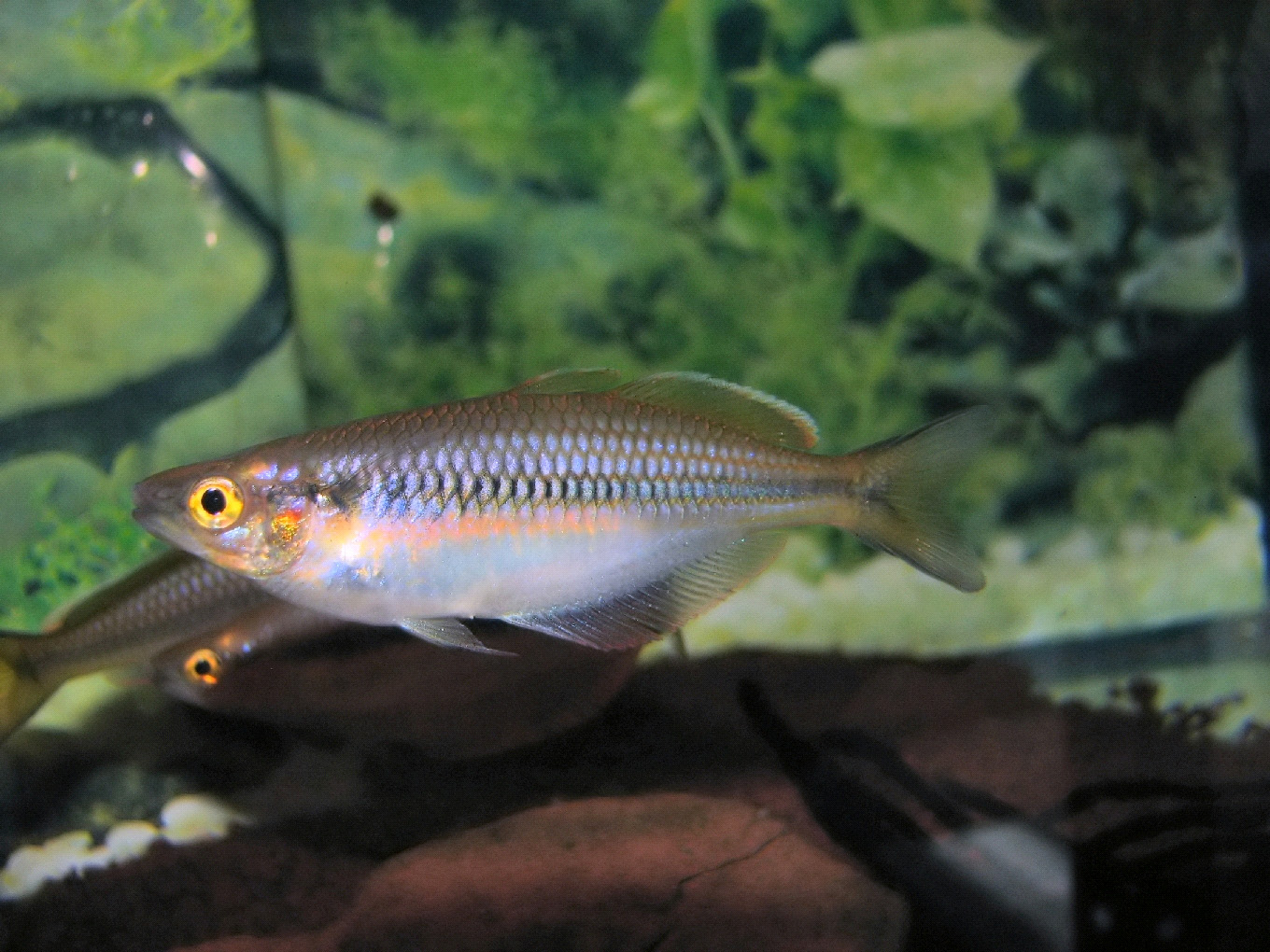
Melanotaenia irianjaya does not appear to be closely related to other members of the genus. This species is unusual in having the middle rays of the dorsal and anal fins longer than the other rays. Instead the middle rays of these fins are the longest, a feature shared only by Melanotaenia corona from north-central New Guinea. Additionally, it appears to lack pronounced sexual dimorphism, a feature which is prominent in most other Melanotaenia. Although most collected specimens were small (under 50 mm SL), a few were sexually mature, but it was necessary to examine the gonads to determine sex. Males may reach a maximum size of 12 cm, but females are usually less than 10 cm. Unlike most rainbowfishes, males of this species lack the pronounced elongation of the posterior dorsal and anal fin rays. Males are more brightly coloured, larger, and deeper bodied than females.
Etymology
The species is named for Irian Jaya (now Papua), Indonesia, where the type locality is situated.
Etymology compiled from C. Scharpf (2023), “Fishes of Sahul: An Etymological Survey (Part 6), the rainbowfishes (continued)”, Fishes of Sahul 37(1): 2006–2022, and etyfish.org.
Distribution & Habitat
Melanotaenia irianjaya are found primarily in river systems that drain into Bintuni Bay, in the southern Vogelkop Peninsular region. In 1982, they were collected by G. Allen and W. Tins from a tributary of the Kamundan River at Senopi Village on the north side of Bintuni Bay, and also by G. Allen and H. Bleher near the villages of Fruata and Merdai. In 2007 live specimens were collected from the Bintuni East River and the Tisbo River.
Habitats consist of rainforest streams ranging from slightly turbid and slow flowing over flat terrain to clear, moderately fast flowing through hills. Temperature and pH values range from 27–28°C and 7.3–7.8 respectively. The fish are found in areas with relatively few aquatic plants, over gravel or sand bottoms, often in the vicinity of submerged logs.
Remarks
Melanotaenia irianjaya have been available into the aquarium hobby since 1983. In 2007, a number of collecting surveys were conducted by the Papuan National Marine and Fisheries Research, the Academy of Fishery Sorong, and the Institut de recherche pour le développement (IRD) Jakarta in a number of regions in West Papua. In the Bintuni Bay region they collected 332 rainbowfish specimens. Among them were specimens of M. irianjaya, which were taken back to Jakarta and the Sorong Fisheries Academy for breeding purposes.
References
- Allen G.R. (1985) Three new rainbowfishes (Melanotaeniidae) from Irian Jaya and Papua New Guinea. Revue française d'Aquariologie 12 (2): 53-62.
- Allen G.R. (1991) Field guide to the freshwater fishes of New Guinea. Christensen Research Institute, Madang, Papua New Guinea.
- Burnett J.B., M. Davies and G. Taylor (2003) Flora and Fauna Survey of the Tanggugh LNG Site Papua Province, Indonesia. P.T. Hatfindo Prima, Bogor.
- Pouyaud L. (2007) Expedition Papua 2007 10 mai - 14 juin. Rapport de mission. IRD Indonesie, departement resources vivantes - UR 175.