

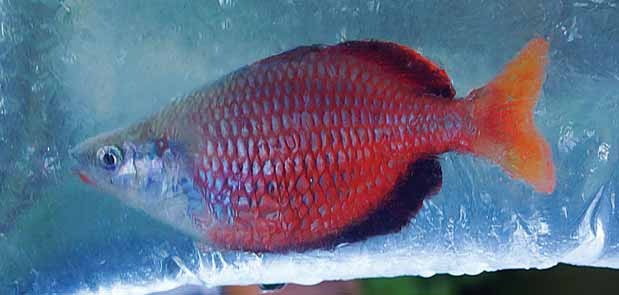
Melanotaenia sneideri
Kumawa Rainbowfish
Species Summary
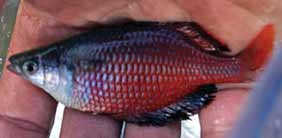
Melanotaenia sneideri is a rainbowfish described in 2013 from a single remote spring-fed creek in the Kumawa Mountains, on the Bomberai Peninsula of West Papua, Indonesia. Adult males are striking: a rich, glowing red body offset by dark brown to blackish dorsal, anal and pelvic fins — a colour combination matched among rainbowfishes only by the unrelated Glossolepis incisus of Lake Sentani, and by captive-bred (but not wild) Melanotaenia parva.
Etymology
The species is named in honour of Richard Sneider (b. 1960), of Los Angeles, California, an entrepreneur, conservationist and explorer who, with Max Ammer, planned and executed the 2013 Kumawa Mountains Expedition, during which Sneider discovered, photographed and filmed this species, and helped collect the holotype.
Etymology compiled from C. Scharpf (2023), “Fishes of Sahul: An Etymological Survey (Part 6), the rainbowfishes (continued)”, Fishes of Sahul 37(1): 2006–2022, and etyfish.org.
Distribution & Habitat
Melanotaenia sneideri is known only from its type locality: a small, ephemeral lake basin roughly 1,000 m long and 600 m wide, high in the Kumawa Mountains at an elevation of 1,050 m. In dry periods this reduces to a remarkably clear creek only 1–2 m wide and 10–50 cm deep, emerging from limestone rock at the edge of the basin and flowing 500–600 m before disappearing underground; during the survey, heavy rain instead flooded the basin into a small lake, dispersing the fish more widely. Most large adults were found concentrated in rocky pools near where the creek vanished underground.

Description
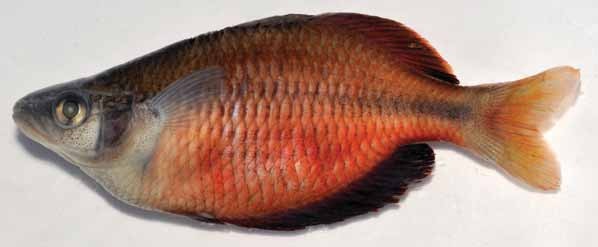
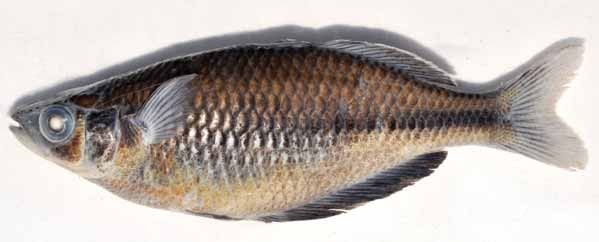
A deep-bodied rainbowfish, the 80.1 mm SL holotype reaching a body depth of 42.3% SL — among the deepest-bodied of any Bird’s Head Melanotaenia, and a value otherwise matched only by a handful of lake-dwelling relatives. One specimen of about 110 mm SL was collected but had to be discarded for lack of a large enough container, indicating the species grows considerably larger still than the preserved type series suggests, rivalled in size among Bird’s Head rainbowfishes only by M. fasinensis and M. angfa. Live adult males are blue-grey with broad red scale margins giving an overall rich red appearance, a mainly grey-blue head shading to whitish below with a reddish chin, dark brown to blackish dorsal, anal and pelvic fins, an orange-red outer margin on the second dorsal fin, and a pinkish orange caudal fin. Females lack the red colouration, are less deep-bodied, and show a broad blackish mid-lateral stripe on the rear half of the body.
Remarks
The unique combination of bright red body colour with dark brown to blackish median fins readily separates Melanotaenia sneideri from every other rainbowfish. Its unusually deep body and evenly rounded (rather than pointed) male anal fin are shared with several other Bird’s Head species — M. ammeri, M. irianjaya, M. kokasensis and M. parva — which together form a genetically distinct ‘Southern Bird’s Head’ group; most of these, like Melanotaenia sneideri, are lake or spring-basin dwellers, and lake-dwelling rainbowfishes generally run deeper-bodied than their stream-dwelling relatives, whose more slender build suits swimming against current.
Account compiled for Home of the Rainbowfish from G. R. Allen & R. K. Hadiaty (2013), “Melanotaenia sneideri, a new species of Rainbowfish (Melanotaeniidae), from West Papua Province, Indonesia”, aqua, International Journal of Ichthyology, 19(3): 137–146.
References
- Allen G.R. and R.K. Hadiaty (2013) Melanotaenia sneideri, a New Species of Rainbowfish (Melanotaeniidae), from West Papua Province, Indonesia. aqua, International Journal of Ichthyology 19(3): 137-146.