

Retropinna semoni
Australian Smelt
Species Summary
One of the better-documented small natives in ANGFA’s archives, Retropinna semoni has been written up as a keeping-and-breeding subject as far back as 1985 and again in two later species profiles, giving a fuller picture than most small Australian natives receive. It belongs to the family Retropinnidae, the southern smelts and graylings, a small group otherwise best known for the Australian Grayling.
Etymology
The genus name Retropinna was coined for the South American genus Argentina retropinna and combines the Latin retro, back, with pinnis, fin, referring to the posterior insertion of the dorsal fin, set back above the anus. The species name honours the German zoologist and evolutionary biologist Richard Semon (1859–1918), who collected the type specimen from the Burnett River, Queensland.
Etymology compiled from C. Scharpf (2019), “Fishes of Sahul: An Etymological Survey (Part 2)”, Fishes of Sahul 33(2): 1417–1439, and etyfish.org.
Description
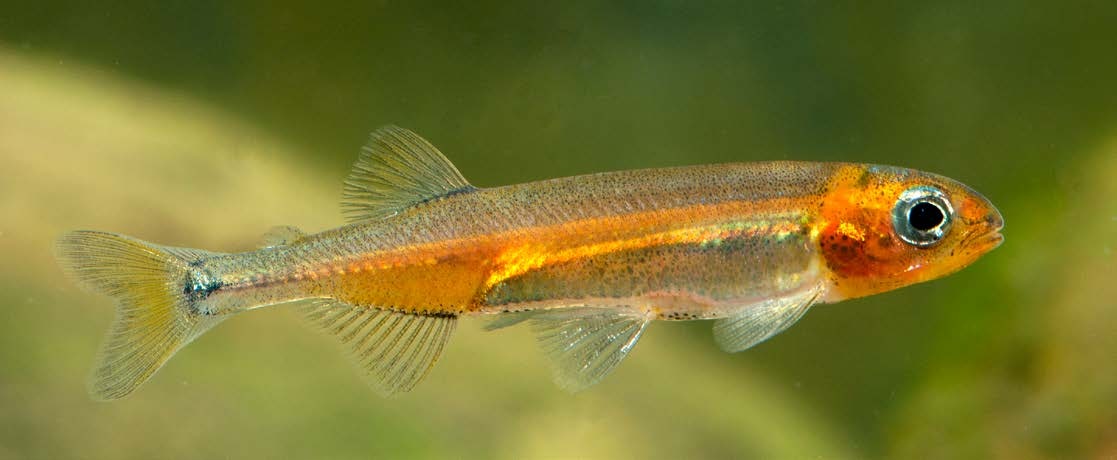
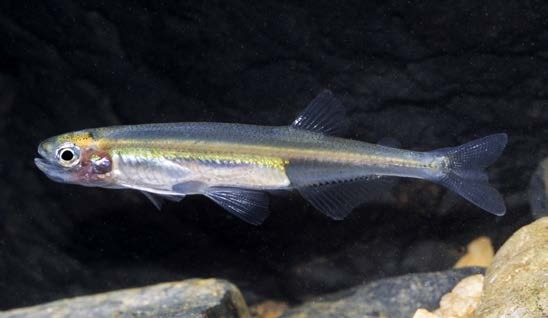
A small fish with large eyes and a rounded snout, growing to a little over 10 cm total length but most commonly seen at 5–6 cm. The dorsal fin starts just in front of or level with the beginning of the anal fin, and there is a very small adipose fin and a moderately forked tail. The back and top of the head are usually olive, the sides lighter and silvery, sometimes with a purplish or bluish sheen, and the belly white; the fins rarely carry any colour. Pigmentation is often minimal and the body translucent enough that internal organs and bones are visible through a silvery body cavity. Freshly caught fish often carry a distinctive cucumber-like smell, a trait shared with the Australian Grayling.
Distribution & Habitat
Retropinna semoni is one of the most widely distributed freshwater fish in south-eastern Australia, extending from the Fitzroy River system in Queensland through the south-east and into the south-western Murray-Darling and Lake Eyre divisions. Three species of Retropinna are formally recognised, endemic to south-eastern Australia and New Zealand between them, but genetic studies have since found evidence of at least five species within Australia alone — a hint that the genus still holds undescribed diversity along the eastern coast (see Remarks, below).
Breeding
Sexual maturity is reached at around 12 months of age and a length of 3–4 cm, with mature females generally producing fewer than 200 eggs. Spawning appears to take place in the littoral shallows of slow-flowing stream pools, where sandy substrate and the bases of aquatic plants provide attachment sites for the adhesive, demersal eggs, each about 0.8 mm across. At 15–18 °C the eggs take 9–10 days to develop, and the newly hatched larvae (around 4.6 mm long) congregate at the surface for two or three days while further development continues. Through the southern part of the species’ range, breeding begins in spring once water temperatures reach 15 °C, with most spawning concentrated in the spring months, though some populations also spawn in summer at temperatures up to 22 °C. In Queensland, breeding instead begins in winter after several months of falling temperature — an earlier start simply reflecting an earlier arrival at the same 15 °C threshold — with most spawning activity between June–July and November. This low spawning-temperature threshold, and a tendency to make short upstream migrations before spawning, reflect the retropinnids’ salmoniform affinities and their otherwise temperate distribution. Fish are known to live for over four years, though two years is more typical.
Diet
Both juveniles and adults are assumed to be carnivorous, taking plankton and a wide variety of small aquatic insects and crustaceans.
Keeping & Caring
Retropinna semoni appreciates plenty of swimming space — a tank under 900 mm (3 feet) long doesn’t do a shoal of them justice. Although they share the wild with many other species, in the aquarium they tend to do best kept by themselves in a group of 6 to 30, in a planted, well-filtered tank; morning sun through the front top of the tank shows off their colours particularly well. Regular small water changes suit them — around 25% weekly, using tap water aged for several days — and while they tolerate a range of pH and hardness, they do best close to neutral pH and 50–100 ppm hardness, at 16–25 °C. Strong, active swimmers that mostly occupy the top half of the tank, they suit a layout of tall plants at each end with low, clumped plants across the bottom, and a cover glass is a wise precaution since they are liable to jump if startled. They are mainly carnivorous and feed readily from the surface, doing well on a varied diet that includes some live food alongside scraped red meat, shrimp and a good-quality flake.
Remarks
Richard Semon, honoured in this species’ name, collected extensively across Australia for European museums but met a tragic end: he took his own life shortly after the First World War, wrapped in a German flag, reportedly depressed by Germany’s role and defeat in the war and by the death of his wife.
The genus’s hidden diversity has turned up in unexpected ways. In the early 2000s, ANGFA Queensland member Adrian Dawson collected orange-gold smelt from a Mary River tributary that looked too deep-bodied to be typical Retropinna semoni. Years later, Michael Hammer, Curator of Fishes at the Museum and Art Gallery of the Northern Territory, told Dawson he had collected two distinct, as-yet-unidentified forms of smelt in south-east Queensland — a deep-bodied form matching Dawson’s fish, and a shallower-bodied form with a dark border to the scales on its upper body — and suspected further undescribed forms remain to be found along the eastern coast.
Compiled for Home of the Rainbowfish from ANGFA sources: R. Leggett, “Keeping & Caring — Retropinna semoni — Australian Smelt”, Qld Newsletter 1(1), June 1985, p. 3; “Retropinna semoni”, In-Stream 12(5), October 2003, p. 17; “Retropinna semoni (Weber 1895) Australian Smelt”, In-Stream 20(9), September 2011, p. 22; and A. Dawson & A. R. Tappin, “Mary River Smelt (Retropinna sp.)”, In-Stream 21(10), October 2012, pp. 6–11.
References
- Hammer M.P., P.J. Unmack, F. Adams, M. Adams, D.A. Bevege and J.A. Johnson (2007) A coalescence-based approach to identify cryptic diversity within Retropinna in south-eastern Australia. Molecular Ecology 16: 3050-3065.