

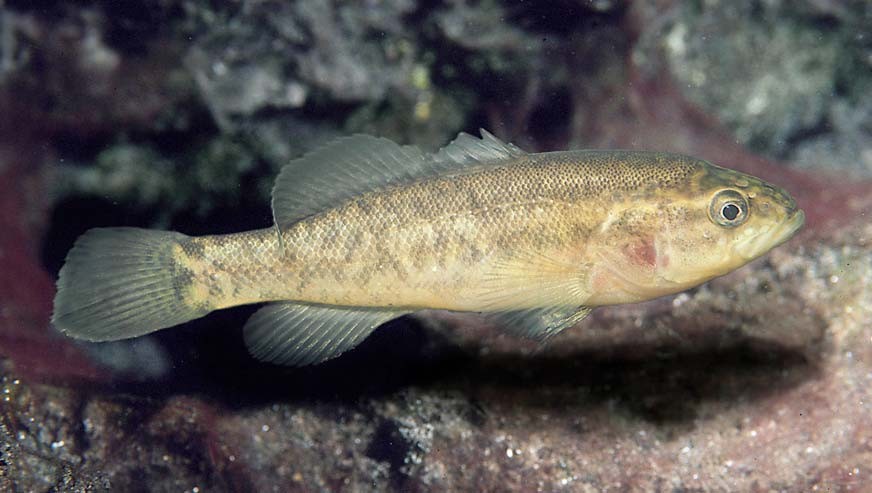
Bostockia porosa
Nightfish
Species Summary
The only member of its genus, which is endemic to south-western Western Australia, Bostockia porosa is a nocturnal ambush predator that grows to a maximum size of 180 mm, but is more commonly seen around 75 mm, with a dark brown, unobtrusive body well suited to hiding among driftwood and other cover while it waits for something edible to swim past.
Distribution & Habitat
Found in freshwater streams and rivers across the south-west of Western Australia, including temporary roadside pools that fill in winter and dry out over summer. It turns up across a wide range of water chemistry, from crystal-clear circumneutral streams to heavily tannin-stained water too dark to read a pH chart against, the common thread being very low mineral content, generally under 100 ppm hardness. It shares its range with several other south-western endemics — Nannoperca vittata, Nannatherina balstoni, Galaxias occidentalis, Galaxias maculatus, Galaxias truttaceus, Galaxiella munda, Galaxiella nigrostriata and Lepidogalaxias salamandroides — though never all at once; a handful of sites hold Nannoperca vittata, Nannatherina balstoni, Galaxiella munda, Lepidogalaxias salamandroides and Bostockia porosa together.
Description & Diet
Juveniles take small crustaceans, insects and their larvae, and fish up to their own length or longer; adults prefer larger prey such as fish, glass shrimp and small crayfish (Marron and Gilgies). In the aquarium Bostockia porosa has proved a genuine predator, taking White Cloud Mountain Minnows, rainbowfish, Otocinclus catfish, pygmy perch and Galaxias occidentalis among others, and developing a distinct feeding-time colour change — larger fish shift from dark brown to cream with dark speckling while feeding, then fade back to plain dark brown once done. A feeding hierarchy is obvious from the first food drop: smaller fish feed first, then retreat as the larger fish emerge from their caves to tear off large mouthfuls, leaving scraps for the smaller fish to mop up.
Keeping & Caring
Bostockia porosa can be genuinely difficult to establish: wild-caught adults often refuse anything but live food at first and are prone to whitespot within days of capture, although juveniles under about 25 mm settle far more readily, take brine shrimp within days and gradually accept dead foods including fish, prawn, bloodworm and grindle worm. Fish are best kept in a well-decorated tank with plenty of caves (clay flowerpots, driftwood, rockwork) and, somewhat counterintuitively, do better housed with other similarly sized fish than alone, since tankmates seem to help settle their natural shyness. Never keep Bostockia porosa in alkaline water or above 200 ppm general hardness, and avoid methylene blue or malachite-green treatments, to which they are notably sensitive; fungal and bacterial infections, particularly around the caudal peduncle, are common in soft-bodied natives like this one and are best treated the moment they are noticed.
Remarks
In the wild, most Bostockia porosa encountered are around 75 mm, with true juveniles under 25 mm and adults over 100 mm both comparatively scarce — possibly because smaller fish need less water to survive as pools shrink toward summer, while larger fish that have reached a size safe from most predators do best when permanent water lasts long enough for them to breed. Once Bostockia porosa passes about 75 mm, only the catfish Tandanus bostocki is large enough to threaten it, and even then rarely does, given the catfish’s small mouth and patchy overlap in range with this species.
Compiled for Home of the Rainbowfish from ANGFA sources: C. Trneny, “A day time view of a night time fish”, Fishes of Sahul 15, 2001, pp. 758–765.