
Gadopsis bispinosus
Two-spined Blackfish
Species Summary
Gadopsis bispinosus is confined to the upper reaches of Murray-Darling Basin rivers, from the Murrumbidgee River in New South Wales and the ACT south and west to the Goulburn River in Victoria, with King Parrot Creek marking its westernmost population. It favours clear, cool, strongly flowing sub-alpine rivers and streams with relatively intact forest cover, often at elevations of 200–700 m, and originally shared much of this range with two other large percichthyids, the Macquarie Perch and Trout Cod.
Etymology
The genus name Gadopsis was proposed by surgeon-naturalist John Richardson in 1848 for the River Blackfish, combining Greek gados, cod, with opsis, appearance — Richardson explained the name directly, writing that “the general shape of the body, its rather prominent belly, large head, obtuse snout… and its slender jugular ventrals give it a good deal the aspect of a codfish.” Andrew Sanger’s 1984 species name combines the Latin bi-, two, with spinosus, spined, referring to this species’ two (rarely one or three) dorsal-fin spines, against the River Blackfish’s seven to thirteen.
Conservation Status
Easy to find through much of its Victorian range, but substantially declined in the Murrumbidgee catchment, which represents the species’ northern, likely more climate-vulnerable limit. Mining, fire, land-use change and competition or predation from introduced trout have all probably contributed. Trout do not appear to cause major decline in Victoria, likely thanks to this species’ nocturnal, cover-oriented habits, but severe bushfires across south-eastern Australia in 2003–2006, 2009 and 2019–2020 have since choked many upland rivers with silt, filling in the rocky interstices this species relies on to shelter from trout — a real concern for its long-term future in fire-affected catchments. Blackfishes generally have low fecundity, slow growth, long lifespans and limited movement, making them especially vulnerable to overfishing and local extirpation.
Description
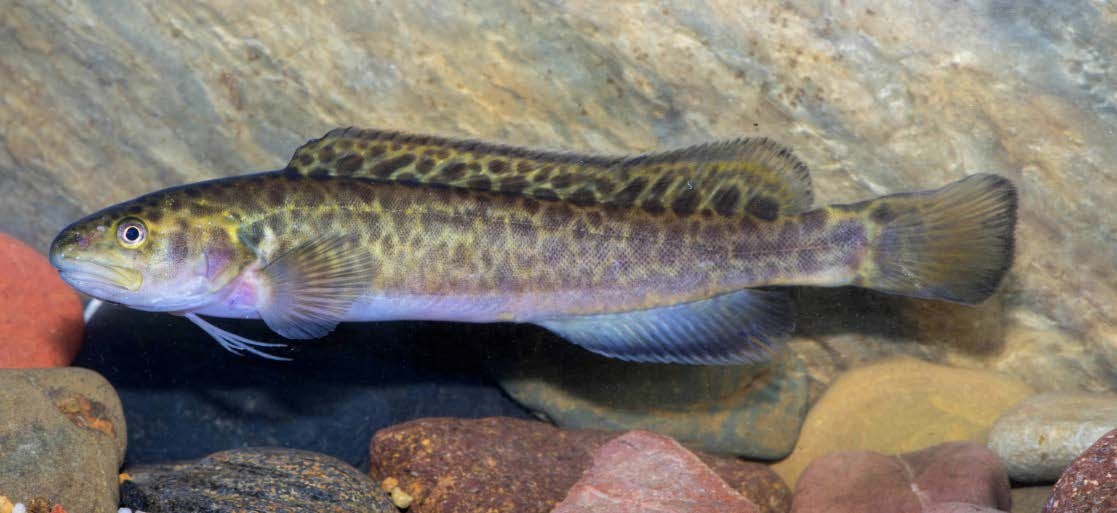
Similar in shape and general appearance to the River Blackfish, but told apart by dorsal-fin spine count and a fairly consistent colour pattern: a light, irregular fishnet-like mottling most prominent on the upper head, body and dorsal fin, with white edges to the anal and dorsal fins. Grows to a maximum of 32 cm; a 20–25 cm fish is considered large. Movements are restricted to a remarkably small stretch of river, on the order of 15 m, over an individual’s entire life.
Diet
In the wild, feeds mostly on aquatic insect larvae and terrestrial invertebrates, fishes, fish eggs, earthworms, crayfishes and shrimps. Juveniles take mainly small early-instar mayfly and midge larvae; the proportion of caddisfly larvae in the diet rises with fish size, while mayflies and true flies become relatively less important. Terrestrial prey is absent from the juvenile diet, minor for immature fish and a major component for adults, peaking in summer and autumn. Diet overlaps significantly with introduced Rainbow Trout, implying real competition between the two species.
Keeping & Caring
Can be highly pugnacious toward its own kind, but is straightforward to keep singly in cool, clean water — an aquarium chiller is close to essential. Live earthworms make a good first food, and fish adjust to captivity quickly, though being strongly nocturnal this is not a great display species, since it tends to hide all day. One ANGFA member who set up a large tank for five wild-caught 15 cm specimens found the largest had vanquished the other four within a month, driving them to shelter, and still hold territories, inside the tank’s backdrop filter compartment — each fish was eventually given its own aquarium.
Breeding
Sexual maturity is reached after about two years at around 15 cm. Breeding takes place between October and December, with large, yolky, adhesive, demersal eggs deposited among rocks and timber once water temperatures exceed 16–17 °C. Fecundity is low, generally under 300 eggs per female, and a large adult male remains with each egg mass throughout. Eggs hatch after roughly 15–17 days, the embryo emerging from the egg case while the yolk sac stays attached to the spawning substrate for a further three to four weeks of continued paternal care, by which point the young are strong swimmers; juveniles are often found afterward in large groups among leaf litter and woody debris.
Compiled for Home of the Rainbowfish from ANGFA sources: G. Martin, G. Briggs, P. J. Unmack & C. Scharpf, “Fish in focus: Twospine Blackfish Gadopsis bispinosa (Gadopsidae)”, Fishes of Sahul 35, September 2021, pp. 1789–1794; and R. Kuiter, “Freshwater Blackfishes”, Fishes of Sahul 23, 2009, pp. 499–500.