
Maccullochella mariensis
Mary River Cod
Species Summary
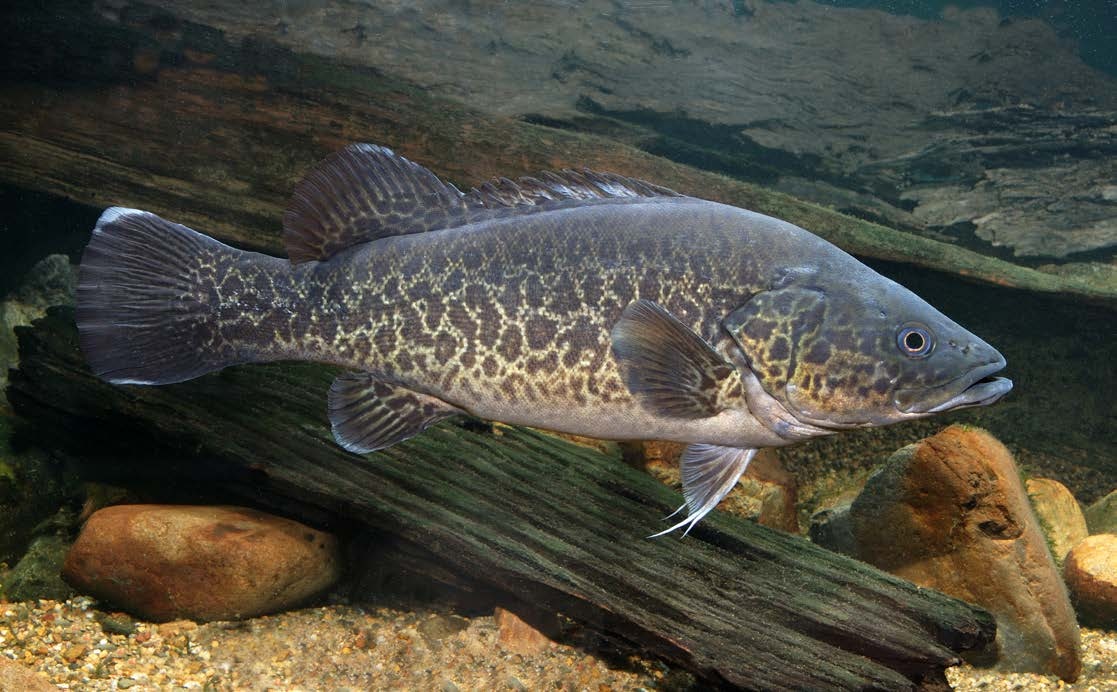
One of Australia’s large iconic apex-predator fishes, Maccullochella mariensis grows to a maximum recorded 1.2 m and 40 kg, with a heavy body, broad concave head, large jaws and rows of fine sharp teeth. Colouration ranges from almost black to the classic cod pattern of dark mottling over a green-brown or golden-yellow background, and the species carries longer pelvic-fin extensions and distinctive white pelvic and caudal fin margins compared to other cod species. Once found across the Mary, Brisbane, Albert/Logan and Coomera River systems of south-east Queensland, a 1996 population estimate found fewer than 600 adults remaining, confined to under 30% of the Mary River’s former range for the species — a decline that made Maccullochella mariensis one of Australia’s most endangered freshwater fishes.
Habitat & Diet
A habitat-driven species requiring clean, cool, oxygenated water, deep pools, dense large woody debris, rocky outcrops and undercut riverbanks; historical desnagging and siltation of waterways destroyed many of the spawning sites adults depend on. Juveniles appear to prefer shallower, denser habitat such as macrophyte beds, undercut banks and woody debris. Diet has never been formally studied, but observations of regurgitated gut contents and wild feeding suggest Maccullochella mariensis will eat almost anything that fits in its cavernous mouth, including fish, crayfish, waterbirds, lizards and even unlucky possums.
Breeding & Conservation History
Much of what is known of this species’ breeding biology comes from one extraordinary conservation story: Gerry Cook, an English-born electrical engineer turned hobby fish breeder, began experimenting with native fish culture at his own Tinbeerwah Fish Hatchery, Noosa, in 1968 — Australia’s first warmwater fish hatchery — and went on to pioneer the artificial breeding of Maccullochella mariensis decades before it was even formally recognised as a distinct species (it was described as a Murray Cod subspecies in 1993, and only elevated to full species status in 2010). After early hormone-injection attempts from 1982 produced only a handful of infertile or unsuccessful eggs, Cook found far greater success providing conditioned adult pairs with prepared ponds and purpose-built spawning pipes — a minimum 1.5 m long and over 25 cm in diameter, lined with fly-screen mesh for easy egg collection. The breakthrough came in 1984 with the first 45 fingerlings raised to release; by 1991 the hatchery, since renamed the Gerry Cook Fish Hatchery in his honour, had produced around 40,000. Spawning occurs in spring once water reaches about 20 °C, with adhesive eggs laid on hard structure such as hollow logs or rock caves; egg batches rarely exceed 13,000 (more typically around 2,000), hatch in about four days at 21 °C, and a male will guard the brood for roughly two weeks after spawning. Over Cook’s lifetime and since, the hatchery he founded has produced more than 740,000 fingerlings for restocking waterways across south-east Queensland.
Compiled for Home of the Rainbowfish from ANGFA sources: D. Roberts, “Conserving the Endangered Mary River Cod (Maccullochella mariensis): the difference one person can make”, Fishes of Sahul 34, December 2020, pp. 1658–1675.