

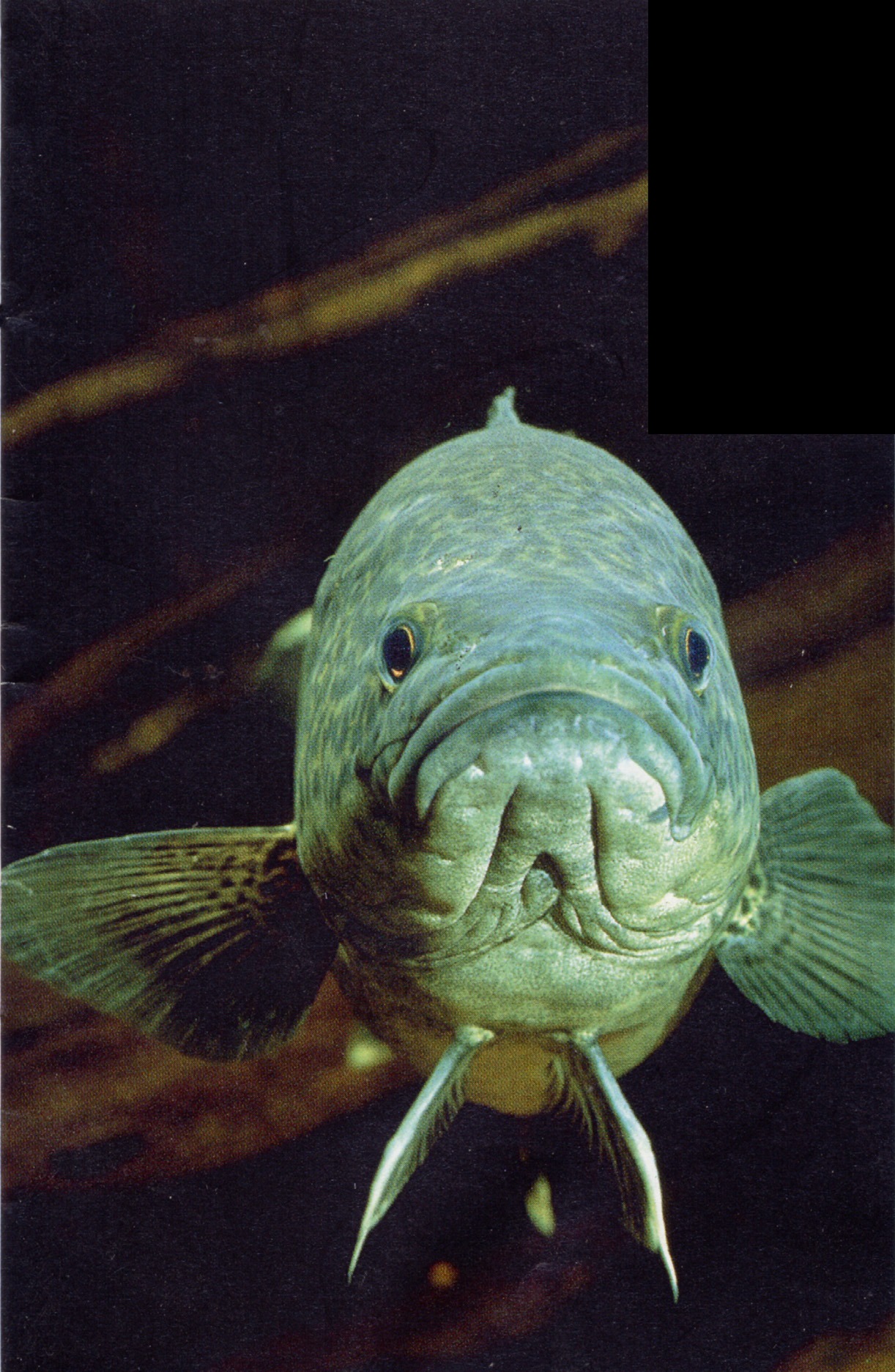
Maccullochella peelii
Murray Cod
Species Summary
Australia’s largest freshwater fish and the largest member of its genus, Maccullochella peelii was once common throughout the Murray-Darling Basin, Australia’s largest drainage system, before 200 years of habitat change saw both its range and abundance decline sharply. The current record weight is 113.5 kg, though tall tales of far larger fish circulate widely; one famous but unverifiable photograph purporting to show an “over 400 pound” (roughly 180 kg) specimen is, on close inspection of its proportions and shadows, probably a fish well under 60 pounds (27 kg).
Aboriginal Dreamtime
As the dominant fish of the Murray-Darling system, Maccullochella peelii features prominently in Aboriginal Dreamtime stories under names including Ponde, Byangil, Bandil, Mungee and Gurumerug — generally meaning “cod”, “big cod” or “big fish”. One story tells how a giant cod named Otchout, pursued and repeatedly speared by the hunter Totyerguil, carved the course of the Murray River itself by charging from waterhole to waterhole, each impact collapsing a new channel — the row of spear marks said to explain the fish’s mottled back to this day. Another story holds that a Murray Cod’s swim bladder, opened and spread out, reveals in its network of blood vessels a picture of the tree the fish was born under.
Conservation
Listed as threatened in Victoria under the Flora and Fauna Guarantee Act and managed under a combination of captive breeding and release, field monitoring and wild-capture restrictions. State hatcheries at Snobs Creek (Victoria) and Narrandera (New South Wales) breed genetically unrelated wild broodstock for release, guided by field survey data and historical records; both states have frozen and are phasing out commercial Murray Cod licences, alongside minimum size limits, closed seasons and bag limits for recreational anglers. While European Carp are often blamed for the species’ decline, the real picture is broader: dams and other barriers, loss of riparian vegetation, irrigation and salinity, the removal of submerged timber (“river improvement”), pollution, boat-wake erosion, and fishing pressure alongside introduced species have all played a part.
Remarks
Education has proved as important to the species’ cause as any breeding program. A 27 kg, roughly metre-long Murray Cod named Mulloka (an Aboriginal word for “Water Spirit”), estimated at 25–40 years old and on permanent display at the Snobs Creek Visitor Centre, became one of Australia’s most photographed fish, appearing in film, television and even the glass of its own tank covered in visitors’ kiss marks — a reminder that public affection for a single, friendly display fish can do as much for a species’ prospects as any release program.
Compiled for Home of the Rainbowfish from ANGFA sources: A. Caughey, “The Murray Cod — Myth and Magic”, Fishes of Sahul 10, March 1996, pp. 433–439.
References
- Douglas J.W., G.J. Gooley and B.A. Ingram (1994) Trout Cod, Maccullochella macquariensis (Cuvier) (Pisces: Percichthyidae), Resource Handbook and Research and Recovery Plan. Department of Conservation and Natural Resources, Victoria.