

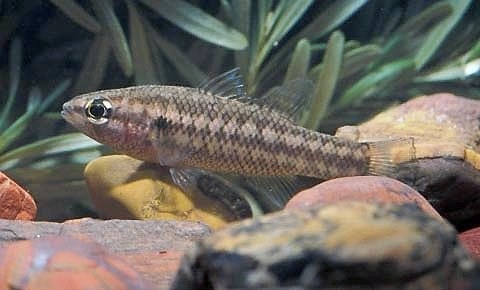
Nannatherina balstoni
Balston’s Pygmy Perch
Species Summary
The rarest of all the endemic freshwater fishes of south-western Australia, Nannatherina balstoni historically ranged from the Moore River in the north to Two Peoples Bay (Goodga River) in the south, but has disappeared from most of that northern range, seemingly including the Swan Coastal Plain — a 1981 museum record from Gingin Brook is the last confirmed evidence there, before agricultural development, urbanisation and introduced fish took their toll. For a long time it was thought to survive only in the extreme south-west corner of the state, though a previously undocumented population has recently turned up in the Perth hills.
Distribution & Habitat
Nannatherina balstoni has been lost from most of the northern half of its range, including the Moore River — recent surveys of almost 70 sites across that river and its tributaries between 1996 and 2003 failed to find a single specimen, the river’s main channel now salt-affected from large-scale land clearing and heavily infested with mosquitofish. It fares little better in the Blackwood River catchment, where surveys of 151 sites turned up just one low-salinity location still holding the species. As salinisation has spread through the larger rivers of the south-west, Nannatherina balstoni has been pushed into small tributaries, headwater streams and lakes that remain fresh and largely undisturbed, with its centre of distribution now the small lakes and streams around Windy Harbour in D’Entrecasteaux National Park. It typically favours dark, acidic water (pH as low as 3.0 at the extreme, though not every population lives in such conditions) with large seasonal temperature swings (11–30 °C), and has only ever been recorded in fresh water (generally under 2 ppt), suggesting low salinity tolerance. It co-occurs with the Western Pygmy Perch (Nannoperca vittata) over part of its range, though always in smaller numbers.
Biology
Larvae feed mainly on cladocerans, copepods and midge larvae, while juveniles and adults shift to mostly terrestrial prey. Both sexes reach maturity at the end of their first year of life, at an average total length of about 6.0 cm in males and 6.3 cm in females.
Genetics & Conservation
A comprehensive 2025 genetic survey resolved Nannatherina balstoni into three geographically distinct subpopulations: one confined to the Margaret River catchment, one restricted to the Shannon River Basin, and a broader “southern” group spanning the eastern Blackwood, the Angove River and areas east of the Shannon — a pattern of fine-scale structuring consistent with a habitat specialist with limited dispersal ability. The Margaret River subpopulation faces a specific, documented threat: the introduced eastern gambusia (Gambusia holbrooki), which has established in key permanent-water refuges in the upper catchment.
Compiled for Home of the Rainbowfish from ANGFA sources: “Nannatherina balstoni (Balston’s pygmy perch)”, In-Stream 15(1), February 2006, p. 21.
References
- Hammer M.P., D.L. Morgan, S.J. Beatty, M.G. Allen, P.J. Unmack, S.J. Buckley, L.B. Beheregaray, J. Murphy and M. Adams (2025) Species delineation, phylogeography and conservation of temperate perches (Actinopterygii: Percichthyidae) from an endemism and climate change hotspot. Marine and Freshwater Research 76: MF24257.