

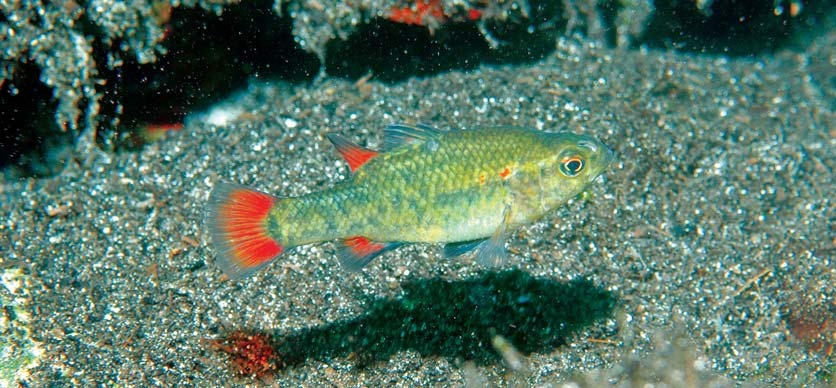
Nannoperca australis
Southern Pygmy Perch
Species Summary
The most widespread and commonly encountered of the Victorian pygmy perches, Nannoperca australis carries bright red fins (excepting the pelvic fins) with dark edges and usually a red stripe along the body, flanked by two indistinct dark-spotted horizontal bands, the lower one running through the eye. Overall body colour ranges from brownish to green, and it grows to about 10 cm.
Distribution & Habitat
Recorded from northern Tasmania, several Bass Strait islands, and from the Murray River in South Australia east through Victoria to the Betka River near Mallacoota. Nannoperca australis once occupied the entire Murray River system (though not the Darling), but today survives only at a few restricted South Australian sites and in small numbers in some Victorian Murray tributaries, remaining common and abundant only in coastal drainages. Its response to the introduced mosquitofish (Gambusia holbrooki) is puzzlingly inconsistent: in some South Australian Murray tributaries the pygmy perch disappears soon after gambusia arrive, while in Melbourne’s Yarra River and Dandenong Creek the two species have coexisted abundantly for many years. It favours areas with few predators — still water close to aquatic vegetation, particularly milfoil, in small permanent and intermittent streams and slower river reaches including billabongs.
Taxonomy
Nannoperca australis has been formally described five times under different names, all now treated as synonyms, and genuine variability across its range remains only partly explained. Preliminary molecular work suggests the species may in fact comprise two forms — one spanning the Murray Basin from southern New South Wales and Victoria down to the lower reaches, the other ranging from south-eastern South Australia to the Bass Strait region including Victoria, northern Tasmania and the larger islands — with populations from Flinders Island and eastern Victoria looking distinct enough to hint at a second species, though eastern and western Tasmanian populations differ from each other by a similarly small margin. Whether these represent genuinely separate species, subspecies, or simply geographic variation within one wide-ranging species remains unresolved.
Keeping & Caring
Pygmy perches generally are peaceful, attractive and personable aquarium fish, best suited to a cold-water setup — they become stressed at high temperatures and may die at 29 °C, with pH around 7 to 7.5 suiting them well. Water quality matters more than its exact chemistry: fish waste away if it deteriorates, so good filtration is essential. Live foods such as daphnia and brine shrimp are strongly preferred, especially while fish are settling in, though most will eventually take frozen food; artificial food is usually refused outright. Nannoperca australis has been bred in aquaria: females are drawn into a male’s territory, eggs are scattered randomly over the substrate with no parental care, and spawning happens in late winter and early spring, apparently cued more by day length than temperature, since captive spawning has been recorded from 10.5 °C to 21 °C. Pygmy perches are not available through the aquarium trade, so keeping them means collecting your own stock, subject to local permit requirements.
Remarks
In August 2010, around 1,600 Nannoperca australis were rescued from drying pools in Coppabella Creek near Jingellic, on the NSW/Victoria border, as drought shrank even pools previously thought secure — 1,400 were held at the Narrandera Fisheries Centre and the rest at Tumut, pending a habitat-mapping project aimed at finding secure refuge pools and alternative release sites for the species.
Compiled for Home of the Rainbowfish from ANGFA sources: R. H. Kuiter, “The Southern Pygmy Perch”, Fishes of Sahul 22, 2008, pp. 414–417; P. Unmack, “Victorian Pygmy Perches”, Fishes of Sahul 7, 1992, pp. 321–323; and “Ripples & Reflections: Narrandera Fisheries Centre — Nannoperca australis”, In-Stream 19(8), August 2010, p. 27.
References
- Llewellyn L.C. (1974) Spawning, development and distribution of the Southern Pygmy Perch, Nannoperca australis australis (Gunther) from inland waters in eastern Australia. Australian Journal of Marine and Freshwater Research 25: 121-149.
- Hammer M. (2002) Recovery Outline for the Southern Pygmy Perch in the Mount Lofty Ranges, South Australia. Department of Environmental Biology, Adelaide University and Native Fish Australia (SA) Inc.