

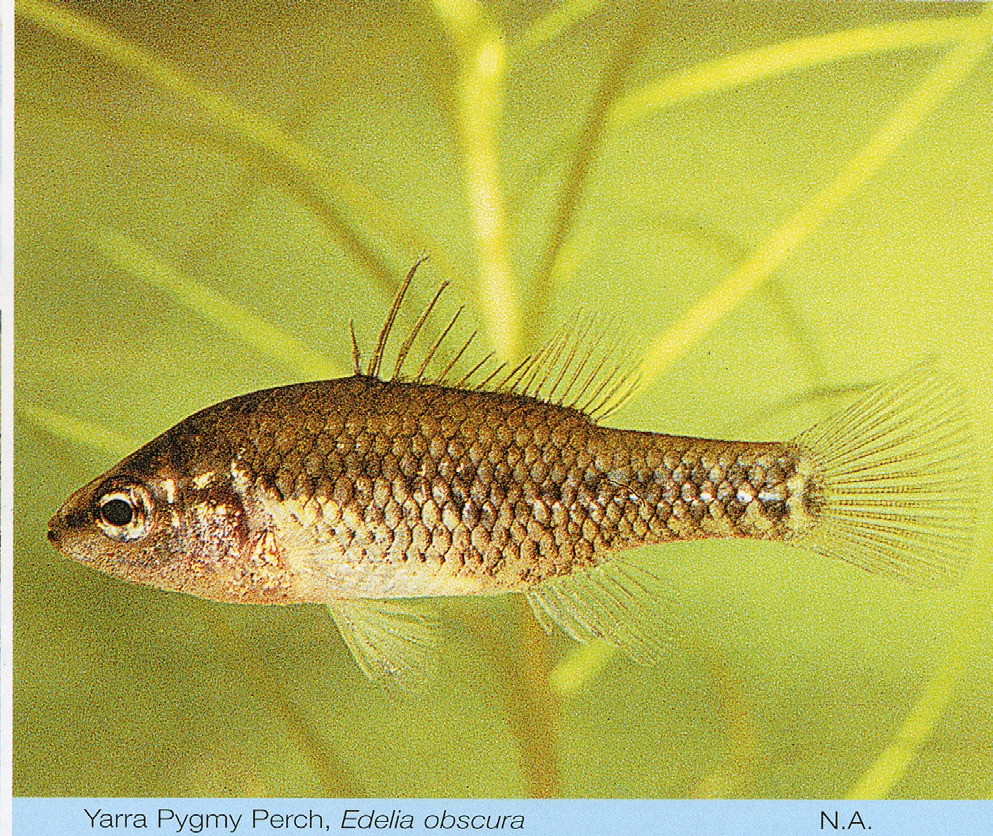
Nannoperca obscura
Yarra Pygmy Perch
Species Summary
Long placed in the separate genus Edelia alongside the Western Pygmy Perch, Nannoperca obscura has an overall green colour with dark scale margins, often dark fins, and a dark stripe through the eye, distinguished from Nannoperca species by a noticeably more pointed snout and by never showing the red or orange colouration other Victorian pygmy perches display. It grows to about 8 cm. The common name is something of a misnomer — for many years the species was known from only one Yarra River tributary.
Distribution & Habitat
Nannoperca obscura occurs sporadically from coastal drainages east of Melbourne to the Bool Lagoon drainage system in south-eastern South Australia, a range that coincides closely with Victoria’s ancient volcanic region, where streams tend to run notably alkaline and mineral-rich. The best-studied population sits in Deep Creek, a tributary of the Maribyrnong River (itself flowing into the Yarra near its mouth), restricted to about 10 km of the creek’s upper reaches near Lancefield. In this stretch, Deep Creek is normally clear and slow to steady-flowing over silt or solid rock, roughly 0.5–1.5 m deep in winter but much reduced by summer, with water chemistry around pH 7.6–7.8 and 100–250 ppm hardness. An ANGFA Victoria field trip in the Port Fairy area also found the species to be locally common there, sharing water with Nannoperca australis, Galaxias maculatus and, at one site, a single juvenile Gadopsis marmoratus.
Keeping & Caring
Nannoperca obscura adapts well to captivity: juveniles from Deep Creek have been kept successfully in outdoor ponds and unheated troughs, tolerating summer water temperatures of 32–35 °C and winter lows of 5–9 °C without apparent harm. Regular partial water changes and small live foods or frozen bloodworm suit the species well. A colony of eight (four adults, four juveniles) kept in an unheated 120 cm tank on Melbourne tap water (pH 7, 80 ppm hardness) and fed frozen bloodworm and brine shrimp twice daily reached peak breeding condition by late winter, the dominant male displaying a glistening bronze colour with dark scale edging, a black horizontal line from forehead through the eye bordered in pale gold, and a dark stripe down the nape.
Breeding
Males develop striking breeding colour as spring approaches: intensified body markings, jet-black pelvic and anal-fin spiny areas, and a white nape stripe reminiscent of a juvenile Barramundi’s head markings, all fading again once the weather warms in early summer; females stay in plain colouration throughout, pale with dark scale margins and irregular dark blotches toward the tail. Each male vigorously defends a small 20–30 cm territory centred on a clump of plants, pursuing gravid females there with short darting movements and folded fins. Small motionless fry typically appear near the aquarium walls a few weeks after courtship is first observed, are entirely ignored by the adults, and grow on a diet of small invertebrates living among the water plants, occasionally supplemented with baby brine shrimp. In one aquarium account, the dominant male in a colony was seen herding the largest, ripest female to the edge of his territory for a vigorous spawning against the tank’s rear wall, then continuing to guard the spawning site from the rest of the colony afterward — a possible form of primitive paternal care.
Compiled for Home of the Rainbowfish from ANGFA sources: G. Briggs, “Yarra Pygmy Perch Edelia obscura”, Fishes of Sahul 13, 1999, pp. 638–641; D. Olney, “Observations of Pygmy Perch (Edelia obscura) in an Aquarium”, Fishes of Sahul 13, 1999, p. 642; and “Information from the Journals: Catchment-Scale Conservation Units Identified for the Threatened Yarra Pygmy Perch (Nannoperca obscura) in Highly Modified River Systems”, In-Stream 23(2), February 2014, p. 23.