
Nannoperca oxleyana
Oxleyan Pygmy Perch
Species Summary
One of Australia’s most range-restricted and vulnerable native fishes, Nannoperca oxleyana occurs only in coastal wallum (heathland) swamps, streams and dune lakes between the Richmond River in New South Wales and Tin Can Bay in Queensland, plus Fraser and Moreton Islands — a distribution that overlaps closely with the Honey Blue-eye (Pseudomugil mellis) and Rhadinocentrus ornatus, and with an area of dense human settlement.
Distribution & Habitat
Nannoperca oxleyana favours slightly acid, soft, tea-coloured wallum water, typically pH 5.9–7.2 depending on recent rainfall, and is highly sensitive to habitat disturbance: the delicate sandy substrates of wallum country erode rapidly once vegetation is cleared, leading to infilling and siltation of streams. A tributary creek north of Brisbane illustrates the pattern starkly — upstream of a 1980s highway-bridge clearing, in pristine habitat, the species remains abundant alongside Rhads and Honey Blue-eyes; downstream, in a shallow, weed-choked, gambusia-dominated channel, it is rarely caught and Honey Blue-eyes are never seen at all.
Conservation
Listed as endangered under the Commonwealth Environment Protection and Biodiversity Conservation Act 1999, the NSW Fisheries Management Act 1994 and the IUCN Red List, Nannoperca oxleyana faces ongoing threats from habitat clearing for residential development, farming, mining and pine plantations, water pollution, and competition from the introduced mosquitofish. Extensive New South Wales surveys since the late 1990s have found a fragmented but persisting distribution in national parks north of Coffs Harbour, and in 2007 the species turned up in a new location, Newfoundland State Forest — a reminder that its true range may still be under-recorded given how remote and rarely surveyed much of its wallum habitat is.
Keeping & Caring
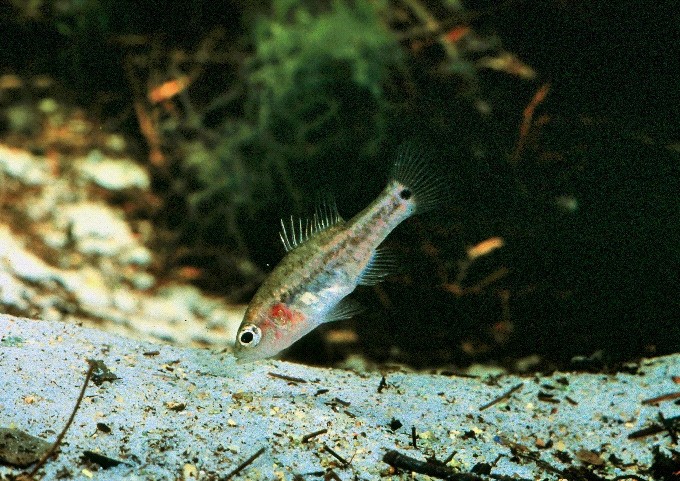
Requires slightly acid, soft water (0–50 ppm hardness, pH around 6.5) and tolerates 12–28 °C, with spawning triggered above 20 °C. Nannoperca oxleyana has a strong preference for live food — cladocerans, ostracods, copepods and rotifers make an ideal diet, and mosquito wrigglers and earthworms will be taken too, hunted with a characteristic head-down, tail-up stalking posture that makes watching this species almost addictive. This stalking behaviour means prepared food is often ignored outright, though aquarium-bred generations take it more readily, with crumbled pellets or slow-sinking preparations achieving the best results. Well fed in good water, both sexes reveal a hidden beauty: a blue ring around the eye similar to a blue-eye’s, a red-margined spot at the tail base, a reddish-brown hue intensifying toward each scale’s outer edge, three or four patchy dark lines from head to tail, and a blue iridescent operculum. A 100-litre tank with plenty of fine root cover (Callistemon roots are ideal) and six to eight mature fish over 25 mm should ensure at least one breeding pair is present.
Breeding
Courtship is fleeting: a pair casually approach each other, shudder and release eggs and milt while still moving, then continue on their way, with eggs dropped onto the substrate or nearby vegetation depending where the brief mating occurred. Females lay a few eggs daily throughout the season; young hatch in three to four days and begin feeding one to two days later. Daily additions of live plankton culture will sustain both newly hatched fry (on rotifers and infusoria) and adults (on the larger items) in the same tank, though growth is slow and some cannibalism is likely; a new juvenile of around 10 mm typically appears every two or three weeks under this method, and within six to eight months a tank holds a range of sizes. For larger numbers of fry, a dozen adults spawned in a bare 50–100-litre tank furnished with spawning mops can drop up to 100 eggs within a week or two; fry hatch in the spawning tank and grow quickly on finely sieved plankton, reaching 20 mm in seven to eight weeks and maturity in four to five months.
Compiled for Home of the Rainbowfish from ANGFA sources: R. Leggett, “A Fish in Danger — Nannoperca oxleyana”, Fishes of Sahul 6, 1990, pp. 247–249; R. Wager, “The Oxleyan Pygmy Perch: Maintaining Breeding Populations”, Fishes of Sahul 7, 1992, pp. 309–312; J. Knight & G. Butler, “Conserving Threatened Australian Fishes: Nannoperca oxleyana and Maccullochella ikei”, Fishes of Sahul 18, 2004, pp. 50–56; K. Keller & C. Brown, “A New Sighting of the Oxleyan Pygmy Perch”, Fishes of Sahul 22, 2008, pp. 400–404; and “Information from the Journals: Conservation Biology and Management of the Endangered Oxleyan Pygmy Perch Nannoperca oxleyana in Australia”, In-Stream 21(12), December 2012, p. 18.