
Nannoperca variegata
Variegated Pygmy Perch (also Ewens Pygmy Perch)
Species Summary
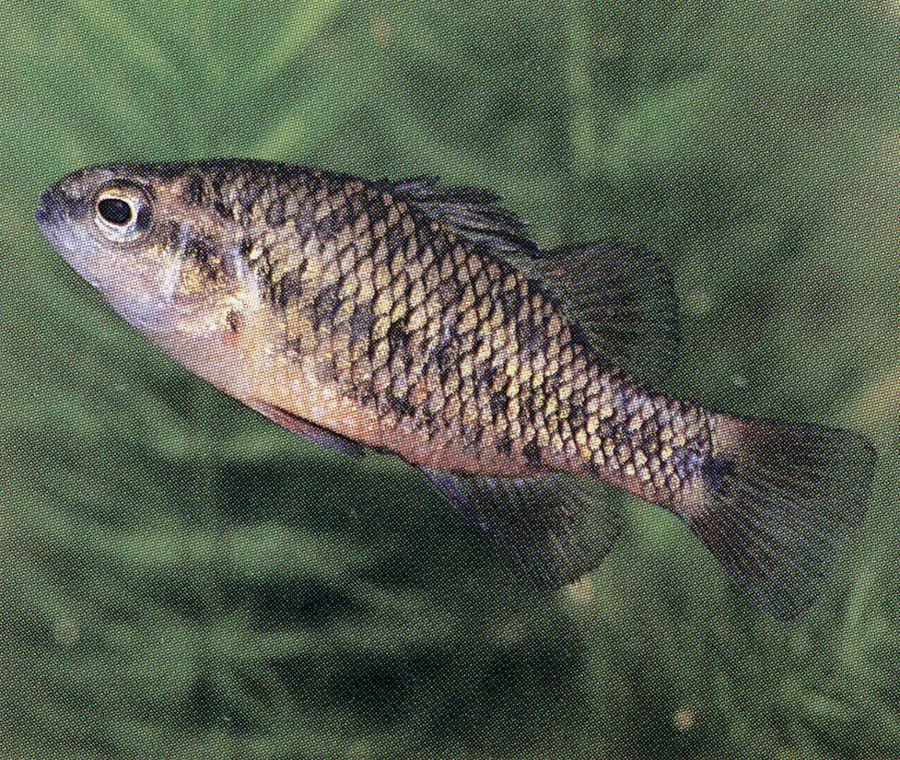
First recognised as a distinct species in 1986, Nannoperca variegata is known from just two locations: a stream near Winnap in south-western Victoria and Ewens Ponds in South Australia, with a possible former population at nearby Piccaninnie Ponds. Males are reddish-orange ventrally with a golden mid-lateral band and two rows of brown blotches along the side; females are duller, mostly whitish below with two or three rows of irregular brown blotches. It grows to about 5–6 cm.
Distribution & Habitat
Originally recorded from only two sites, six further Glenelg River system localities were found during targeted 1990 surveys by the Victorian Freshwater Ecology branch, all still within the same broad drainage. Unlike the still-water-loving N. australis and N. obscura, Nannoperca variegata favours flowing water — typically shallow (around 1 m), rocky-and-gravel-bedded, fast streams in full sun over open pastureland, pH 6.8–7.5 and around 150 ppm hardness. At Ewens Ponds it shares water with N. australis, though the two species partition habitat there, N. australis sticking to quiet still water while Nannoperca variegata prefers the rapid flow.
Keeping & Caring
Kept in a 135-litre aquarium with an internal power filter for current, Nannoperca variegata does well at 14–27 °C (18 °C ideal), pH 7.2 and 150 ppm hardness, fed on mosquito wrigglers, other live foods and frozen bloodworm. It is compatible with its own kind and with other small natives such as juvenile Tupong, and does well over a gravel and rock substrate planted with Potamogeton, Triglochin and Vallisneria. A quarter water change weekly is important, and fish have been kept for at least two years in captivity, possibly longer.
Breeding
Spawns in spring, triggered by rising temperature and a good live-food diet; no separate conditioning period is needed. Java moss and hornwort make good spawning furnishings, and in outdoor ponds well-fed adults have not been observed eating their own fry. After hatching, filtration is best switched from a power filter to airstones to avoid harming fry, which are raised on green water, commercial fry starter and then the usual finely graded foods, reaching about 25 mm with good body depth by the end of their first summer. Raising large numbers of fry at once is reportedly difficult, and water temperature needs careful management through hot weather.
Compiled for Home of the Rainbowfish from ANGFA sources: N. Armstrong, “ANGFA’s A–Z Notebook of Native Freshwater Fish — N for Nannoperca: Nannoperca variegata (Variegated Pygmy Perch)”, Qld Newsletter 14(6), December 1998; and P. Unmack, “Victorian Pygmy Perches”, Fishes of Sahul 7, 1992, pp. 321–323.