

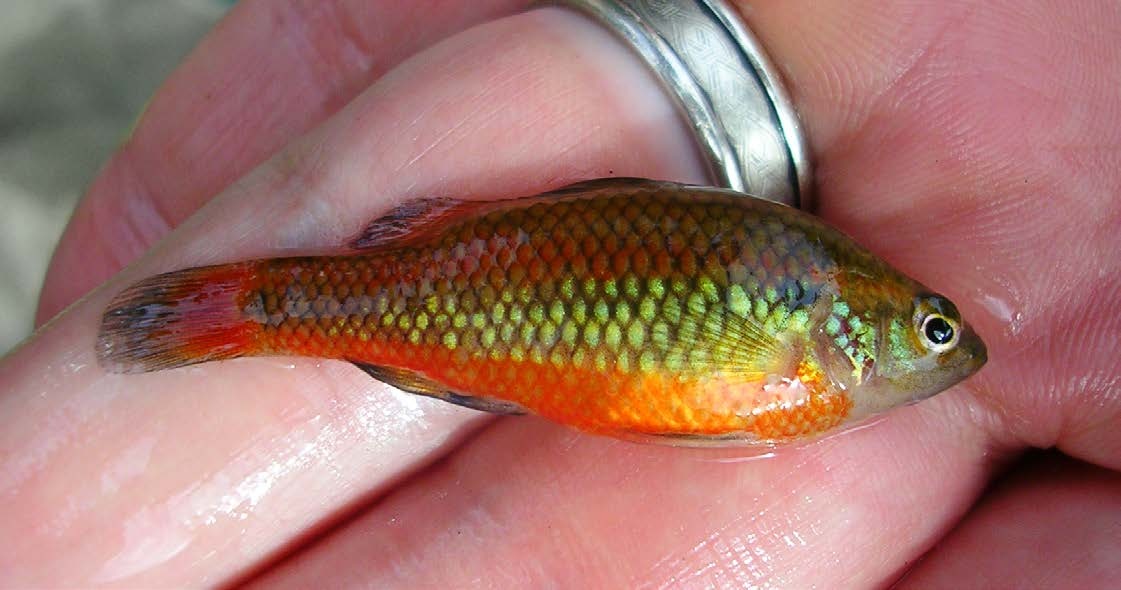
Nannoperca vittata
Western Pygmy Perch
Species Summary
Common and widespread across the south-west, Nannoperca vittata occurs from the Arrowsmith River, 270 km north of Perth, to the Phillips River, 240 km west of Albany, generally scarcer north of Perth where freshwater habitat is limited. In the last decade three further forms previously included under this name have been recognised as genetically distinct: the Little Pygmy Perch (N. pygmaea), with one of the most restricted ranges of any Australian fish; an undescribed form restricted to the Margaret River catchment, informally the Margaret Pygmy Perch; and a further undescribed form from the Deep and Shannon river basins south and west of Northcliffe, which a comprehensive 2025 genetic survey found to be more closely related to the Little Pygmy Perch than to the rest of the Western Pygmy Perch complex — the two forming a distinct evolutionary lineage of their own. A full taxonomic revision covering all of these forms is still pending.
Etymology
The genus name Nannoperca was proposed by Albert Günther of the British Museum for N. australis in 1861, combining Greek nanno-, from nanus, dwarf, with -perca, perch — Günther thought the type species resembled a young perch in general appearance. Nannoperca vittata was originally described as Edelia vittata by French naturalist Francis de Laporte de Castelnau in 1873; vittata, the feminine of vittatus, means “banded”, referring to the broad, straight, reddish longitudinal band Castelnau described running from the gill cover to the base of the tail.
Conservation Status
No listing, as Nannoperca vittata remains common and widespread; the closely related Little Pygmy Perch, Margaret Pygmy Perch and the Shannon form have far smaller ranges and are already listed or likely to be listed as threatened.
Keeping & Caring
An inquisitive, engaging aquarium fish that moves around the tank to watch its keeper, Nannoperca vittata is a relatively passive tankmate for Murray Rainbowfish, other pygmy perch species and similarly sized cold-water natives, though as an aggressive feeder it can outcompete shyer tankmates and will happily eat any small shrimp added to the tank. It tolerates a wide temperature range (2–30 °C, ideally 8–21 °C) and pH 6.2–7.4 in fresh to slightly brackish water; some keepers maintain it at 1.5–2 ppt salt outside the breeding season. At consistently warm temperatures above 26 °C it tends to stop feeding and sit motionless on the bottom, making it poorly suited to tropical community tanks. A well-planted aquarium suits its ambush-predator instincts and shows off the male’s spawning colours to best effect. Diet is not fussy — quality pellets and flake, freeze-dried blackworm, frozen bloodworm, daphnia, artemia and mosquito larvae are all readily taken.
Breeding
Sexes are hard to distinguish outside the breeding season, when males colour up brilliantly with mottled gold flanks, a red-orange belly and dark fins, while females may show a bluish tinge; less dominant males may lack the vivid orange but still develop black finnage and dark mottling. Maturity is reached at 8–12 months, sexual activity from about 4 cm, with adults typically 6–8 cm and a lifespan of five to six years. Breeding season runs July–November in the wild in Western Australia, and September–February in Victoria; captive spawning follows tank temperatures above 16 °C. Females lay small numbers of eggs, usually 8–12 at a time, sporadically over the season, after males court for several hours; eggs settle into the substrate and hatch in 2–4 days depending on temperature, with fry 3.0–3.2 mm at hatching. Being quite underdeveloped initially, fry need infusoria in green water at first, moving on to vinegar eels, artemia and copepods, then powdered fry food and crushed flake once large enough.
Remarks
Given adequate water conditions and good plant cover, Nannoperca vittata readily establishes self-sustaining populations in native fish and frog ponds, where its small mouth makes it tadpole-friendly while it happily devours mosquito larvae.
Compiled for Home of the Rainbowfish from ANGFA sources: C. Lamin, P. J. Unmack & C. Scharpf, “Fish in focus: Western Pygmy Perch Nannoperca vittata (Percichthyidae)”, Fishes of Sahul 33(2), June 2019, pp. 1440–1446.
References
- Buckley S.J., F.M. Domingos, C.R. Attard, C.J. Brauer, J. Sandoval-Castillo, R. Lodge, P.J. Unmack and L.B. Beheregaray (2018) Phylogenomic history of enigmatic pygmy perches: implications for biogeography, taxonomy and conservation. Royal Society Open Science 5: 172125.
- Hammer M.P., D.L. Morgan, S.J. Beatty, M.G. Allen, P.J. Unmack, S.J. Buckley, L.B. Beheregaray, J. Murphy and M. Adams (2025) Species delineation, phylogeography and conservation of temperate perches (Actinopterygii: Percichthyidae) from an endemism and climate change hotspot. Marine and Freshwater Research 76: MF24257.
- Pen L.J. and I.C. Potter (1991) Biology of the western pygmy perch, Edelia vittata, and comparisons with two other teleost species endemic to south-western Australia. Environmental Biology of Fishes 31: 365-380.
- Unmack P.J., M.P. Hammer, M. Adams and T.E. Dowling (2011) A phylogenetic analysis of pygmy perches (Teleostei: Percichthyidae) with an assessment of the major historical influences on aquatic biogeography in southern Australia. Systematic Biology 60: 797-812.