

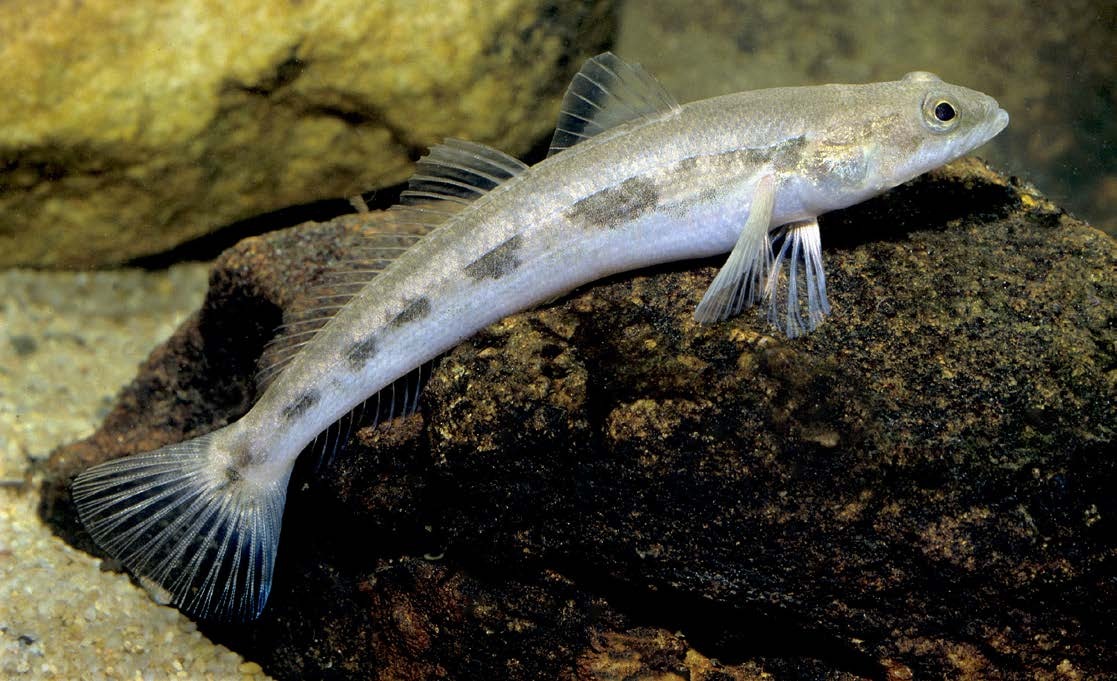
Pseudaphritis urvillii
Tupong (also Congolli, Freshwater Flathead, Sandy)
Species Summary
Known as Tupong in Victoria and Congolli in South Australia, among other names, Pseudaphritis urvillii is a bottom-dwelling ambush predator endemic to south-eastern Australia, spending time in both marine and freshwater environments over its life. Superficially similar to a flathead, it rests on the substrate propped on its ventral fins and will bury itself in sand or mud with just its eyes and large, upturned mouth showing.
Etymology
The genus name Pseudaphritis was proposed by the French naturalist François de Castelnau, combining the prefix pseudo-, false, with Aphritis, a genus this species closely resembles but, according to Castelnau, differs from in scale size and fin details. The name Aphritis itself, coined by Achille Valenciennes in 1832 for what is now this very species, turned out to already be in use for a genus of flies, so the name was eventually replaced — and when later ichthyologists worked out that the replacement genus and Pseudaphritis were one and the same, the older, “false” name Pseudaphritis became the valid one by priority. So, in a neat irony, the “false Aphritis” turned out to actually be the true Aphritis all along. The species name honours Jules Sébastien César Dumont d’Urville (1790–1842), the French naval officer and explorer who led the expedition on which the type specimen was collected — a gifted linguist fluent in some eight languages, who also has the Adélie Penguin (named for his wife Adélie) and the Australian Longtom among the species carrying his name. Dumont d’Urville survived a career at sea only to die on land: in 1842 he, his wife and their son were killed along with some fifty other passengers when a runaway train derailed and caught fire on the Versailles–Paris line.
Distribution & Habitat
Pseudaphritis urvillii occurs in coastal rivers from the Clyde River in New South Wales, through Victoria, to around Port Lincoln in South Australia, as well as throughout Tasmania. Historically it extended well up the Murray River, to at least Echuca and probably further; dams and weirs have since curtailed its ability to migrate upstream across its entire range. It occupies a broad span of habitat wherever there is ocean access, from fully marine conditions through estuaries into headwater stream reaches, though it is most commonly found today in the lower reaches of streams, favouring beds of slow-flowing water thick with leaf litter, among rocks, sunken logs and undercut banks. Juveniles are most abundant in lower river reaches during spring and summer, while larger fish are generally found further upstream.
Taxonomy & Relatives
Until relatively recently Pseudaphritis urvillii was classified in the family Bovichtidae, a group of mostly Antarctic and southern-temperate marine “icefishes,” but genetic evidence and differences such as its lack of head spines and scales eventually saw it placed in its own small family, Pseudaphritidae, alongside a single South American freshwater relative. More distantly, it is related to the Antarctic icefishes proper (family Channichthyidae) and to the Patagonian Blennie of South America — all descended from ancestors separated when continental drift carried some lineages north away from Antarctica while others stayed behind and evolved the remarkable adaptations that let today’s icefishes survive in sub-zero water.
Conservation Status
Listed as Vulnerable in South Australia, with no listings in other states, and assessed as Least Concern by the IUCN. Pseudaphritis urvillii remains relatively widespread and abundant through most of its range, less so in South Australia, though dams, weirs and reduced river flows have reduced its overall extent.
South Australia’s Millennium Drought (the mid-2000s to 2010) hit the species particularly hard. Juvenile Congolli normally migrate upstream from the Murray estuary to Lake Alexandrina via fishways on the barrages each spring and summer, but with no freshwater flow reaching the Coorong through the drought, adult females could not reach the ocean to breed, and the barrage fishways were effectively closed from 2007 to 2010 — roughly the species’ entire lifespan — blocking juvenile migration in the other direction too. The result was a catastrophic population crash and genuine fears of local extinction. Continuous freshwater flows through the fishways since September 2010 have allowed Congolli to migrate between the Coorong and Lake Alexandrina again, and numbers in the Lower Lakes have been recovering since.
Description
An efficient osmoregulator, Pseudaphritis urvillii can be transferred directly between salt and fresh water without apparent distress. Sexing is not externally obvious, but males appear to grow only to around 150 mm while females reach 360 mm, and females are effectively the only sex found in fresh water — males only rarely venture into the lowermost freshwater reaches. Colouration is a fine study in camouflage: fish from the tannin-rich waters of north-western Tasmania show deep, mottled colouration that blends into a substrate of leaves and submerged sticks, while fish from clear, sandy-bottomed streams in southern Victoria are much lighter with less vivid markings.
Breeding
Female Pseudaphritis urvillii are catadromous, living as adults in fresh water but migrating to spawn in the sea — an unusual pattern given males are not catadromous in the same way, spending most of their time instead in the upper reaches of estuaries. Increased flow from winter rain triggers a downstream spawning migration between May and August, most often around intermediate moon phases; the precise spawning location isn’t known but is presumed to be near the estuary mouth or nearby coast. Once hatched, larvae spend around four months drifting on ocean currents before returning to rivers and estuaries to grow. Upstream migration of juveniles has separately been recorded from October to February, generally tracking rising water temperatures, and this species is a genuinely strong traveller: one 25 cm specimen was caught in 1995 near Canberra in the Australian Capital Territory, hundreds of kilometres from the sea, and was displayed at that year’s ANGFA convention.
Diet
An opportunistic benthic carnivore and ambush predator, Pseudaphritis urvillii has a flattened head and small, high-set eyes well suited to lying buried in the substrate. In Tasmanian streams its diet is mostly aquatic insect larvae (chironomids, caddisflies, mayflies), small crustaceans such as shrimp and amphipods, snails and worms, with some plant material too; as fish grow, shrimp, caddisflies and snails become more important in the diet while chironomids and mayflies decline. Congolli are themselves an important prey species for Mulloway.
Keeping & Caring
An excellent, if unconventional, aquarium subject. Being such an efficient osmoregulator, wild-caught fish can go straight into either a marine or freshwater aquarium without ill effect, and one keeper subjected fish to sudden, drastic salinity swings with no apparent harm, maintaining individuals across water from pH 7.0 and under 10 ppm hardness to pH 8.6 and over 2,000 ppm. As a temperate species it should not be kept heated: one long-term keeper maintained fish comfortably from 11–22 °C and, with vigorous aeration, up to 25 °C, well beyond which feeding tends to stop. Captive fish can live four to five years, acclimatise rapidly, and become tame enough to take a worm from the surface by hand, even though they spend most of their time sitting buried in sand with only eyes and mouth exposed — a 20 cm fish has been seen exploding from its sandy bed to seize and swallow a 7.5 cm rainbow trout. Given the species’ large mouth, tankmates need choosing with some care. It has been kept successfully with Galaxias truttaceus, Galaxias maculatus and Prototroctes maraena of suitable size, but poorly with Gadopsis marmoratus, which sparred with it constantly. It is also quarrelsome with its own kind: two individuals may coexist peacefully at opposite ends of a large tank, but adding a third, or moving the same two fish to a smaller tank, reliably triggers regular sparring between all the fish present, seemingly unrelated to sex. A Tupong on long-term public display at the Snobs Creek Visitor Centre has been a reliable crowd-pleaser, with visitors regularly assuming the motionless fish is dead or sick right up until it explodes into life after an earthworm.
In captivity it takes frozen bloodworm, earthworms, small yabbies, shrimp, aquatic insects and cut fish fillet without fuss, often with a comical “lying in ambush” routine before darting out to seize the food.
Compiled for Home of the Rainbowfish from ANGFA sources: G. Martin, P. J. Unmack & C. Scharpf, “Fish in Focus: Congolli Pseudaphritis urvillii (Pseudaphritidae)”, Fishes of Sahul 34, December 2020, pp. 1676–1688; G. Walker & D. Walker, “Congolli’s Past and Future in South Australia”, Fishes of Sahul 19, 2005, pp. 120–124; and A. Caughey, “Aquarium Notes on Keeping the Tupong — Pseudaphritis urvillii”, Fishes of Sahul 9, 1995, pp. 396–397.
References
- Crook D.A., W.M. Koster, J.I. Macdonald, S.J. Nicol, C.A. Belcher, D.R. Dawson, D.J. O'Mahony, D. Lovett, A. Walker and L. Bannam (2010) Catadromous migrations by female tupong (Pseudaphritis urvillii) in coastal streams in Victoria, Australia. Marine and Freshwater Research 61: 474-483.