

Brine Shrimp
Brine shrimp nauplii are widely used in aquariculture for feeding early-stage fish and crustacean larvae. The nauplii exhibit two essential qualities for this purpose: they are of an appropriate size to be ingestible, and they move actively in the water column, establishing themselves as targets for young carnivores. Brine shrimp can produce cysts (eggs) under certain conditions and these, since they float, are easily harvestable. The eggs are collected and placed into cold storage for at least three months. This process is called ‘Diapause Inactivation’ - a process that is similar to hibernation. Following the cold storage period, the eggs are cleaned, washed, and separated. The partially hydrated eggs are disinfected, dried in rotary ovens to about 6% residual moisture, and then vacuum packed. The finished product can then be stored for long periods.
When the eggs are placed into saltwater they are re-hydrated and hatch. The hatching rate of cysts varies according to storage time and conditions as well as geographical origin and commercial brand. Generally, 150,000 hatched Artemia nauplii can be obtained from 1 gram of cysts. There is also a large variation in nutritional quality, hatching quality, and size of nauplii among commercial sources of brine shrimp eggs.
Brine shrimp eggs can last for several years as long as they are maintained in a dry condition at all times. Sealed cans can be stored for years at room temperature, but once opened, should be used up within two months. Store opened eggs in an airtight container in the refrigerator or in a cool dry place. If the entire contents of a can will not be used up in two months, it is recommended that the portion that is expected to be unused be placed in a tightly closed container and frozen until needed.
Alvin Seale, the Superintendent of the Steinhart Aquarium, USA, first reported the suitability of brine shrimp nauplii as a source for larval fish in 1933. However, it wasn’t until the late 1970s that a continuous supply of eggs was available. At that time, the major supply of eggs occurred in the United States, mainly from San Francisco Bay and the Great Salt Lakes, Utah. Commercial brine shrimp farms have now been established in many parts of the world, and are commonly introduced into evaporation ponds used for the commercial production of salt. However, except for limited, small-scale production, the bulk of the eggs used today emanate from a wild -capture harvest susceptible to over-fishing and reduced production due to uncontrollable climatic influences. The net result is an unreliable supply of a product with accompanying fluctuation in price.
The ease of hatching brine shrimp eggs and the commercial availability of the adult stage has made them a popular food source. Freshly hatched brine shrimp nauplii have a lipid-rich yolk, high in unsaturated fatty acids. Due to this nutritious yolk and small size, brine shrimp nauplii have become the standard food for larval fish in the aquaculture industry. Brine shrimp nauplii emerging from their protective shells are extremely small, mostly less than 500 µm but can differ (400 to 800 µm) according to origin. The smallest is believed to be the San Francisco Bay variety.
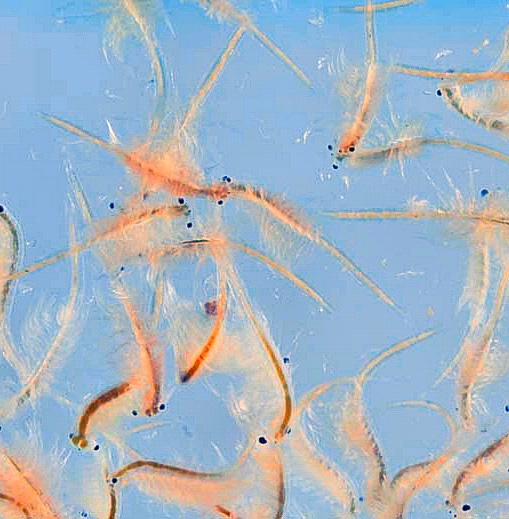
Fish larvae are thought to take advantage of the nauplius’ digestive enzymes, as most fish larvae have a very weak digestive system when being young. Additional support for this hypothesis is found in the different growth results when fish larvae are fed with either decapsulated cysts or nauplii. On an individual weight basis, the decapsulated cysts and nauplii have similar biochemical composition in all the major nutrients. Thus, with regard to the amount of nutrients, there is no difference in feeding brine shrimp cysts or nauplii to fish larvae. However, in some fish species higher growth rates have been achieved with nauplii. Protein is the major component of the dry matter in brine shrimp. Because the interaction of proteins with water has an effect on the functional properties of the protein, the protein structure might differ between cysts and nauplii due to the high water content in the latter.
Brine shrimp nauplii are an excellent live food, not only for larvae but also for adults of the smaller species of rainbowfishes. However, they are not suitable as a first food for all rainbowfish larvae; some larvae are so small that they will require micro-organisms. A major drawback in feeding brine shrimp nauplii to freshwater fish is that the nauplii usually die after 30–60 minutes in fresh water.
Brine shrimp were initially sold as a frozen product to the ornamental fish hobby. However, it is now marketed live, and in several forms such as decapsulated eggs, newly hatched nauplii, meta nauplii, juveniles and adult stages as well as processed forms such as frozen, freeze dried, dried and flakes.
Brine shrimp are a relatively primitive form of aquatic crustacean that occurs naturally in saline waterbodies worldwide. The original species first described by Schlosser from the Salterns of Lymington, England (1755) and named by Linnaeus (1758) as Artemia salina is now considered extinct, and several other species or sub-species are recognised today.
Brine shrimp belong to the subclass Branchiopoda, which is characterised by many pairs of flattened appendages on the thorax, in contrast to other members of the Crustacea that have no more than six pairs. Branchiopoda is an ancient group of primitive crustaceans found today primarily in inland, often temporary, waters such as wet weather ponds and saline lakes. The gills are located on the trunk appendages, hence the name Branchiopoda (= gill foot). The lack of a true carapace places them in the suborder Anostraca, and further in the family Artemiidae. The Anostraca are branchiopods in which there is no carapace (anostraca = without shell) and are similar in many features to the ancestral crustaceans. The group is small and includes the fairy shrimps and brine shrimps.
Probably the most distinctive feature of Artemia is the compressed, triangular, and blade-shaped distal segment of the second antenna of the male. In the male the antennae are transformed into muscular claspers used to secure the female during copulation. Artemia are the largest of the branchiopods, measuring up to 19 mm total length (TL) in parthenogenetic populations, and up to 12 mm in bisexual strains. They have a life span of about six months, becoming sexually mature two to four weeks after hatching.
The environmental conditions under which brine shrimp live are highly variable. The salinity can exceed 300‰, (parts per thousand) where most other life cannot survive. Advantaged by the absence of predators and food competitors in such places, brine shrimp develop very dense populations. Although not a marine species, they sometimes occur in bays and lagoons. They are more commonly found in highly saline lakes, such as the Great Salt Lake, Utah where the shoreline may become ringed with brown layers of accumulated brine shrimp eggs.
The development of brine shrimp is influenced by many factors and the tolerance of these factors is strain dependent. Optimum temperature for most strains ranges between 25 and 35°C but strains have been reported thriving at 40°C. Most geographical strains do not survive temperatures below 6°C except as eggs. These eggs are tolerant of temperatures from far below 0°C to near the boiling point of water.
Although brine shrimp can survive and reproduce under a wide range of salinity, they are seldom found in nature in salinities below 45‰ or above 200‰. The pH tolerance varies from neutral to highly alkaline but the eggs will hatch best at a pH of 7.5 to 8.5. Many predators including zooplankton that populate natural salt waters, fish, several insect groups (odonates, hemipterans and beetles), and birds feed on brine shrimp in situations where they can tolerate the conditions.
Copulation is initiated when the male grasps the female with its modified antennae. At low salinities (<85‰) and optimal food levels, fertilised females usually produce free swimming nauplii (ovoviviparous reproduction) at a rate of up to 75 nauplii per day. They may produce 10-11 broods over an average life cycle of 50 days. Under ideal conditions adult brine shrimp survive for several months and produce up to 300 nauplii every 4 days.
Cyst production (oviparous reproduction) is considered to be induced by high salinity, under conditions of high eutrophication (large O2 fluctuations between day and night) and chronic food shortages. At high salinities (>150‰) and low oxygen concentrations, the embryos develop to the gastrula stage. They then become surrounded by a thick shell and enter dormancy (diapause). Females can release up to 75 cysts per day which float in the highly saline water (eggs from Mono Lake in California sink). The floating cysts are eventually blown ashore where they accumulate in large masses.
Development is resumed when the cysts are re-hydrated and the life cycle is begun again. After several hours the outer membrane bursts and the embryo emerges still encased in the hatching membrane. Soon the hatching membrane is ruptured and the free-swimming nauplius is born. The first instar is brownish-orange coloured and has three pairs of appendages. The larva grows through about 15 moults and becomes differentiated into male or female after the tenth moult.
Brine shrimp are typically filter feeders that consume organic detritus, microscopic algae, and bacteria. Blooms of microscopic algae are favourite habitats, and large populations develop in such areas where they feed on the algae and heterotrophic bacteria that are produced by these blooms.
Australian saline lakes harbour a rich diversity (about eight described species) of endemic brine shrimps of the genus Parartemia, which, like Artemia, can produce cysts from which nauplii hatch, but under quite different limnological conditions. Their economic and scientific values remain almost totally unexplored. Australia also has a freshwater cousin of the brine shrimp (Branchinella) with about nineteen described species, which occurs in temporary fresh waters (pools, ditches, rock-pools, and ponds).